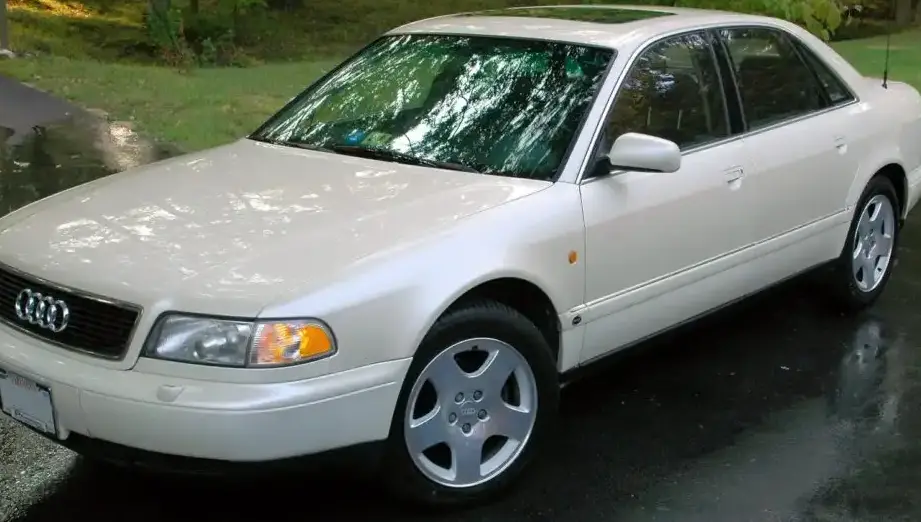
The Audi A8 (D2) 2.5 TDI V6, produced from 1998 to 2000, represented a compelling entry point into Audi’s flagship luxury sedan range. This variant, powered by the AKN-code engine, occupied a middle ground within the D2 A8 lineup, offering a balance between performance, fuel efficiency, and cost. It was positioned below the more powerful 4.2-liter V8 models and the later 3.3 TDI, targeting buyers who prioritized economical long-distance cruising and a refined driving experience. The facelifted D2 A8, introduced in 1998, brought subtle styling updates and improvements to the interior, solidifying the car’s position as a technologically advanced and luxurious vehicle for its time.
Technical Specifications
| Brand | Audi |
| Model | A8 |
| Generation | A8 (D2, 4D, facelift 1998) |
| Type (Engine) | 2.5 TDI V6 (150 Hp) |
| Start of production | 1998 |
| End of production | 2000 |
| Powertrain Architecture | Internal Combustion engine |
| Body type | Sedan |
| Seats | 5 |
| Doors | 4 |
| Fuel consumption (economy) – urban (NEDC) | 10.2 l/100 km (23.1 US mpg, 27.7 UK mpg, 9.8 km/l) |
| Fuel consumption (economy) – extra urban (NEDC) | 5.5 l/100 km (42.8 US mpg, 51.4 UK mpg, 18.2 km/l) |
| Fuel consumption (economy) – combined (NEDC) | 7.2 l/100 km (32.7 US mpg, 39.2 UK mpg, 13.9 km/l) |
| CO2 emissions (NEDC) | 197 g/km |
| Fuel Type | Diesel |
| Acceleration 0 – 100 km/h | 9.9 sec |
| Acceleration 0 – 62 mph | 9.9 sec |
| Acceleration 0 – 60 mph | 9.4 sec |
| Maximum speed | 220 km/h (136.7 mph) |
| Emission standard | Euro 3 |
| Weight-to-power ratio | 10.8 kg/Hp, 92.6 Hp/tonne |
| Weight-to-torque ratio | 5.2 kg/Nm, 191.4 Nm/tonne |
| Power | 150 Hp @ 4000 rpm |
| Power per litre | 60.1 Hp/l |
| Torque | 310 Nm @ 1500-3200 rpm (228.64 lb.-ft. @ 1500-3200 rpm) |
| Engine layout | Front, Longitudinal |
| Engine Model/Code | AKN |
| Engine displacement | 2496 cm3 (152.32 cu. in.) |
| Number of cylinders | 6 |
| Engine configuration | V-engine |
| Cylinder Bore | 78.3 mm (3.08 in.) |
| Piston Stroke | 86.4 mm (3.4 in.) |
| Compression ratio | 19.5:1 |
| Number of valves per cylinder | 4 |
| Fuel injection system | Direct injection |
| Engine aspiration | Turbocharger, Intercooler |
| Valvetrain | DOHC |
| Engine oil capacity | 5.5 l (5.81 US qt | 4.84 UK qt) |
| Coolant | 10 l (10.57 US qt | 8.8 UK qt) |
| Kerb Weight | 1620 kg (3571.49 lbs.) |
| Max. weight | 2220 kg (4894.26 lbs.) |
| Max load | 600 kg (1322.77 lbs.) |
| Trunk (boot) space – minimum | 525 l (18.54 cu. ft.) |
| Fuel tank capacity | 90 l (23.78 US gal | 19.8 UK gal) |
| Max. roof load | 100 kg (220.46 lbs.) |
| Permitted trailer load with brakes (8%) | 1900 kg (4188.78 lbs.) |
| Permitted trailer load with brakes (12%) | 1700 kg (3747.86 lbs.) |
| Permitted trailer load without brakes | 750 kg (1653.47 lbs.) |
| Permitted towbar download | 95 kg (209.44 lbs.) |
| Length | 5034 mm (198.19 in.) |
| Width | 1880 mm (74.02 in.) |
| Width including mirrors | 1973 mm (77.68 in.) |
| Height | 1438 mm (56.61 in.) |
| Wheelbase | 2880 mm (113.39 in.) |
| Front track | 1597 mm (62.87 in.) |
| Rear (Back) track | 1586 mm (62.44 in.) |
| Front overhang | 1018 mm (40.08 in.) |
| Rear overhang | 1136 mm (44.72 in.) |
| Drag coefficient (Cd) | 0.29 |
| Minimum turning circle (turning diameter) | 12.3 m (40.35 ft.) |
| Drivetrain Architecture | The Internal combustion engine (ICE) drives the front wheels of the vehicle. |
| Drive wheel | Front wheel drive |
| Number of gears and type of gearbox | 6 gears, manual transmission |
| Front suspension | Independent multi-link suspension, Transverse stabilizer |
| Rear suspension | Independent on trapezoidal lever, Transverse stabilizer |
| Front brakes | Ventilated discs |
| Rear brakes | Ventilated discs |
| Assisting systems | ABS (Anti-lock braking system) |
| Steering type | Steering rack and pinion |
| Power steering | Hydraulic Steering |
| Tires size | 225/60 R16 |
| Wheel rims size | 7J x 16 |
Powertrain & Engine Architecture
The heart of the A8 2.5 TDI was the AKN engine, a 2.5-liter V6 diesel. This engine utilized a direct injection system, injecting fuel directly into the combustion chamber under extremely high pressure. This technology, coupled with a turbocharger and intercooler, allowed for a good balance of power and fuel efficiency. The AKN engine featured a double overhead camshaft (DOHC) valvetrain with four valves per cylinder, optimizing gas flow and contributing to its relatively high specific output for a diesel engine of the era. The engine’s robust construction and use of materials like cast iron for the block ensured durability. The 6-speed manual transmission was standard, providing a wide range of gear ratios to maximize fuel economy and deliver adequate acceleration.
Driving Characteristics
The 2.5 TDI V6 A8 offered a comfortable and refined driving experience, prioritizing smoothness and quietness over outright performance. With 150 horsepower and 310 Nm (228 lb-ft) of torque, acceleration was adequate for highway cruising and overtaking, but it wasn’t particularly brisk. The 0-60 mph time of around 9.4 seconds reflects this. The manual transmission, while offering more driver engagement than an automatic, required frequent shifting to maintain momentum, especially when climbing hills or accelerating quickly. Compared to the more powerful V8 models, the 2.5 TDI felt noticeably slower, but it offered significantly better fuel economy. The long gearing, typical of European cars designed for Autobahn cruising, contributed to relaxed highway driving.
Equipment & Trim Levels
The A8 2.5 TDI typically came well-equipped, reflecting Audi’s commitment to luxury. Standard features included leather upholstery, power-adjustable front seats, automatic climate control, and a high-quality audio system. Wood trim was common throughout the interior, adding to the sense of opulence. Optional extras included a sunroof, upgraded audio systems, and parking sensors. The A8 also boasted a range of advanced safety features for its time, including ABS brakes and airbags. The trim level was generally consistent across the 2.5 TDI models, with options being the primary way to personalize the vehicle.
Chassis & Braking
The D2 A8 featured an independent suspension system on all four wheels, providing a comfortable ride and good handling. The front suspension utilized a multi-link design, while the rear employed a trapezoidal lever setup. Stabilizer bars were fitted front and rear to reduce body roll during cornering. Braking duties were handled by ventilated disc brakes on all four wheels, providing ample stopping power. The ABS system helped to maintain control during emergency braking situations. The chassis was designed to provide a balance between comfort and handling, leaning towards the former in the 2.5 TDI variant due to its lower power output and focus on long-distance cruising.
Market Reception & Comparison
The A8 2.5 TDI was generally well-received by automotive critics as a comfortable and refined luxury sedan. It was praised for its fuel efficiency, quiet cabin, and well-appointed interior. However, some critics noted that its performance was not as exhilarating as that of the V8 models. Compared to the 3.3 TDI, the 2.5 TDI offered a lower price point but with slightly less power and torque. The 2.5 TDI appealed to buyers who prioritized fuel economy and a relaxed driving experience over outright performance.
Legacy
The Audi A8 (D2) 2.5 TDI V6, while not the most powerful variant of the D2 generation, has proven to be a relatively reliable and durable vehicle. The AKN engine, when properly maintained, is known for its longevity. Today, these cars are increasingly sought after by enthusiasts and collectors, particularly those who appreciate classic European luxury. Finding well-maintained examples can be challenging, as age and mileage take their toll. However, the A8 2.5 TDI remains a testament to Audi’s engineering prowess and its commitment to building high-quality, long-lasting automobiles.