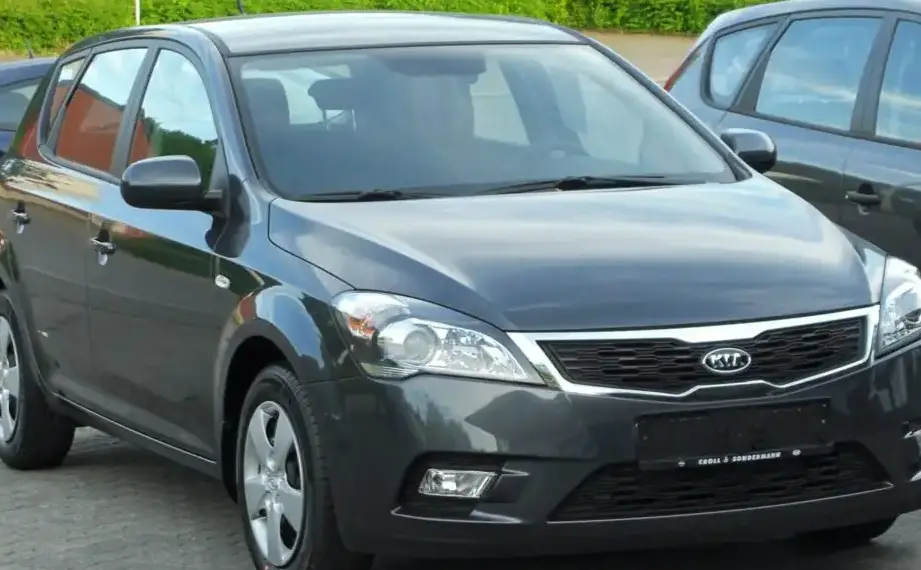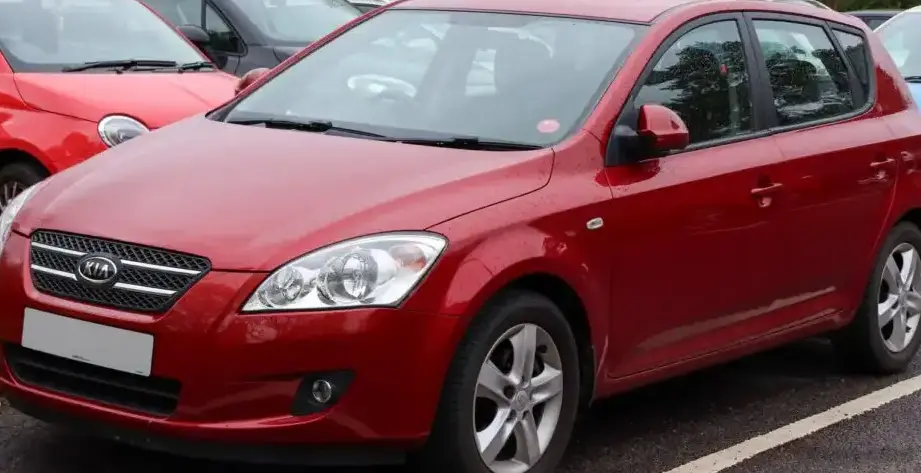
The Kia Cee’d, launched in 2007, represented Kia’s first foray into the European C-segment hatchback market. Designed specifically for European tastes, the Cee’d aimed to challenge established rivals like the Ford Focus and Volkswagen Golf. The 2.0 CVVT variant, producing 143 horsepower, was introduced as a mid-range offering within the first generation (Cee’d I) lineup, produced from 2007 to 2009. It positioned itself as a step up from the base 1.4 and 1.6 liter engines, offering more performance without the higher price tag of the eventual 2.0 CRDi diesel option. This model was primarily sold in Europe, and was not offered in the North American market.
Technical Specifications
| Brand | Kia |
| Model | Cee’d |
| Generation | Cee’d I |
| Type (Engine) | 2.0 CVVT (143 Hp) |
| Start of production | 2007 |
| End of production | 2009 |
| Powertrain Architecture | Internal Combustion engine |
| Body type | Hatchback |
| Seats | 5 |
| Doors | 5 |
| Fuel consumption (urban) | 9.2 l/100 km (25.6 US mpg) |
| Fuel consumption (extra urban) | 5.9 l/100 km (39.9 US mpg) |
| Fuel consumption (combined) | 7.1 l/100 km (33.1 US mpg) |
| CO2 emissions | 170 g/km |
| Fuel Type | Petrol (Gasoline) |
| Acceleration 0 – 100 km/h | 10.4 sec |
| Acceleration 0 – 62 mph | 10.4 sec |
| Acceleration 0 – 60 mph | 9.9 sec |
| Maximum speed | 205 km/h (127.38 mph) |
| Emission standard | Euro 4 |
| Weight-to-power ratio | 9.4 kg/Hp |
| Weight-to-torque ratio | 7.2 kg/Nm |
| Power | 143 Hp @ 6000 rpm |
| Torque | 186 Nm @ 4600 rpm (137.19 lb.-ft. @ 4600 rpm) |
| Engine layout | Front, Transverse |
| Engine Model/Code | G4GC |
| Engine displacement | 1975 cm3 (120.52 cu. in.) |
| Number of cylinders | 4 |
| Engine configuration | Inline |
| Cylinder Bore | 82 mm (3.23 in.) |
| Piston Stroke | 93.5 mm (3.68 in.) |
| Compression ratio | 10.1:1 |
| Number of valves per cylinder | 4 |
| Fuel injection system | Multi-port manifold injection |
| Engine aspiration | Naturally aspirated engine |
| Valvetrain | DOHC CVVT |
| Engine oil capacity | 4 l (4.23 US qt | 3.52 UK qt) |
| Coolant capacity | 6.3 l (6.66 US qt | 5.54 UK qt) |
| Kerb Weight | 1341-1413 kg (2956.4 – 3115.13 lbs.) |
| Max. weight | 1770 kg (3902.18 lbs.) |
| Max load | 357-429 kg (787.05 – 945.78 lbs.) |
| Trunk (boot) space – minimum | 340 l (12.01 cu. ft.) |
| Trunk (boot) space – maximum | 1300 l (45.91 cu. ft.) |
| Fuel tank capacity | 53 l (14 US gal | 11.66 UK gal) |
| Max. roof load | 80 kg (176.37 lbs.) |
| Permitted trailer load with brakes (12%) | 1200 kg (2645.55 lbs.) |
| Permitted trailer load without brakes | 550 kg (1212.54 lbs.) |
| Permitted towbar download | 55 kg (121.25 lbs.) |
| Length | 4235 mm (166.73 in.) |
| Width | 1790 mm (70.47 in.) |
| Height | 1480 mm (58.27 in.) |
| Wheelbase | 2650 mm (104.33 in.) |
| Front track | 1546 mm (60.87 in.) |
| Rear track | 1544 mm (60.79 in.) |
| Front overhang | 865 mm (34.06 in.) |
| Rear overhang | 720 mm (28.35 in.) |
| Minimum turning circle | 10.8 m (35.43 ft.) |
| Drivetrain | Front wheel drive |
| Number of gears | 5 |
| Gearbox type | Manual transmission |
| Front suspension | Independent type McPherson |
| Rear suspension | Independent multi-link suspension, Transverse stabilizer |
| Front brakes | Ventilated discs, 280 mm |
| Rear brakes | Disc, 262 mm |
| Assisting systems | ABS (Anti-lock braking system) |
| Steering type | Steering rack and pinion |
| Power steering | Electric Steering |
| Tires size | 185/65 R15; 195/65 R15; 205/55 R16; 225/45 R17 |
| Wheel rims size | 5.5J x 15; 6J x 16; 7J x 17 |
Powertrain & Engine Architecture
The 2.0 CVVT engine, designated G4GC, is a naturally aspirated, four-cylinder inline engine. It features a cast iron block and an aluminum cylinder head. The “CVVT” designation stands for Continuously Variable Valve Timing, a technology employed on both the intake and exhaust valves to optimize engine performance and fuel efficiency across the rev range. Fuel delivery is handled by a multi-point fuel injection system. The engine produces 143 horsepower at 6000 rpm and 186 Nm (137 lb-ft) of torque at 4600 rpm. The Cee’d 2.0 CVVT was exclusively offered with a five-speed manual transmission in Europe. This transmission was chosen for its balance of cost-effectiveness and durability, providing smooth shifts and reliable operation.
Driving Characteristics
The 2.0 CVVT Cee’d offered a noticeable step up in performance compared to the lower-displacement engines. Acceleration from 0 to 60 mph took approximately 9.9 seconds, and it could reach a top speed of 127.38 mph. While not a sports car, the 2.0L engine provided sufficient power for comfortable highway cruising and overtaking maneuvers. The five-speed manual transmission allowed drivers to effectively utilize the engine’s torque band. Compared to the later diesel variants, the 2.0 CVVT offered a more linear power delivery and a more engaging driving experience, albeit with lower fuel economy. The gear ratios were fairly standard for the class, prioritizing everyday usability over outright performance.
Equipment & Trim Levels
The 2.0 CVVT trim typically included features such as air conditioning, power windows, central locking, and a basic audio system. Higher trim levels, such as the ‘2’ or ‘3’ variants, added features like alloy wheels, fog lights, a trip computer, and upgraded interior trim. Interior upholstery was generally cloth, with options for different color schemes. Optional extras included a sunroof, leather upholstery, and a more advanced audio system with CD changer. Safety features included ABS brakes, front airbags, and seatbelt pretensioners.
Chassis & Braking
The Cee’d I utilized a McPherson strut front suspension and a multi-link rear suspension, providing a comfortable ride and decent handling characteristics. The suspension was tuned for everyday driving, prioritizing comfort over sporty handling. Front brakes were ventilated discs, while rear brakes were solid discs. The braking system was adequate for the vehicle’s weight and performance, with ABS providing additional safety. Stabilizer bars were fitted to both the front and rear axles to reduce body roll during cornering.
Market Reception & Comparison
The Kia Cee’d 2.0 CVVT was generally well-received by automotive critics as a competent and well-equipped hatchback. It was praised for its value for money, comfortable ride, and spacious interior. However, some critics noted that the engine lacked the refinement of some of its rivals, and the styling was considered somewhat conservative. Compared to the 1.4 and 1.6 liter versions, the 2.0 CVVT offered significantly improved performance, but at the cost of slightly higher fuel consumption. The diesel variants offered superior fuel economy, but were more expensive to purchase.
Legacy
The Kia Cee’d I 2.0 CVVT has proven to be a relatively reliable vehicle, with the G4GC engine generally considered durable. Common issues are typically related to wear and tear, such as suspension components and exhaust system parts. The Cee’d’s simple design and readily available parts contribute to its affordability and ease of maintenance. On the used car market, the 2.0 CVVT variant represents a good value proposition for buyers seeking a practical and reliable hatchback. While not a collector’s item, it remains a popular choice for those seeking an affordable and dependable mode of transportation.