
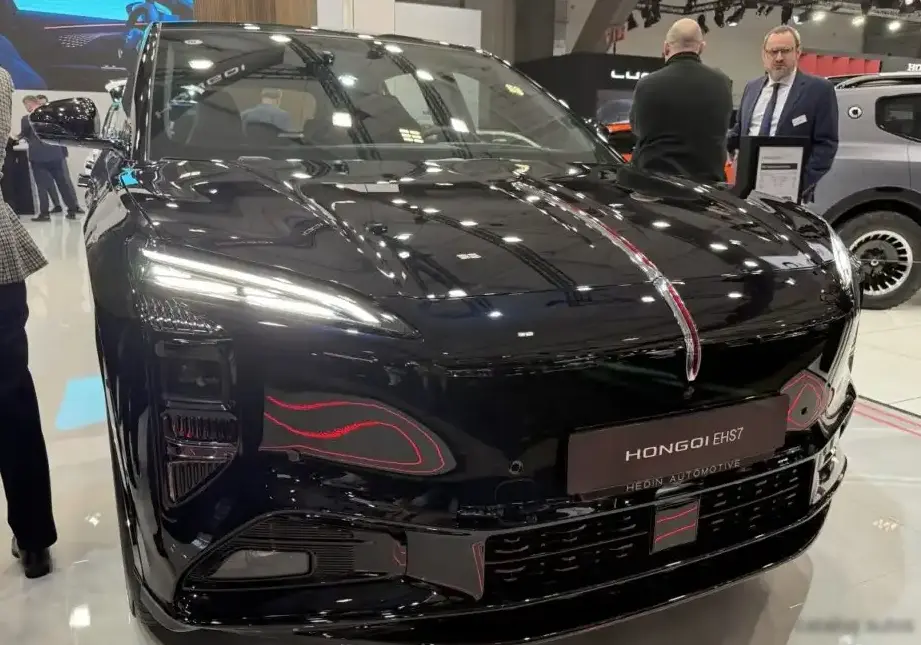
The Hongqi EHS7 111 kWh, producing 344 horsepower, represents a significant entry into the burgeoning luxury electric SUV market from the Chinese automaker Hongqi. Introduced in October 2024, the EHS7 is built upon a dedicated electric vehicle platform and aims to compete with established international brands. It is positioned as a flagship model within Hongqi’s expanding lineup, showcasing the brand’s commitment to advanced technology and upscale design. The EHS7 is primarily targeted at the Chinese domestic market, but represents Hongqi’s ambitions for global expansion.
Technical Specifications
| Brand | Hongqi |
| Model | EHS7 |
| Generation | EHS7 |
| Type (Engine) | 111 kWh (344 Hp) |
| Start of production | October, 2024 |
| Powertrain Architecture | BEV (Electric Vehicle) |
| Body type | SUV |
| Seats | 5 |
| Doors | 5 |
| Fuel Type | Electricity |
| Acceleration 0 – 100 km/h | 6.3 sec |
| Acceleration 0 – 62 mph | 6.3 sec |
| Acceleration 0 – 60 mph | 6 sec |
| Maximum speed | 200 km/h (124.27 mph) |
| Weight-to-power ratio | 6.9 kg/Hp, 144.4 Hp/tonne |
| Weight-to-torque ratio | 5.3 kg/Nm, 188.8 Nm/tonne |
| Gross battery capacity | 111 kWh |
| Net (usable) battery capacity | 103.5 kWh |
| Battery voltage | 400 V |
| Battery technology | Lithium nickel manganese cobalt oxides (Li-NMC) |
| Battery location | Below the floor |
| All-electric range (WLTP) | 600 km (372.82 mi) |
| Average Energy consumption (WLTP) | 18.5 kWh/100 km (29.77 kWh/100 mi) |
| Average Energy consumption (MPGe) | 113 MPGe |
| Average Energy consumption (km/kWh) | 5.4 km/kWh |
| Average Energy consumption (mi/kWh) | 3.4 mi/kWh |
| Electric motor power | 344 Hp |
| Electric motor Torque | 450 Nm (331.9 lb.-ft.) |
| Electric motor location | Rear axle, Transverse |
| Electric motor type | Synchronous |
| System power | 344 Hp |
| System torque | 450 Nm (331.9 lb.-ft.) |
| Kerb Weight | 2383 kg (5253.62 lbs.) |
| Max. weight | 2833 kg (6245.7 lbs.) |
| Max load | 450 kg (992.08 lbs.) |
| Trunk (boot) space – minimum | 456 l (16.1 cu. ft.) |
| Trunk (boot) space – maximum | 1709 l (60.35 cu. ft.) |
| Max. roof load | 75 kg (165.35 lbs.) |
| Permitted trailer load with brakes (12%) | 1500 kg (3306.93 lbs.) |
| Permitted trailer load without brakes | 750 kg (1653.47 lbs.) |
| Length | 4925 mm (193.9 in.) |
| Width | 1950 mm (76.77 in.) |
| Height | 1680 mm (66.14 in.) |
| Wheelbase | 3000 mm (118.11 in.) |
| Drivetrain Architecture | One electric motor drives the rear wheels. |
| Drive wheel | Rear wheel drive |
| Number of gears and type of gearbox | 1 gears, automatic transmission |
| Front suspension | Double wishbone |
| Rear suspension | Independent multi-link suspension |
| Assisting systems | ABS (Anti-lock braking system) |
| Steering type | Steering rack and pinion |
| Power steering | Electric Steering |
| Tires size | Front wheel tires: 255/45 R21Rear wheel tires: 275/40 R21 |
| Wheel rims size | 21 |
Powertrain & Engine Architecture
The Hongqi EHS7 111 kWh is powered by a single rear-mounted synchronous electric motor, delivering 344 horsepower and 450 Nm (331.9 lb.-ft.) of torque. The powertrain utilizes a 400V architecture and a lithium nickel manganese cobalt oxide (Li-NMC) battery pack with a gross capacity of 111 kWh, providing a usable capacity of 103.5 kWh. This battery is positioned under the floor of the vehicle to optimize space and lower the center of gravity. The single-speed automatic transmission is typical for electric vehicles, providing seamless acceleration. The motor’s transverse mounting contributes to efficient packaging within the rear axle assembly. The EHS7 does not feature a traditional internal combustion engine, aligning with its fully electric vehicle (BEV) designation.
Driving Characteristics
The EHS7 111 kWh offers brisk acceleration, achieving 0-60 mph in approximately 6 seconds and 0-100 km/h in 6.3 seconds. The rear-wheel-drive configuration provides a balanced driving experience, although it may exhibit some traction limitations in adverse weather conditions. The single-speed transmission delivers instant torque, characteristic of electric motors, resulting in responsive performance. Compared to potential future higher-performance variants, the 344 hp model prioritizes a balance between efficiency and adequate power for everyday driving. The relatively low center of gravity, thanks to the underfloor battery pack, contributes to stable handling.
Equipment & Trim Levels
The EHS7 111 kWh is well-equipped with standard features expected of a luxury SUV. These typically include a large touchscreen infotainment system, a digital instrument cluster, premium upholstery (likely leather or synthetic leather), and a comprehensive suite of advanced driver-assistance systems (ADAS). Specific trim levels and optional extras may vary depending on the market, but commonly available options include a panoramic sunroof, upgraded audio system, ventilated and massaging front seats, and advanced parking assistance features. The interior design emphasizes a modern and minimalist aesthetic, with high-quality materials and attention to detail.
Chassis & Braking
The EHS7 utilizes a double wishbone suspension setup at the front and an independent multi-link suspension at the rear, designed to provide a comfortable ride and responsive handling. The vehicle is equipped with an anti-lock braking system (ABS) as standard. Braking performance is enhanced by regenerative braking, which recovers energy during deceleration and contributes to increased range. Steering is provided by an electric power steering system with a rack and pinion setup. The EHS7 rides on 21-inch alloy wheels, fitted with 255/45 R21 tires at the front and 275/40 R21 tires at the rear.
Market Reception & Comparison
The Hongqi EHS7 has been generally well-received in the Chinese market, praised for its luxurious interior, advanced technology, and competitive range. Critics have noted its strong performance and comfortable ride. Compared to other electric SUVs in its class, such as the Tesla Model X or the BMW iX, the EHS7 offers a compelling value proposition, particularly within its domestic market. Its energy consumption of 18.5 kWh/100 km (113 MPGe) is competitive with other similarly sized electric SUVs. Long-term reliability data is still emerging, given the vehicle’s recent introduction.
Legacy
As a relatively new model, the long-term reliability of the Hongqi EHS7 111 kWh remains to be fully established. However, Hongqi’s increasing focus on quality control and its adoption of proven battery technology suggest a positive outlook. The EHS7 represents a significant step forward for the brand, demonstrating its ability to compete with established international automakers in the electric vehicle segment. Its success will likely influence Hongqi’s future product development and expansion plans. In the used car market, the EHS7 is expected to hold its value reasonably well, particularly among buyers seeking a luxurious and technologically advanced electric SUV.
