
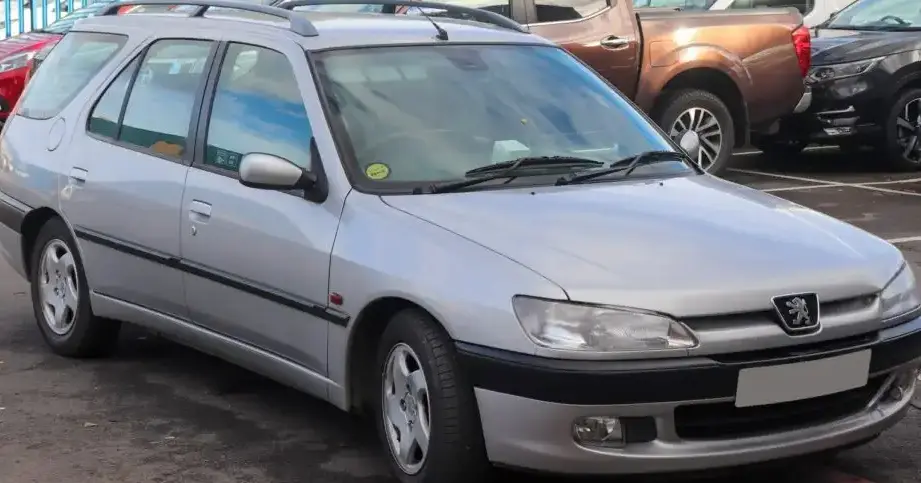
The Peugeot 306 Break 1.8i, produced between 1997 and 2002, represents a practical and popular iteration of Peugeot’s compact family car. Part of the 7E series, the Break (estate/station wagon) body style offered increased cargo capacity compared to the hatchback, making it a favored choice for families and those requiring versatile load-lugging capabilities. This 1.8-liter variant occupied a middle ground in the 306 Break lineup, offering a balance between affordability, fuel economy, and acceptable performance. It served as a step up from the base 1.4-liter models, while remaining more accessible than the sportier 2.0-liter versions.
Technical Specifications
| Brand | Peugeot |
| Model | 306 |
| Generation | 306 Break (7E) |
| Type (Engine) | 1.8i (110 Hp) |
| Start of production | 1997 |
| End of production | 2002 |
| Powertrain Architecture | Internal Combustion engine |
| Body type | Station wagon (estate) |
| Seats | 5 |
| Doors | 5 |
| Fuel consumption (urban) | 12 l/100 km (19.6 US mpg) |
| Fuel consumption (extra urban) | 6.3 l/100 km (37.3 US mpg) |
| Fuel Type | Petrol (Gasoline) |
| Acceleration 0 – 100 km/h | 12 sec |
| Acceleration 0 – 62 mph | 12 sec |
| Acceleration 0 – 60 mph | 11.4 sec |
| Maximum speed | 191 km/h (118.68 mph) |
| Weight-to-power ratio | 10.9 kg/Hp |
| Weight-to-torque ratio | 7.7 kg/Nm |
| Power | 110 Hp @ 5500 rpm |
| Torque | 155 Nm @ 4250 rpm (114.32 lb.-ft. @ 4250 rpm) |
| Engine layout | Front, Transverse |
| Engine Model/Code | LFY XU7JP4 |
| Engine displacement | 1761 cm3 (107.46 cu. in.) |
| Number of cylinders | 4 |
| Engine configuration | Inline |
| Cylinder Bore | 83 mm (3.27 in.) |
| Piston Stroke | 81.4 mm (3.2 in.) |
| Compression ratio | 10:1 |
| Number of valves per cylinder | 4 |
| Fuel injection system | Multi-port manifold injection |
| Engine aspiration | Naturally aspirated engine |
| Valvetrain | DOHC |
| Engine oil capacity | 4.3 l (4.54 US qt | 3.78 UK qt) |
| Coolant capacity | 7.5 l (7.93 US qt | 6.6 UK qt) |
| Kerb Weight | 1200 kg (2645.55 lbs.) |
| Max. weight | 1645 kg (3626.6 lbs.) |
| Max load | 445 kg (981.06 lbs.) |
| Trunk (boot) space – minimum | 440 l (15.54 cu. ft.) |
| Trunk (boot) space – maximum | 1510 l (53.33 cu. ft.) |
| Fuel tank capacity | 60 l (15.85 US gal | 13.2 UK gal) |
| Length | 4338 mm (170.79 in.) |
| Width | 1680 mm (66.14 in.) |
| Height | 1415 mm (55.71 in.) |
| Wheelbase | 2580 mm (101.57 in.) |
| Front track | 1423-1433 mm (56.02 – 56.42 in.) |
| Rear track | 1424-1432 mm (56.06 – 56.38 in.) |
| Front overhang | 815 mm (32.09 in.) |
| Rear overhang | 943 mm (37.13 in.) |
| Drivetrain Architecture | Front wheel drive |
| Number of gears | 5 |
| Gearbox type | Manual transmission |
| Front suspension | Wishbone |
| Rear suspension | Trailing arm |
| Front brakes | Disc |
| Rear brakes | Drum |
| Assisting systems | ABS (Anti-lock braking system) |
| Steering type | Steering rack and pinion |
| Power steering | Hydraulic |
| Tires size | 185/65 R14 |
Powertrain & Engine Architecture
The heart of the 306 Break 1.8i is the XU7JP4 engine, a 1761cc inline-four cylinder petrol engine. This engine, often referred to by its LFY engine code, is a naturally aspirated unit featuring a double overhead camshaft (DOHC) valvetrain and multi-point fuel injection. The XU series of engines were widely used across various Peugeot and Citroën models, known for their robustness and relatively simple design. The 1.8-liter version produced 110 horsepower at 5500 rpm and 155 Nm (114 lb-ft) of torque at 4250 rpm. The engine’s design prioritized drivability and fuel efficiency over outright performance. The five-speed manual transmission was the standard offering, providing a reasonable spread of gears for both urban and highway driving. The transmission was known for its light shift action, though not particularly sporty in feel.
Driving Characteristics
The 306 Break 1.8i offered a comfortable and predictable driving experience. Acceleration from 0-60 mph took around 11.4 seconds, and top speed was approximately 118 mph. While not a particularly quick car, the 1.8-liter engine provided sufficient power for everyday driving and overtaking maneuvers. The manual transmission allowed for a good degree of driver control, and the gear ratios were well-matched to the engine’s powerband. Compared to the more powerful 2.0-liter versions, the 1.8 felt less strained at higher speeds, and the fuel economy benefit was noticeable. The suspension, tuned for comfort, absorbed bumps and imperfections in the road well, contributing to a relaxed ride quality. However, this did result in some body roll during cornering.
Equipment & Trim Levels
The 306 Break 1.8i typically came equipped with features considered standard for a family car of its era. These included central locking, power steering, and an adjustable steering column. Interior upholstery was typically cloth, with a relatively simple dashboard layout. Optional extras included air conditioning, electric windows, and a sunroof. Higher trim levels, such as the GLX, added features like alloy wheels, upgraded interior trim, and a more comprehensive stereo system. The Break’s defining feature, of course, was its spacious estate body, offering a generous 440 liters of boot space (minimum) which expanded to 1510 liters with the rear seats folded down.
Chassis & Braking
The 306 Break utilized a front-wheel-drive layout with independent wishbone suspension at the front and a trailing arm setup at the rear. The front brakes were discs, providing adequate stopping power, while the rear brakes were drums. Anti-lock Braking System (ABS) was standard, enhancing safety. The suspension was tuned for comfort, prioritizing ride quality over sporty handling. Stabilizer bars were fitted to both the front and rear axles to reduce body roll, but the car still exhibited a noticeable degree of lean in corners. The steering was hydraulic power-assisted, making it light and easy to maneuver at low speeds.
Market Reception & Comparison
The Peugeot 306 Break 1.8i was generally well-received by automotive critics as a practical and affordable family car. It was praised for its spacious interior, comfortable ride, and reasonable fuel economy. However, some critics noted that the engine lacked outright power, particularly when fully loaded. Compared to other estate cars in its class, such as the Ford Focus Estate and the Vauxhall/Opel Astra Estate, the 306 Break offered a competitive package in terms of price and practicality. The 1.8-liter engine provided a good balance between performance and fuel efficiency, making it a popular choice for those seeking a versatile and economical family vehicle.
Legacy
The Peugeot 306 Break 1.8i has proven to be a relatively reliable car, with the XU7JP4 engine being known for its durability. However, like any older vehicle, it is susceptible to age-related issues such as corrosion and wear and tear on suspension components. In the used car market today, the 306 Break 1.8i represents an affordable and practical option for those seeking a classic family estate. Its simple mechanical design makes it relatively easy to maintain and repair, and parts availability is generally good. While it may not offer the same level of refinement or technology as modern cars, the 306 Break 1.8i remains a capable and charming vehicle that embodies the spirit of 1990s French automotive design.
