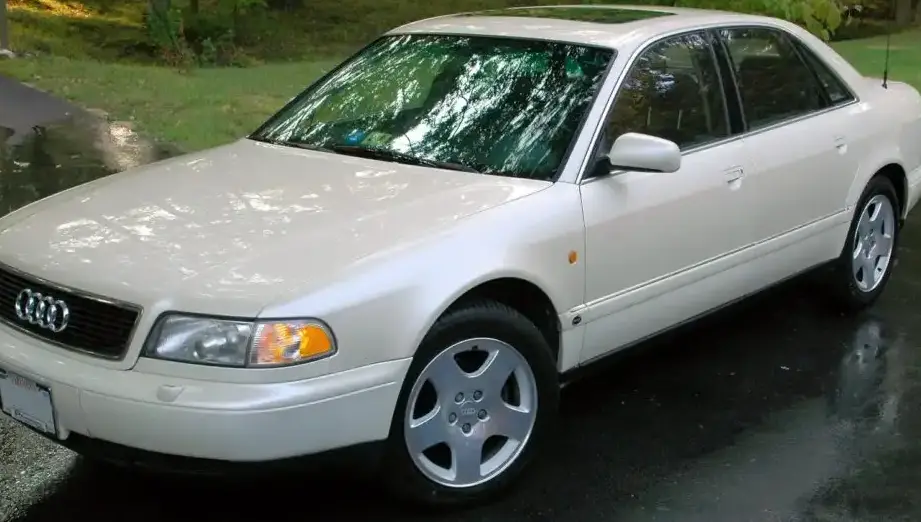
The Audi A8 (D2) facelift, produced from 1998 to 2000, represented a significant evolution of Audi’s flagship luxury sedan. Among the various engine options available, the 2.5 TDI V6 with a 5-speed tiptronic automatic transmission offered a compelling blend of efficiency and comfort, particularly within European markets. This variant occupied a mid-range position in the A8 lineup, appealing to buyers seeking a refined driving experience without the higher costs associated with the larger displacement engines like the 4.2 V8. The D2 A8, internally designated as the 4D chassis code, was a groundbreaking vehicle for Audi, showcasing advanced aluminum construction in its space frame and pioneering technologies for the time.
Technical Specifications
| Brand | Audi |
| Model | A8 |
| Generation | A8 (D2, 4D, facelift 1998) |
| Type (Engine) | 2.5 TDI V6 (150 Hp) tiptronic |
| Start of production | 1998 |
| End of production | 2000 |
| Powertrain Architecture | Internal Combustion engine |
| Body type | Sedan |
| Seats | 5 |
| Doors | 4 |
| Fuel consumption (economy) – urban (NEDC) | 11.6 l/100 km (20.3 US mpg, 24.4 UK mpg, 8.6 km/l) |
| Fuel consumption (economy) – extra urban (NEDC) | 6.2 l/100 km (37.9 US mpg, 45.6 UK mpg, 16.1 km/l) |
| Fuel consumption (economy) – combined (NEDC) | 8.2 l/100 km (28.7 US mpg, 34.4 UK mpg, 12.2 km/l) |
| CO2 emissions (NEDC) | 221 g/km |
| Fuel Type | Diesel |
| Acceleration 0 – 100 km/h | 10.9 sec |
| Acceleration 0 – 62 mph | 10.9 sec |
| Acceleration 0 – 60 mph | 10.4 sec |
| Maximum speed | 214 km/h (132.97 mph) |
| Emission standard | Euro 2 |
| Weight-to-power ratio | 11.1 kg/Hp, 90.4 Hp/tonne |
| Weight-to-torque ratio | 5.4 kg/Nm, 186.7 Nm/tonne |
| Power | 150 Hp @ 4000 rpm |
| Power per litre | 60.1 Hp/l |
| Torque | 310 Nm @ 1500-3200 rpm (228.64 lb.-ft. @ 1500-3200 rpm) |
| Engine layout | Front, Longitudinal |
| Engine Model/Code | AKN |
| Engine displacement | 2496 cm3 (152.32 cu. in.) |
| Number of cylinders | 6 |
| Engine configuration | V-engine |
| Cylinder Bore | 78.3 mm (3.08 in.) |
| Piston Stroke | 86.4 mm (3.4 in.) |
| Compression ratio | 19.5:1 |
| Number of valves per cylinder | 4 |
| Fuel injection system | Direct injection |
| Engine aspiration | Turbocharger, Intercooler |
| Valvetrain | DOHC |
| Engine oil capacity | 5.5 l (5.81 US qt, 4.84 UK qt) |
| Coolant | 10 l (10.57 US qt, 8.8 UK qt) |
| Kerb Weight | 1660 kg (3659.67 lbs.) |
| Max. weight | 2260 kg (4982.45 lbs.) |
| Max load | 600 kg (1322.77 lbs.) |
| Trunk (boot) space – minimum | 525 l (18.54 cu. ft.) |
| Fuel tank capacity | 90 l (23.78 US gal, 19.8 UK gal) |
| Max. roof load | 100 kg (220.46 lbs.) |
| Permitted trailer load with brakes (8%) | 2100 kg (4629.71 lbs.) |
| Permitted trailer load with brakes (12%) | 2100 kg (4629.71 lbs.) |
| Permitted trailer load without brakes | 750 kg (1653.47 lbs.) |
| Permitted towbar download | 95 kg (209.44 lbs.) |
| Length | 5034 mm (198.19 in.) |
| Width | 1880 mm (74.02 in.) |
| Width including mirrors | 1973 mm (77.68 in.) |
| Height | 1438 mm (56.61 in.) |
| Wheelbase | 2880 mm (113.39 in.) |
| Front track | 1597 mm (62.87 in.) |
| Rear (Back) track | 1586 mm (62.44 in.) |
| Front overhang | 1018 mm (40.08 in.) |
| Rear overhang | 1136 mm (44.72 in.) |
| Drag coefficient (Cd) | 0.29 |
| Minimum turning circle (turning diameter) | 12.3 m (40.35 ft.) |
| Drivetrain Architecture | The Internal combustion engine (ICE) drives the front wheels of the vehicle. |
| Drive wheel | Front wheel drive |
| Number of gears and type of gearbox | 5 gears, automatic transmission tiptronic |
| Front suspension | Independent multi-link suspension, Transverse stabilizer |
| Rear suspension | Independent on trapezoidal lever, Transverse stabilizer |
| Front brakes | Ventilated discs |
| Rear brakes | Ventilated discs |
| Assisting systems | ABS (Anti-lock braking system) |
| Steering type | Steering rack and pinion |
| Power steering | Hydraulic Steering |
| Tires size | 225/60 R16 |
| Wheel rims size | 7J x 16 |
Powertrain & Engine Architecture
The heart of this A8 variant is the 2.5-liter AKN inline-six diesel engine. This engine utilized a direct injection system, a technology that significantly improved fuel efficiency and reduced emissions compared to older indirect injection diesels. The AKN engine featured a turbocharger with an intercooler, boosting power output to 150 horsepower and 310 Nm (228.64 lb-ft) of torque. The torque curve was notably flat, providing strong pulling power from as low as 1500 rpm, making it well-suited for relaxed highway cruising and effortless overtaking. The engine employed a double overhead camshaft (DOHC) valvetrain with four valves per cylinder, optimizing gas flow for improved performance. Paired with the engine was a 5-speed tiptronic automatic transmission. This transmission allowed for both fully automatic operation and manual gear selection, offering drivers a degree of control over the drivetrain. The tiptronic system used a torque converter for smooth launches and low-speed driving, and electronically controlled gear changes.
Driving Characteristics
The 2.5 TDI with the tiptronic transmission delivered a comfortable and refined driving experience. While not overtly sporty, the engine’s ample torque provided brisk acceleration, with a 0-60 mph time of around 10.4 seconds. The tiptronic transmission generally shifted smoothly, although it could sometimes feel hesitant during quick downshifts. Compared to the more powerful V8 models, the 2.5 TDI offered a more economical driving experience, with combined fuel consumption figures around 8.2 l/100 km (28.7 US mpg). The gear ratios were optimized for fuel efficiency and relaxed cruising, rather than outright performance. Manual gear selection via the tiptronic function allowed drivers to hold gears for longer during spirited driving, but the transmission lacked the responsiveness of a dedicated manual gearbox.
Equipment & Trim Levels
The 2.5 TDI tiptronic A8 typically came equipped with a generous level of standard features. These included leather upholstery, automatic climate control, power-adjustable front seats, a premium audio system, and alloy wheels. Optional extras included a sunroof, navigation system, upgraded leather trim, and parking sensors. The interior design was characterized by Audi’s typically understated elegance, with high-quality materials and a focus on ergonomics. The dashboard layout was clean and functional, with intuitive controls.
Chassis & Braking
The D2 A8 featured an advanced aluminum space frame, which significantly reduced weight and improved rigidity compared to traditional steel chassis. The suspension consisted of independent multi-link suspension at the front and an independent trapezoidal lever setup at the rear, providing a comfortable and controlled ride. Stabilizer bars were fitted to both axles to reduce body roll during cornering. Braking duties were handled by ventilated discs on all four wheels, coupled with an Anti-lock Braking System (ABS) for enhanced safety. The braking system was generally effective, providing ample stopping power for a vehicle of this size and weight.
Market Reception & Comparison
The 2.5 TDI tiptronic A8 was well-received in European markets as a practical and luxurious executive sedan. Critics praised its comfortable ride, refined interior, and fuel efficiency. Compared to the more expensive V8 models, the 2.5 TDI offered a more accessible entry point into the A8 range. However, some reviewers noted that the tiptronic transmission could feel sluggish at times, and that the engine lacked the outright performance of its larger displacement counterparts. The 1.8L petrol and 2.8L V6 models offered different driving experiences, prioritizing fuel economy and agility respectively, while the 4.2 V8 focused on outright power and prestige.
Legacy
The AKN engine, while generally reliable, is known to require regular maintenance, particularly regarding the turbocharger and fuel injection system. The tiptronic transmission, while durable, can be expensive to repair if issues arise. Today, the 2.5 TDI A8 (D2) represents a relatively affordable entry point into the world of Audi luxury. Well-maintained examples are sought after by enthusiasts who appreciate the car’s blend of comfort, refinement, and fuel efficiency. The D2 A8’s pioneering aluminum construction and advanced technology continue to be admired, cementing its place as a significant milestone in Audi’s history.