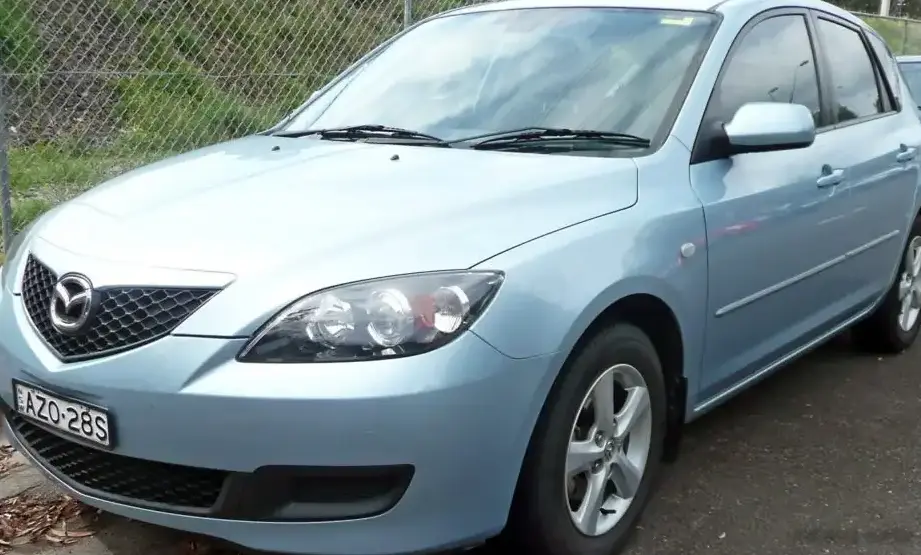
The Mazda 3 first generation (BK) facelift, produced from 2006 to 2009, represented a significant step forward for Mazda in the competitive compact car segment. The 2.0 CD variant, introduced in 2007, offered a diesel engine option aimed at European markets prioritizing fuel efficiency and torque. This model year saw updates to the original BK platform, including revised styling and improved interior materials. The 2.0 CD, producing 143 horsepower, positioned itself as a mid-range offering within the Mazda 3 lineup, bridging the gap between the lower-powered gasoline engines and the later introduction of more performance-focused variants.
Technical Specifications
| Brand | Mazda |
| Model | 3 |
| Generation | I Hatchback (BK, facelift 2006) |
| Type (Engine) | 2.0 CD (143 Hp) |
| Start of production | 2007 |
| End of production | 2009 |
| Powertrain Architecture | Internal Combustion engine |
| Body type | Hatchback |
| Seats | 5 |
| Doors | 5 |
| Fuel consumption (urban) | 7.1 l/100 km (33.1 US mpg, 39.8 UK mpg, 14.1 km/l) |
| Fuel consumption (extra urban) | 5.4 l/100 km (43.6 US mpg, 52.3 UK mpg, 18.5 km/l) |
| Fuel consumption (combined) | 6 l/100 km (39.2 US mpg, 47.1 UK mpg, 16.7 km/l) |
| CO2 emissions | 162 g/km |
| Fuel Type | Diesel |
| Acceleration 0 – 100 km/h | 9.9 sec |
| Acceleration 0 – 62 mph | 9.9 sec |
| Acceleration 0 – 60 mph | 9.4 sec |
| Maximum speed | 203 km/h (126.14 mph) |
| Emission standard | Euro 4 |
| Weight-to-power ratio | 9.9 kg/Hp, 101.4 Hp/tonne |
| Weight-to-torque ratio | 3.9 kg/Nm, 255.3 Nm/tonne |
| Power | 143 Hp @ 3500 rpm |
| Torque | 360 Nm @ 2000 rpm (265.52 lb.-ft. @ 2000 rpm) |
| Engine layout | Front, Transverse |
| Engine Model/Code | RF7J |
| Engine displacement | 1998 cm3 (121.93 cu. in.) |
| Number of cylinders | 4 |
| Engine configuration | Inline |
| Cylinder Bore | 86 mm (3.39 in.) |
| Piston Stroke | 86 mm (3.39 in.) |
| Compression ratio | 16.7:1 |
| Number of valves per cylinder | 4 |
| Fuel injection system | Diesel Commonrail |
| Engine aspiration | Turbocharger, Intercooler |
| Valvetrain | SOHC |
| Engine oil capacity | 4.1 l (4.33 US qt | 3.61 UK qt) |
| Coolant | 8.8 l (9.3 US qt | 7.74 UK qt) |
| Kerb Weight | 1410 kg (3108.52 lbs.) |
| Max. weight | 1945 kg (4287.99 lbs.) |
| Max load | 535 kg (1179.47 lbs.) |
| Trunk (boot) space – minimum | 300 l (10.59 cu. ft.) |
| Trunk (boot) space – maximum | 635 l (22.42 cu. ft.) |
| Fuel tank capacity | 55 l (14.53 US gal | 12.1 UK gal) |
| Permitted trailer load with brakes (12%) | 1500 kg (3306.93 lbs.) |
| Permitted trailer load without brakes | 600 kg (1322.77 lbs.) |
| Length | 4415 mm (173.82 in.) |
| Width | 1755 mm (69.09 in.) |
| Width including mirrors | 1935 mm (76.18 in.) |
| Height | 1465 mm (57.68 in.) |
| Wheelbase | 2640 mm (103.94 in.) |
| Front track | 1530 mm (60.24 in.) |
| Rear (Back) track | 1515 mm (59.65 in.) |
| Ride height (ground clearance) | 160 mm (6.3 in.) |
| Drag coefficient (Cd) | 0.30 |
| Minimum turning circle (turning diameter) | 10.4 m (34.12 ft.) |
| Drivetrain Architecture | The Internal combustion engine (ICE) drives the front wheels of the vehicle. |
| Drive wheel | Front wheel drive |
| Number of gears and type of gearbox | 6 gears, manual transmission |
| Front suspension | Independent, type McPherson with coil spring and anti-roll bar |
| Rear suspension | Independent multi-link spring suspension with stabilizer |
| Front brakes | Ventilated discs |
| Rear brakes | Disc |
| Assisting systems | ABS (Anti-lock braking system) |
| Steering type | Steering rack and pinion |
| Power steering | Electric Steering |
| Tires size | 205/55 R16 |
| Wheel rims size | 16 |
INTRODUCTION
The Mazda 3 BK facelift 2.0 CD, launched in 2007, was a key component of Mazda’s strategy to offer a compelling and efficient alternative to traditional gasoline-powered compacts in the European market. Built on the 1HX0 platform (shared with the Ford Focus Mk2), the facelift brought subtle styling revisions and improvements to the interior. The 2.0 CD engine was specifically designed to appeal to drivers seeking lower running costs and increased torque for everyday driving and occasional long journeys. This variant occupied a middle ground in the Mazda 3 range, offering a balance between performance and economy.
Powertrain & Engine Architecture
The heart of the 2.0 CD is the RF7J engine, a 1998cc inline-four cylinder diesel. This engine utilizes a common rail direct injection system, delivering fuel directly into the combustion chamber at extremely high pressure. This technology, coupled with a turbocharger and intercooler, allows for efficient combustion and increased power output. The engine features a single overhead camshaft (SOHC) valvetrain, operating four valves per cylinder. The high compression ratio of 16.7:1 contributes to the engine’s efficiency. The 2.0 CD was paired with a six-speed manual transmission, optimized for maximizing fuel economy and providing smooth gear changes. The transmission’s gear ratios were tuned to take advantage of the engine’s strong low-end torque.
Driving Characteristics
The 2.0 CD offered a distinctly different driving experience compared to the gasoline-powered Mazda 3 variants. While not as overtly sporty, the diesel engine delivered a substantial 360 Nm (265.52 lb.-ft.) of torque at just 2000 rpm. This resulted in strong acceleration in everyday driving situations, particularly when overtaking or climbing hills. The six-speed manual transmission allowed drivers to keep the engine within its optimal torque band. Acceleration from 0-60 mph took approximately 9.4 seconds, and the car could reach a top speed of 203 km/h (126.14 mph). Compared to the higher-output gasoline engines, the 2.0 CD prioritized usability and fuel efficiency over outright performance.
Equipment & Trim Levels
The 2.0 CD trim level typically included standard features such as air conditioning, power windows, power mirrors, and a CD player with auxiliary input. Safety features included ABS, front and side airbags, and seatbelt pretensioners. Higher trim levels offered options like alloy wheels, a sunroof, and upgraded audio systems. Interior upholstery was typically cloth, with a focus on durability and comfort. The dashboard layout was functional and driver-focused, with clear instrumentation and logically placed controls.
Chassis & Braking
The Mazda 3 BK facelift utilized an independent suspension system on both the front and rear axles. The front suspension employed a McPherson strut design with coil springs and an anti-roll bar, while the rear featured a multi-link setup with a stabilizer bar. This configuration provided a good balance between ride comfort and handling. The braking system consisted of ventilated discs on the front wheels and solid discs on the rear. ABS was standard, enhancing braking performance and stability. The chassis was tuned to provide responsive steering and predictable handling characteristics.
Market Reception & Comparison
The Mazda 3 2.0 CD was generally well-received by automotive critics, who praised its fuel efficiency, strong torque, and comfortable ride. It was often compared to rivals such as the Volkswagen Golf TDI and the Ford Focus TDCi. While the Golf TDI was often considered the benchmark in the segment, the Mazda 3 offered a more engaging driving experience. The 2.0 CD’s fuel economy was competitive, achieving around 39.2 US mpg on a combined cycle. Reliability was generally good, although diesel engines can be more susceptible to issues with the fuel injection system and turbocharger over time.
Legacy
The Mazda 3 BK facelift 2.0 CD remains a popular choice in the used car market, particularly for drivers seeking a reliable and economical compact car. The RF7J engine, while not without its potential maintenance needs, is generally considered durable when properly maintained. Parts availability is good, and the car’s relatively simple mechanical design makes it relatively easy to repair. The 2.0 CD variant represents a significant step forward in Mazda’s diesel engine technology and continues to offer a compelling blend of performance, economy, and practicality.