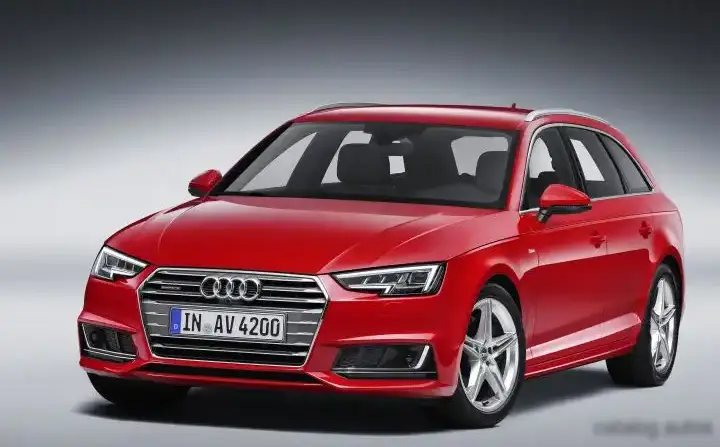
The Audi A4 Avant (B9 8W) 2.0 TDI ultra, produced from 2015 to 2018, represents a significant iteration of Audi’s popular compact executive estate. Positioned as a fuel-efficient and performance-oriented variant within the B9 A4 Avant range, the 2.0 TDI ultra aimed to deliver a balance between driving pleasure and economy. This model occupied a mid-range position in the A4 Avant lineup, slotting between the lower-powered diesel options and the more potent petrol and higher-output diesel versions. It was primarily marketed in Europe, where demand for diesel-powered estates remained strong, offering a practical and refined option for families and business users alike.
Technical Specifications
| Brand | Audi |
| Model | A4 |
| Generation | A4 Avant (B9 8W) |
| Type (Engine) | 2.0 TDI ultra (190 Hp) |
| Start of production | 2015 |
| End of production | 2018 |
| Powertrain Architecture | Internal Combustion engine |
| Body type | Station wagon (estate) |
| Seats | 5 |
| Doors | 5 |
| Fuel consumption (urban) | 4.9-5.1 l/100 km (48 – 46.1 US mpg, 57.6 – 55.4 UK mpg, 20.4 – 19.6 km/l) |
| Fuel consumption (extra urban) | 3.6-3.8 l/100 km (65.3 – 61.9 US mpg, 78.5 – 74.3 UK mpg, 27.8 – 26.3 km/l) |
| Fuel consumption (combined) | 4.0-4.2 l/100 km (58.8 – 56 US mpg, 70.6 – 67.3 UK mpg, 25 – 23.8 km/l) |
| CO2 emissions | 104-111 g/km |
| Fuel Type | Diesel |
| Acceleration 0 – 100 km/h | 7.9 sec |
| Acceleration 0 – 62 mph | 7.9 sec |
| Acceleration 0 – 60 mph | 7.5 sec |
| Maximum speed | 210 km/h (130.49 mph) |
| Emission standard | Euro 6 |
| Weight-to-power ratio | 7.9 kg/Hp, 126.7 Hp/tonne |
| Weight-to-torque ratio | 3.8 kg/Nm, 266.7 Nm/tonne |
| Power | 190 Hp @ 3800-4200 rpm |
| Power per litre | 96.5 Hp/l |
| Torque | 400 Nm @ 1750-3000 rpm (295.02 lb.-ft. @ 1750-3000 rpm) |
| Engine layout | Front, Longitudinal |
| Engine Model/Code | DETA |
| Engine displacement | 1968 cm3 (120.09 cu. in.) |
| Number of cylinders | 4 |
| Engine configuration | Inline |
| Cylinder Bore | 81 mm (3.19 in.) |
| Piston Stroke | 95.5 mm (3.76 in.) |
| Compression ratio | 15.5:1 |
| Number of valves per cylinder | 4 |
| Fuel injection system | Diesel Commonrail |
| Engine aspiration | Turbocharger, Intercooler |
| Valvetrain | DOHC |
| Engine oil capacity | 4.7 l (4.97 US qt | 4.14 UK qt) |
| Kerb Weight | 1500 kg (3306.93 lbs.) |
| Max. weight | 2120 kg (4673.8 lbs.) |
| Max load | 620 kg (1366.87 lbs.) |
| Trunk (boot) space – minimum | 505 l (17.83 cu. ft.) |
| Trunk (boot) space – maximum | 1510 l (53.33 cu. ft.) |
| Fuel tank capacity | 40 l (10.57 US gal | 8.8 UK gal) |
| Max. roof load | 90 kg (198.42 lbs.) |
| Permitted trailer load with brakes (8%) | 1600 kg (3527.4 lbs.) |
| Permitted trailer load with brakes (12%) | 1400 kg (3086.47 lbs.) |
| Permitted trailer load without brakes | 750 kg (1653.47 lbs.) |
| Permitted towbar download | 80 kg (176.37 lbs.) |
| Length | 4725 mm (186.02 in.) |
| Width | 1842 mm (72.52 in.) |
| Width including mirrors | 2022 mm (79.61 in.) |
| Height | 1434 mm (56.46 in.) |
| Wheelbase | 2820 mm (111.02 in.) |
| Front track | 1572 mm (61.89 in.) |
| Rear (Back) track | 1555 mm (61.22 in.) |
| Front overhang | 880 mm (34.65 in.) |
| Rear overhang | 1025 mm (40.35 in.) |
| Drag coefficient (Cd) | 0.26 |
| Minimum turning circle (turning diameter) | 11.6 m (38.06 ft.) |
| Drivetrain Architecture | The Internal combustion engine (ICE) drives the front wheels of the vehicle. |
| Drive wheel | Front wheel drive |
| Number of gears and type of gearbox | 6 gears, manual transmission |
| Front suspension | Independent multi-link suspension |
| Rear suspension | Independent multi-link suspension |
| Front brakes | Ventilated discs |
| Rear brakes | Disc |
| Assisting systems | ABS (Anti-lock braking system) |
| Steering type | Steering rack and pinion |
| Power steering | Electric Steering |
| Tires size | 205/60 R16; 225/50 R17; 245/40 R18 |
| Wheel rims size | 7J x 16; 17; 18 |
Powertrain & Engine Architecture
The heart of the A4 Avant 2.0 TDI ultra is the DETA engine, a 2.0-liter inline-four cylinder diesel engine. This engine is a member of the Volkswagen Group’s modular engine family, known for its efficiency and refinement. The DETA utilizes a common rail direct injection system, delivering fuel at extremely high pressures for optimized combustion. A single turbocharger, often paired with an intercooler, provides forced induction, boosting power and torque. The engine also features a Dual Overhead Camshaft (DOHC) valvetrain with four valves per cylinder, enhancing breathing and contributing to its power output. The 6-speed manual transmission was standard, providing precise gear changes and a direct connection to the engine. The engine’s longitudinal mounting allowed for front-wheel drive configuration, common in European A4 models.
Driving Characteristics
The 190 horsepower and 400 Nm (295 lb-ft) of torque delivered by the 2.0 TDI ultra provided a respectable level of performance for a family estate. Acceleration from 0 to 100 km/h (0-62 mph) took approximately 7.9 seconds. While not as rapid as the higher-powered petrol variants, the TDI ultra offered strong mid-range acceleration, making it well-suited for overtaking and highway cruising. The manual transmission, while engaging, had gear ratios tuned for fuel efficiency rather than outright performance. Compared to the 150 hp TDI models, the 190 hp version felt noticeably more responsive. However, it lacked the outright punch of the more expensive petrol-powered A4 Avants.
Equipment & Trim Levels
The A4 Avant 2.0 TDI ultra typically came well-equipped, reflecting its mid-range positioning. Standard features included Audi’s MMI infotainment system with a central display screen, automatic climate control, and a leather-wrapped steering wheel. Upholstery was generally cloth, with leather options available as an upgrade. Common optional extras included navigation, parking sensors, a panoramic sunroof, and upgraded sound systems. The ‘ultra’ designation also implied some weight-saving measures, contributing to improved fuel economy. Trim levels varied slightly depending on the market, but generally offered a good balance of comfort and technology.
Chassis & Braking
The A4 Avant’s chassis featured independent multi-link suspension at both the front and rear, providing a comfortable and controlled ride. The suspension was tuned to balance handling with ride quality, making it suitable for both city driving and long-distance journeys. Braking duties were handled by ventilated discs at the front and solid discs at the rear, providing adequate stopping power. Anti-lock Braking System (ABS) was standard, enhancing safety. The steering was a rack-and-pinion system with electric power assistance, offering precise and responsive control.
Market Reception & Comparison
The Audi A4 Avant 2.0 TDI ultra was generally well-received by automotive critics. It was praised for its fuel efficiency, refined engine, and comfortable ride. However, some reviewers noted that the manual transmission, while competent, wasn’t as engaging as some competitors. Compared to the lower-powered TDI models, the 190 hp version offered a significant performance upgrade without a substantial increase in fuel consumption. Against petrol-powered rivals, the TDI ultra offered superior fuel economy, but often at the expense of outright performance. Its main competitors included the BMW 3 Series Touring and the Mercedes-Benz C-Class Estate, both offering similar blends of practicality and refinement.
Legacy
The 2.0 TDI ultra engine proved to be a reliable and durable powertrain. While diesel engines, in general, have faced increased scrutiny in recent years, the DETA engine has a relatively good reputation for longevity, provided it has been properly maintained. In the used car market, the A4 Avant 2.0 TDI ultra remains a popular choice, offering a compelling combination of practicality, fuel efficiency, and Audi’s renowned build quality. Regular servicing, including oil changes and filter replacements, is crucial for maintaining the engine’s health. The availability of spare parts is generally good, ensuring that maintenance and repairs can be carried out without significant difficulty.