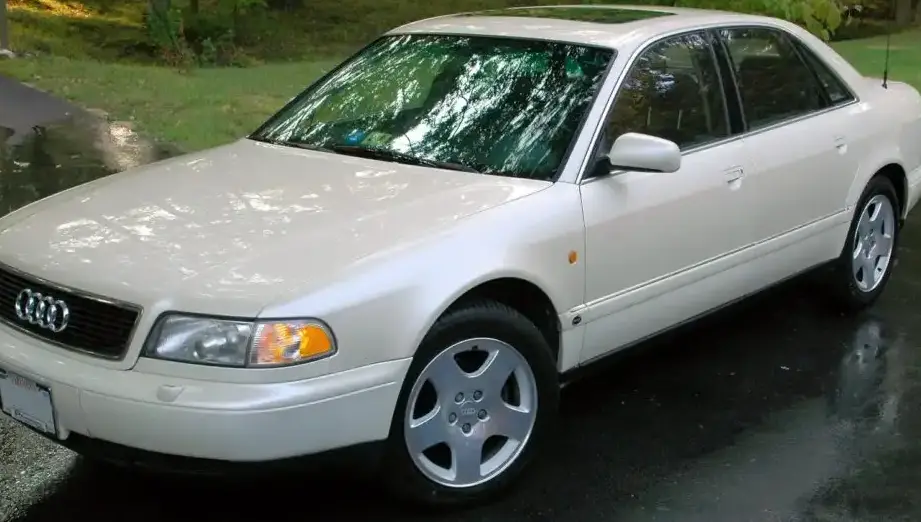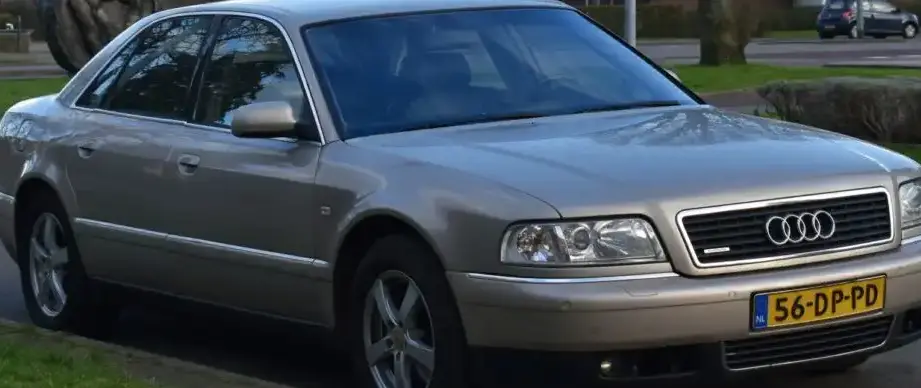
The Audi A8 (D2) 2.8 V6 quattro, produced from 1998 to 2000, represents a significant iteration of Audi’s flagship luxury sedan. This version, part of the facelifted D2 generation (internally designated 4D), offered a compelling blend of performance and refinement, positioned as a mid-range option within the A8 lineup. It slotted between the entry-level 2.8 V6 front-wheel drive model and the more potent 4.2 V8 quattro, appealing to buyers seeking a balance of power, all-weather capability, and a more accessible price point. The D2 A8 was a groundbreaking vehicle for Audi, introducing aluminum construction to a mass-produced luxury car, and the 2.8 V6 quattro continued this tradition while offering a more economical engine choice.
Technical Specifications
| Brand | Audi |
| Model | A8 |
| Generation | A8 (D2, 4D, facelift 1998) |
| Type (Engine) | 2.8 V6 30V (193 Hp) quattro |
| Start of production | 1998 |
| End of production | 2000 |
| Powertrain Architecture | Internal Combustion engine |
| Body type | Sedan |
| Seats | 5 |
| Doors | 4 |
| Fuel consumption (urban) | 15.7 l/100 km (15 US mpg, 18 UK mpg, 6.4 km/l) |
| Fuel consumption (extra urban) | 8.4 l/100 km (28 US mpg, 33.6 UK mpg, 11.9 km/l) |
| Fuel consumption (combined) | 11.1 l/100 km (21.2 US mpg, 25.4 UK mpg, 9 km/l) |
| CO2 emissions | 266 g/km |
| Fuel Type | Petrol (Gasoline) |
| Acceleration 0 – 100 km/h | 8.5 sec |
| Acceleration 0 – 62 mph | 8.5 sec |
| Acceleration 0 – 60 mph | 8.1 sec |
| Maximum speed | 235 km/h (146.02 mph) |
| Emission standard | Euro 3 |
| Weight-to-power ratio | 8.4 kg/Hp, 119.1 Hp/tonne |
| Weight-to-torque ratio | 5.8 kg/Nm, 172.8 Nm/tonne |
| Power | 193 Hp @ 6000 rpm |
| Power per litre | 69.6 Hp/l |
| Torque | 280 Nm @ 3200 rpm (206.52 lb.-ft. @ 3200 rpm) |
| Engine layout | Front, Longitudinal |
| Engine Model/Code | ALG, AQD |
| Engine displacement | 2771 cm3 (169.1 cu. in.) |
| Number of cylinders | 6 |
| Engine configuration | V-engine |
| Cylinder Bore | 82.5 mm (3.25 in.) |
| Piston Stroke | 86.4 mm (3.4 in.) |
| Compression ratio | 10.6:1 |
| Number of valves per cylinder | 5 |
| Fuel injection system | Multi-port manifold injection |
| Engine aspiration | Naturally aspirated engine |
| Valvetrain | DOHC |
| Engine oil capacity | 5 l (5.28 US qt | 4.4 UK qt) |
| Coolant capacity | 11 l (11.62 US qt | 9.68 UK qt) |
| Kerb Weight | 1620 kg (3571.49 lbs.) |
| Max. weight | 2220 kg (4894.26 lbs.) |
| Max load | 600 kg (1322.77 lbs.) |
| Trunk (boot) space (minimum) | 525 l (18.54 cu. ft.) |
| Fuel tank capacity | 80 l (21.13 US gal | 17.6 UK gal) |
| Max. roof load | 100 kg (220.46 lbs.) |
| Permitted trailer load (8%) | 2100 kg (4629.71 lbs.) |
| Permitted trailer load (12%) | 1900 kg (4188.78 lbs.) |
| Permitted trailer load (without brakes) | 750 kg (1653.47 lbs.) |
| Permitted towbar download | 95 kg (209.44 lbs.) |
| Length | 5034 mm (198.19 in.) |
| Width | 1880 mm (74.02 in.) |
| Width including mirrors | 1973 mm (77.68 in.) |
| Height | 1438 mm (56.61 in.) |
| Wheelbase | 2880 mm (113.39 in.) |
| Front track | 1597 mm (62.87 in.) |
| Rear track | 1586 mm (62.44 in.) |
| Front overhang | 1018 mm (40.08 in.) |
| Rear overhang | 1136 mm (44.72 in.) |
| Drag coefficient (Cd) | 0.30 |
| Minimum turning circle | 12.3 m (40.35 ft.) |
| Drivetrain Architecture | ICE driving all four wheels permanently |
| Drive wheel | All wheel drive (4×4) |
| Number of gears | 5 |
| Gearbox type | Manual transmission |
| Front suspension | Independent multi-link, Transverse stabilizer |
| Rear suspension | Independent on trapezoidal lever, Transverse stabilizer |
| Front brakes | Ventilated discs |
| Rear brakes | Ventilated discs |
| Assisting systems | ABS (Anti-lock braking system) |
| Steering type | Steering rack and pinion |
| Power steering | Hydraulic |
| Tires size | 225/60 R16 |
| Wheel rims size | 7J x 16 |
Powertrain & Engine Architecture
The 2.8 V6 engine, utilizing either the ALG or AQD engine code depending on the specific market and year, is a naturally aspirated, 2.8-liter (2771 cc) V6. It features a 90-degree V-angle, contributing to a smoother engine operation. The engine employs a five-valve-per-cylinder (DOHC) configuration, enhancing volumetric efficiency. Fuel delivery is managed by a multi-port fuel injection system. This engine produced 193 horsepower at 6000 rpm and 280 Nm (206.52 lb-ft) of torque at 3200 rpm. The engine is longitudinally mounted in the front of the vehicle, driving all four wheels through Audi’s Torsen quattro all-wheel-drive system. The transmission is a 5-speed manual, offering precise gear changes and a more engaging driving experience compared to the automatic options available on other A8 variants.
Driving Characteristics
The 2.8 V6 quattro offered a balanced driving experience. While not as overtly powerful as the 4.2 V8, it provided ample power for comfortable cruising and confident overtaking. The 0-60 mph acceleration time of around 8.1 seconds was respectable for the era. The manual transmission allowed for greater driver control, and the quattro all-wheel-drive system provided excellent traction in all weather conditions. The gear ratios were tuned for a blend of performance and fuel economy, with a relatively tall fifth gear for relaxed highway driving. Compared to the automatic versions of the 2.8, the manual offered a more direct connection to the engine and a more sporty feel.
Equipment & Trim Levels
The 2.8 V6 quattro typically came well-equipped, reflecting Audi’s luxury positioning. Standard features included leather upholstery, power-adjustable front seats, automatic climate control, a premium sound system, and alloy wheels. Options included a sunroof, navigation system, upgraded leather, and wood trim. The interior design was characterized by a clean, elegant aesthetic, with a focus on ergonomics and build quality. The A8’s interior was a significant step up in terms of materials and design compared to its predecessor.
Chassis & Braking
The A8 D2 featured an advanced chassis design, incorporating four-link front suspension and a trapezoidal-link rear suspension. This setup provided a comfortable ride while maintaining good handling characteristics. The 2.8 V6 quattro was equipped with ventilated disc brakes on all four wheels, providing ample stopping power. Anti-lock braking system (ABS) was standard. The suspension was tuned to balance comfort and handling, offering a more compliant ride than the sportier S8 model.
Market Reception & Comparison
The Audi A8 2.8 V6 quattro was generally well-received by automotive critics. It was praised for its comfortable ride, refined interior, and all-weather capability. However, some critics noted that the 2.8 V6 engine lacked the outright performance of the 4.2 V8. Compared to the 4.2 V8, the 2.8 offered better fuel economy and lower running costs. The manual transmission version was favored by enthusiasts for its more engaging driving experience. Against competitors like the BMW 7 Series and Mercedes-Benz S-Class, the A8 offered a unique combination of aluminum construction, quattro all-wheel drive, and a modern interior design.
Legacy
The Audi A8 D2 2.8 V6 quattro remains a desirable used car today, particularly among enthusiasts who appreciate its blend of luxury, performance, and all-weather capability. The 2.8 V6 engine is generally considered reliable, although regular maintenance is essential. The quattro all-wheel-drive system is known for its durability. Common issues include age-related wear and tear on suspension components and potential electrical gremlins. The D2 A8’s innovative aluminum construction continues to be a talking point, and the car is remembered as a pioneering vehicle in the luxury sedan segment.