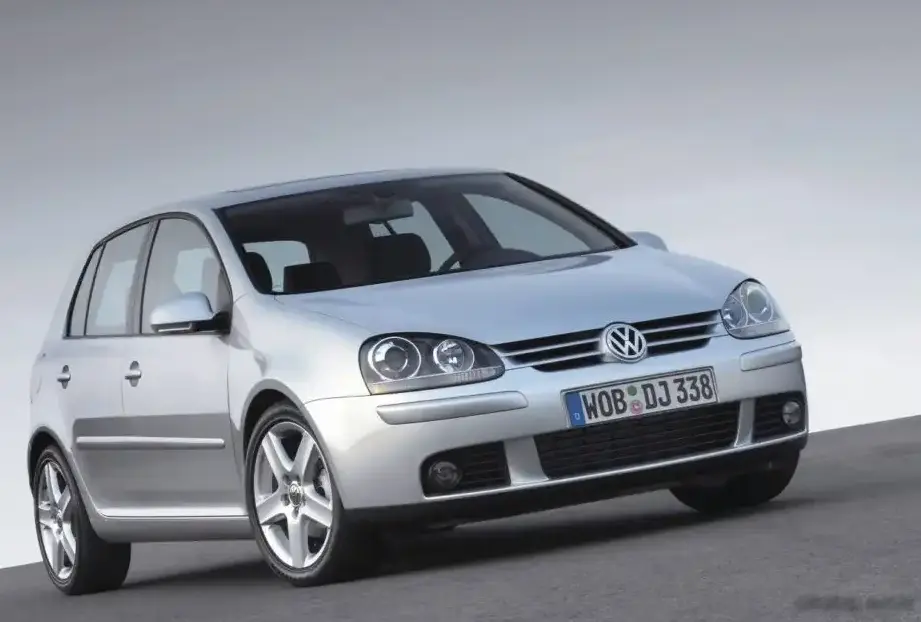
The Volkswagen Golf Mk5, produced from late 2003 through 2009, represented a significant leap forward for Volkswagen’s iconic hatchback. Among the numerous engine and transmission combinations offered, the 1.9 TDI with 105 horsepower coupled to the Direct-Shift Gearbox (DSG) held a prominent position, particularly in European markets. This variant, available from March 2004 to August 2008, offered a blend of fuel efficiency, practicality, and modern transmission technology, appealing to a broad range of buyers. It was positioned as a mid-range offering, bridging the gap between the base petrol engines and the more powerful, higher-trim TDI models.
Technical Specifications
| Brand | Volkswagen |
| Model | Golf |
| Generation | Golf V (5-door) |
| Type (Engine) | 1.9 TDI (105 Hp) DSG |
| Start of production | March, 2004 |
| End of production | August, 2008 |
| Powertrain Architecture | Internal Combustion engine |
| Body type | Hatchback |
| Seats | 5 |
| Doors | 5 |
| Fuel consumption (urban) | 7.3-7.5 l/100 km (32.2 – 31.4 US mpg, 38.7 – 37.7 UK mpg, 13.7 – 13.3 km/l) |
| Fuel consumption (extra urban) | 4.6-4.8 l/100 km (51.1 – 49 US mpg, 61.4 – 58.9 UK mpg, 21.7 – 20.8 km/l) |
| Fuel consumption (combined) | 5.6-5.8 l/100 km (42 – 40.6 US mpg, 50.4 – 48.7 UK mpg, 17.9 – 17.2 km/l) |
| CO2 emissions | 151-157 g/km |
| Fuel Type | Diesel |
| Acceleration 0 – 100 km/h | 11.2 sec |
| Acceleration 0 – 62 mph | 11.2 sec |
| Acceleration 0 – 60 mph | 10.6 sec |
| Maximum speed | 185 km/h (114.95 mph) |
| Emission standard | Euro 4 |
| Weight-to-power ratio | 12.7 kg/Hp, 78.6 Hp/tonne |
| Weight-to-torque ratio | 5.3 kg/Nm, 187.1 Nm/tonne |
| Power | 105 Hp @ 4000 rpm |
| Power per litre | 55.4 Hp/l |
| Torque | 250 Nm @ 1900 rpm (184.39 lb.-ft. @ 1900 rpm) |
| Engine layout | Front, Transverse |
| Engine Model/Code | EA188 / BJB, BKC, BXE |
| Engine displacement | 1896 cm3 (115.7 cu. in.) |
| Number of cylinders | 4 |
| Engine configuration | Inline |
| Cylinder Bore | 79.5 mm (3.13 in.) |
| Piston Stroke | 95.5 mm (3.76 in.) |
| Compression ratio | 19:1 |
| Number of valves per cylinder | 2 |
| Fuel injection system | Pump-nozzle (Unit Injector) |
| Engine aspiration | Turbocharger, Intercooler |
| Valvetrain | SOHC |
| Engine oil capacity | 3.8 l (4.02 US qt | 3.34 UK qt) |
| Coolant | 8 l (8.45 US qt | 7.04 UK qt) |
| Kerb Weight | 1336 kg (2945.38 lbs.) |
| Max. weight | 1880 kg (4144.69 lbs.) |
| Max load | 544 kg (1199.31 lbs.) |
| Trunk (boot) space – minimum | 350 l (12.36 cu. ft.) |
| Trunk (boot) space – maximum | 1305 l (46.09 cu. ft.) |
| Fuel tank capacity | 55 l (14.53 US gal | 12.1 UK gal) |
| Max. roof load | 75 kg (165.35 lbs.) |
| Permitted trailer load with brakes (8%) | 1700 kg (3747.86 lbs.) |
| Permitted trailer load with brakes (12%) | 1400 kg (3086.47 lbs.) |
| Permitted trailer load without brakes | 680 kg (1499.14 lbs.) |
| Permitted towbar download | 75 kg (165.35 lbs.) |
| Length | 4204 mm (165.51 in.) |
| Width | 1759 mm (69.25 in.) |
| Width including mirrors | 2010 mm (79.13 in.) |
| Height | 1485 mm (58.46 in.) |
| Wheelbase | 2578 mm (101.5 in.) |
| Front track | 1539 mm (60.59 in.) |
| Rear track | 1528 mm (60.16 in.) |
| Front overhang | 880 mm (34.65 in.) |
| Rear overhang | 746 mm (29.37 in.) |
| Minimum turning circle | 10.9 m (35.76 ft.) |
| Front suspension | Independent, type McPherson with coil spring and anti-roll bar |
| Rear suspension | Independent multi-link spring suspension with stabilizer |
| Front brakes | Ventilated discs |
| Rear brakes | Disc |
| Gearbox | 6 gears, automatic transmission DSG |
INTRODUCTION
The Golf Mk5, launched in 2003, represented a significant evolution of Volkswagen’s best-selling model. Built on the A5 platform (also known as the 1HX0 platform), it offered improved refinement, build quality, and technology compared to its predecessor. The 1.9 TDI 105 hp DSG variant was a key component of the Mk5’s success, particularly in Europe where diesel engines were – and continue to be – highly popular. This configuration provided a compelling balance of fuel economy, reasonable performance, and the convenience of an automatic transmission, making it a practical choice for daily commuting and long-distance travel.
Powertrain & Engine Architecture
The heart of this Golf variant is the 1.9-liter inline-four cylinder diesel engine, specifically the EA188 engine family, with common engine codes being BJB, BKC, and BXE. This engine utilizes a pump-nozzle (unit injector) fuel injection system, a technology known for its precision and efficiency. The engine features a single overhead camshaft (SOHC) valvetrain operating two valves per cylinder. A turbocharger with an intercooler is employed to boost power and torque. The 105 horsepower output is achieved at 4000 rpm, while the peak torque of 250 Nm (184 lb-ft) is available from a low 1900 rpm, providing strong pulling power. The engine is transversely mounted in the front of the vehicle.
The DSG (Direct-Shift Gearbox) is a six-speed automated manual transmission. It essentially combines the efficiency of a manual gearbox with the convenience of an automatic. Two clutches are used; one for odd-numbered gears and one for even-numbered gears. This allows for incredibly fast and smooth gear changes, enhancing both performance and driving experience. The DSG’s programming is tuned for fuel efficiency in this 105 hp application, prioritizing smooth shifts and maintaining the engine in its optimal power band.
Driving Characteristics
The 1.9 TDI 105 hp DSG Golf Mk5 delivers a competent, if not exhilarating, driving experience. Acceleration from 0-60 mph takes around 10.6 seconds, and the top speed is 115 mph. The DSG transmission contributes to a responsive feel, with quick shifts and minimal torque interruption. Compared to the manual transmission versions of the same engine, the DSG offers greater ease of use, particularly in urban traffic. However, it doesn’t quite match the engagement and directness of a traditional manual. Compared to the more powerful TDI variants (like the 140 hp or 170 hp versions), this 105 hp model feels less urgent, but its strong low-end torque makes it well-suited for everyday driving. The gear ratios are optimized for fuel economy and smooth cruising, rather than outright performance.
Equipment & Trim Levels
The 1.9 TDI 105 hp DSG typically came equipped with a reasonable level of standard features. These included central locking, electric front windows, power steering, an ABS anti-lock braking system, and a basic audio system. Trim levels varied by market, but common options included alloy wheels, air conditioning, a multi-function steering wheel, and upgraded upholstery. Higher trim levels might also offer features like automatic climate control, a CD changer, and parking sensors. Interior upholstery was typically cloth, with options for upgraded materials on higher-spec models. The dashboard layout was functional and well-designed, typical of Volkswagen interiors of the period.
Chassis & Braking
The Golf Mk5 features an independent suspension setup, with a McPherson strut front suspension and a multi-link rear suspension. This provides a comfortable ride and good handling characteristics. Stabilizer bars are fitted to both the front and rear axles to reduce body roll. Braking is handled by ventilated discs on the front wheels and solid discs on the rear. ABS (Anti-lock Braking System) is standard. The chassis is tuned to provide a balance between comfort and handling, making it suitable for a wide range of driving conditions. The weight distribution is relatively even, contributing to predictable handling.
Market Reception & Comparison
The 1.9 TDI 105 hp DSG Golf Mk5 was generally well-received by automotive critics. It was praised for its fuel efficiency, comfortable ride, and the convenience of the DSG transmission. However, some critics noted that the engine lacked outright power, particularly when compared to the more potent TDI variants. In terms of fuel economy, this variant consistently outperformed the petrol-powered Golfs, offering significantly better miles per gallon. Reliability was generally good, although the DSG transmission could be prone to issues if not properly maintained. Compared to competitors like the Ford Focus and Opel Astra, the Golf Mk5 was often seen as offering a more refined and sophisticated driving experience.
Legacy
The 1.9 TDI engine, in various iterations, proved to be remarkably durable and reliable. The DSG transmission, while requiring periodic maintenance (fluid changes are crucial), also demonstrated good longevity when properly cared for. Today, the Golf Mk5 1.9 TDI 105 hp DSG can be found on the used car market at relatively affordable prices. It remains a popular choice for those seeking a fuel-efficient, practical, and well-built hatchback. However, potential buyers should be aware of the potential maintenance costs associated with the DSG transmission and ensure that the vehicle has been properly serviced throughout its life. Its enduring popularity is a testament to the quality of engineering and the overall package offered by this particular Golf variant.