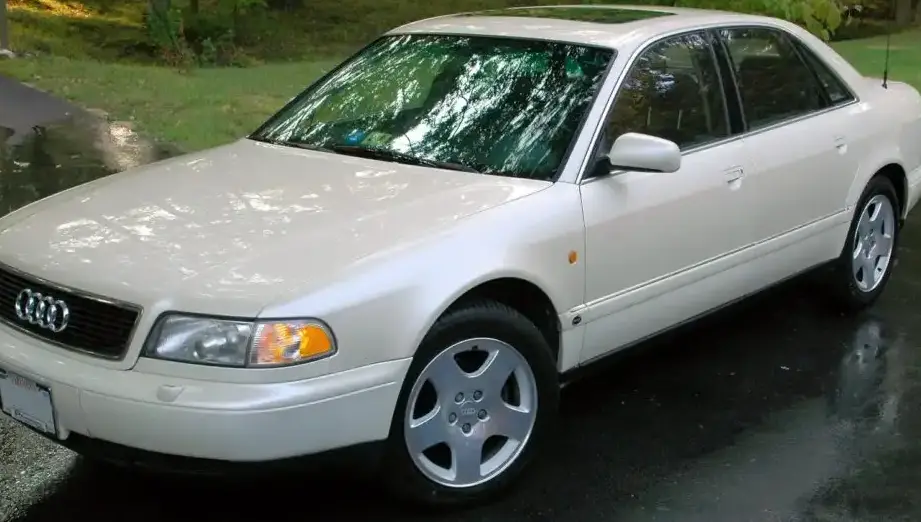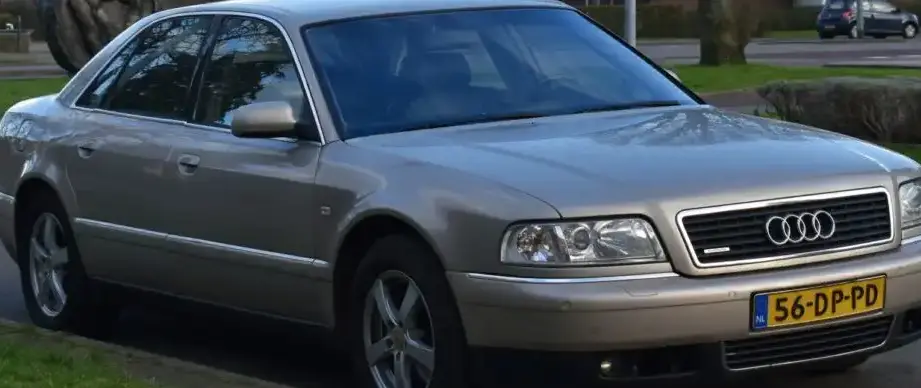
The Audi A8 (D2) 3.3 TDI, produced from 1999 to 2002, represented a significant offering in the luxury sedan segment, particularly in European markets. This variant, equipped with the AKF engine code and a five-speed Tiptronic automatic transmission, occupied a middle ground within the D2 A8 lineup, positioned between the entry-level petrol engines and the higher-performance, larger displacement models. The D2 A8, launched in 1994 and facelifted in 1998, was Audi’s flagship, showcasing advanced technology for its time, including all-aluminum construction for the chassis – a first in mass production – and a sophisticated quattro all-wheel-drive system. The 3.3 TDI aimed to provide a balance of performance, fuel efficiency, and refinement for discerning buyers.
Technical Specifications
| Brand | Audi |
| Model | A8 |
| Generation | A8 (D2, 4D, facelift 1998) |
| Type (Engine) | 3.3 TDI V8 (225 Hp) tiptronic |
| Start of production | 1999 |
| End of production | 2002 |
| Powertrain Architecture | Internal Combustion engine |
| Body type | Sedan |
| Seats | 5 |
| Doors | 4 |
| Fuel consumption (economy) – urban (NEDC) | 13.8 l/100 km (17 US mpg, 20.5 UK mpg, 7.2 km/l) |
| Fuel consumption (economy) – extra urban (NEDC) | 7.3 l/100 km (32.2 US mpg, 38.7 UK mpg, 13.7 km/l) |
| Fuel consumption (economy) – combined (NEDC) | 9.7 l/100 km (24.2 US mpg, 29.1 UK mpg, 10.3 km/l) |
| CO2 emissions (NEDC) | 261 g/km |
| Fuel Type | Diesel |
| Acceleration 0 – 100 km/h | 8.2 sec |
| Acceleration 0 – 62 mph | 8.2 sec |
| Acceleration 0 – 60 mph | 7.8 sec |
| Maximum speed | 242 km/h (150.37 mph) |
| Emission standard | Euro 3 |
| Weight-to-power ratio | 8.3 kg/Hp, 121 Hp/tonne |
| Weight-to-torque ratio | 3.9 kg/Nm, 258.1 Nm/tonne |
| Power | 225 Hp @ 4000 rpm |
| Power per litre | 67.6 Hp/l |
| Torque | 480 Nm @ 1800-3000 rpm (354.03 lb.-ft. @ 1800-3000 rpm) |
| Engine layout | Front, Longitudinal |
| Engine Model/Code | AKF |
| Engine displacement | 3328 cm3 (203.09 cu. in.) |
| Number of cylinders | 8 |
| Engine configuration | V-engine |
| Cylinder Bore | 78.3 mm (3.08 in.) |
| Piston Stroke | 86.4 mm (3.4 in.) |
| Compression ratio | 18.5:1 |
| Number of valves per cylinder | 4 |
| Fuel injection system | Diesel Commonrail |
| Engine aspiration | BiTurbo, Intercooler |
| Valvetrain | DOHC |
| Engine oil capacity | 6.1 l (6.45 US qt, 5.37 UK qt) |
| Coolant | 14.3 l (15.11 US qt, 12.58 UK qt) |
| Kerb Weight | 1860 kg (4100.6 lbs.) |
| Max. weight | 2460 kg (5423.37 lbs.) |
| Max load | 600 kg (1322.77 lbs.) |
| Trunk (boot) space – minimum | 525 l (18.54 cu. ft.) |
| Fuel tank capacity | 90 l (23.78 US gal, 19.8 UK gal) |
| Max. roof load | 100 kg (220.46 lbs.) |
| Permitted trailer load with brakes (8%) | 2300 kg (5070.63 lbs.) |
| Permitted trailer load with brakes (12%) | 2300 kg (5070.63 lbs.) |
| Permitted trailer load without brakes | 750 kg (1653.47 lbs.) |
| Permitted towbar download | 95 kg (209.44 lbs.) |
| Length | 5034 mm (198.19 in.) |
| Width | 1880 mm (74.02 in.) |
| Width including mirrors | 1973 mm (77.68 in.) |
| Height | 1438 mm (56.61 in.) |
| Wheelbase | 2882 mm (113.46 in.) |
| Front track | 1591 mm (62.64 in.) |
| Rear (Back) track | 1580 mm (62.2 in.) |
| Drag coefficient (Cd) | 0.29 |
| Minimum turning circle (turning diameter) | 12.3 m (40.35 ft.) |
| Drivetrain Architecture | The Internal combustion engine (ICE) drives permanently the four wheels of the vehicle. |
| Drive wheel | All wheel drive (4×4) |
| Number of gears and type of gearbox | 5 gears, automatic transmission tiptronic |
| Front suspension | Independent multi-link suspension, Transverse stabilizer |
| Rear suspension | Independent on trapezoidal lever, Transverse stabilizer |
| Front brakes | Ventilated discs |
| Rear brakes | Ventilated discs |
| Assisting systems | ABS (Anti-lock braking system) |
| Steering type | Steering rack and pinion |
| Power steering | Hydraulic Steering |
| Tires size | 225/60 R16 |
| Wheel rims size | 7.5J x 16 |
INTRODUCTION
The Audi A8 (D2) 3.3 TDI, produced between 1999 and 2002, was a key variant within the second-generation A8 range (internally designated D2, with the 4D representing the facelifted model). It aimed to deliver the luxury and technological sophistication of the A8 platform with the fuel efficiency and torque characteristics of a modern diesel engine. The 3.3 TDI was positioned as a compelling alternative to the petrol-powered A8 models, particularly in Europe where diesel engines were – and continue to be – highly popular. This model benefited from the 1998 facelift, which included revised styling, improved interior materials, and updated technology.
Powertrain & Engine Architecture
At the heart of the A8 3.3 TDI lies the AKF engine, a 3.3-liter V8 diesel engine. This engine utilized a sophisticated common rail direct injection system, delivering fuel directly into the cylinders at extremely high pressure for improved combustion efficiency and reduced emissions. The AKF engine featured twin turbochargers with an intercooler, boosting power output to 225 horsepower at 4000 rpm and a substantial 480 Nm (354 lb-ft) of torque available from 1800 to 3000 rpm. The engine employed a double overhead camshaft (DOHC) valvetrain with four valves per cylinder. The Tiptronic five-speed automatic transmission allowed for both fully automatic operation and manual gear selection, providing drivers with greater control. The transmission was designed to handle the high torque output of the diesel V8 and offered smooth, refined shifts.
Driving Characteristics
The A8 3.3 TDI offered a distinctly different driving experience compared to its petrol-powered siblings. While lacking the outright acceleration of the larger displacement engines, the 3.3 TDI excelled in providing effortless cruising and strong mid-range acceleration. The high torque output meant that overtaking maneuvers were executed with ease, and the car felt remarkably composed even when fully loaded. The Tiptronic transmission, while smooth, wasn’t as responsive as a manual gearbox, but it suited the car’s character as a luxurious grand tourer. The gear ratios were optimized for fuel efficiency and relaxed highway driving. Compared to the 2.8L petrol version, the 3.3 TDI offered significantly more torque, resulting in a more relaxed driving experience, especially on long journeys.
Equipment & Trim Levels
The A8 3.3 TDI typically came well-equipped, reflecting its position as a luxury vehicle. Standard features included leather upholstery, automatic climate control, power-adjustable front seats with memory function, a premium sound system, and a multi-function steering wheel. The D2 A8 was also notable for its advanced safety features, including ABS, traction control, and multiple airbags. Optional extras included a navigation system, upgraded leather trim, rear seat entertainment, and a sunroof. The interior trim levels varied, with options for wood veneer or aluminum accents.
Chassis & Braking
The A8’s groundbreaking all-aluminum space frame chassis contributed significantly to its lightweight construction and exceptional rigidity. This resulted in improved handling and ride comfort. The 3.3 TDI variant featured independent multi-link suspension at the front and an independent trapezoidal lever suspension at the rear, both with transverse stabilizers to reduce body roll. Braking duties were handled by ventilated discs on all four wheels, providing ample stopping power. The quattro all-wheel-drive system distributed power between the front and rear axles as needed, enhancing traction and stability in all weather conditions.
Market Reception & Comparison
The A8 3.3 TDI was generally well-received by automotive critics, who praised its refined engine, comfortable ride, and luxurious interior. However, some reviewers noted that the Tiptronic transmission could feel slightly sluggish at times. Compared to the petrol-powered A8 models, the 3.3 TDI offered significantly better fuel economy, making it a more practical choice for high-mileage drivers. Against competitors like the BMW 730d and Mercedes-Benz S320 CDI, the A8 3.3 TDI held its own, offering a compelling combination of performance, luxury, and technology. Reliability was generally good, although the complex common rail injection system required careful maintenance.
Legacy
The Audi A8 (D2) 3.3 TDI remains a sought-after classic among enthusiasts. The AKF engine, while complex, is known for its durability when properly maintained. Today, these cars are relatively affordable on the used market, but finding well-maintained examples can be challenging. The all-aluminum chassis and advanced technology of the D2 A8 continue to impress, and the 3.3 TDI variant offers a unique blend of luxury, performance, and fuel efficiency that still feels relevant today. Parts availability can be an issue, but a dedicated community of A8 owners and specialists exists to provide support and expertise.