Technical Specifications
| Brand | Hyundai |
| Model | i30 |
| Generation | i30 II CW (facelift 2015) |
| Type (Engine) | 1.6 CRDi (136 Hp) DCT |
| Start of production | 2015 |
| End of production | 2017 |
| Powertrain Architecture | Internal Combustion engine |
| Body type | Station wagon (estate) |
| Seats | 5 |
| Doors | 5 |
| Fuel consumption (urban) | 4.6 l/100 km (51.1 US mpg, 61.4 UK mpg, 21.7 km/l) |
| Fuel consumption (extra urban) | 3.9 l/100 km (60.3 US mpg, 72.4 UK mpg, 25.6 km/l) |
| Fuel consumption (combined) | 4.2 l/100 km (56 US mpg, 67.3 UK mpg, 23.8 km/l) |
| CO2 emissions | 109 g/km |
| Fuel Type | Diesel |
| Acceleration 0 – 100 km/h | 10.9 sec |
| Acceleration 0 – 62 mph | 10.9 sec |
| Acceleration 0 – 60 mph | 10.4 sec |
| Maximum speed | 197 km/h (122.41 mph) |
| Emission standard | Euro 6 |
| Weight-to-power ratio | 11 kg/Hp, 90.9 Hp/tonne |
| Weight-to-torque ratio | 5 kg/Nm, 200.5 Nm/tonne |
| Power | 136 Hp @ 4000 rpm |
| Power per litre | 86 Hp/l |
| Torque | 300 Nm @ 1750-2500 rpm (221.27 lb.-ft. @ 1750-2500 rpm) |
| Engine layout | Front, Transverse |
| Engine Model/Code | D4FB |
| Engine displacement | 1582 cm3 (96.54 cu. in.) |
| Number of cylinders | 4 |
| Engine configuration | Inline |
| Cylinder Bore | 77.2 mm (3.04 in.) |
| Piston Stroke | 84.5 mm (3.33 in.) |
| Compression ratio | 16:1 |
| Number of valves per cylinder | 4 |
| Fuel injection system | Diesel Commonrail |
| Engine aspiration | Turbocharger, Intercooler |
| Valvetrain | DOHC |
| Engine oil capacity | 5.3 l (5.6 US qt | 4.66 UK qt) |
| Coolant | 6.9 l (7.29 US qt | 6.07 UK qt) |
| Kerb Weight | 1496 kg (3298.12 lbs.) |
| Max. weight | 1940 kg (4276.97 lbs.) |
| Max load | 444 kg (978.85 lbs.) |
| Trunk (boot) space – minimum | 528 l (18.65 cu. ft.) |
| Trunk (boot) space – maximum | 1642 l (57.99 cu. ft.) |
| Fuel tank capacity | 53 l (14 US gal | 11.66 UK gal) |
| Max. roof load | 80 kg (176.37 lbs.) |
| Permitted trailer load with brakes (12%) | 1400 kg (3086.47 lbs.) |
| Permitted trailer load without brakes | 650 kg (1433 lbs.) |
| Permitted towbar download | 75 kg (165.35 lbs.) |
| Length | 4485 mm (176.57 in.) |
| Width | 1780 mm (70.08 in.) |
| Height | 1495 mm (58.86 in.) |
| Wheelbase | 2650 mm (104.33 in.) |
| Front track | 1549-1555 mm (60.98 – 61.22 in.) |
| Rear (Back) track | 1557-1563 mm (61.3 – 61.54 in.) |
| Ride height (ground clearance) | 135 mm (5.31 in.) |
| Minimum turning circle (turning diameter) | 10.6 m (34.78 ft.) |
| Drivetrain Architecture | The Internal combustion engine (ICE) drives the front wheels of the vehicle. |
| Drive wheel | Front wheel drive |
| Number of gears and type of gearbox | 7 gears, automatic transmission DCT |
| Front suspension | Independent, type McPherson with coil spring and anti-roll bar |
| Rear suspension | Independent multi-link suspension |
| Front brakes | Ventilated discs |
| Rear brakes | Disc |
| Assisting systems | ABS (Anti-lock braking system) |
| Steering type | Steering rack and pinion |
| Power steering | Electric Steering |
| Tires size | 225/45 R17 |
| Wheel rims size | 7.0J x 17 |
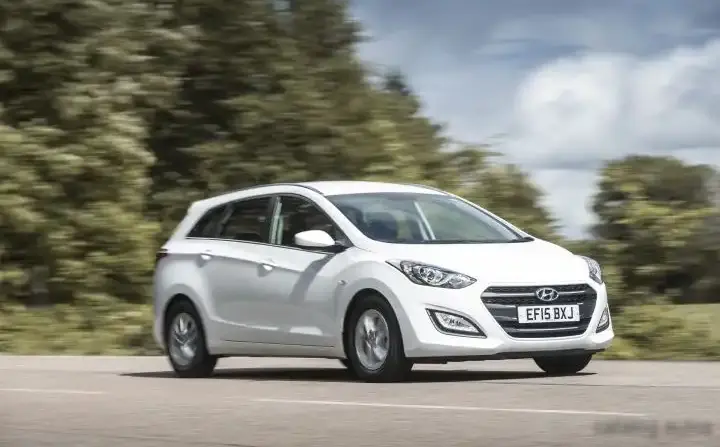
The Hyundai i30 II CW (facelift 2015) 1.6 CRDi 136 Hp DCT is a compact estate car produced between 2015 and 2017. It represents a significant offering in the station wagon segment, falling within the second generation of the i30 (GD platform) after receiving a mid-cycle refresh. Positioned as a practical and fuel-efficient option, this variant aimed to attract buyers seeking a versatile vehicle with modern technology. The “CW” designation specifically denotes the wagon body style, providing increased cargo space compared to the hatchback version. This particular configuration, combining the 1.6-liter CRDi diesel engine with a seven-speed dual-clutch transmission (DCT), was a key component of Hyundai’s strategy to expand the i30’s appeal in the European market, where diesel-powered estates were particularly popular.
Powertrain & Engine Architecture
The Hyundai i30 CW 1.6 CRDi DCT is powered by the D4FB 1.6-liter four-cylinder diesel engine. This engine, part of Hyundai-Kia’s ‘U’ engine family, utilizes a common-rail direct injection system, delivering fuel at high pressure for optimized combustion efficiency. The D4FB is turbocharged, employing a variable geometry turbocharger (VGT) to improve low-end torque and responsiveness. An intercooler further cools the intake air, increasing air density and boosting power output. The engine features a double overhead camshaft (DOHC) valvetrain with four valves per cylinder, contributing to efficient gas exchange. The engine is paired with a seven-speed dual-clutch transmission (DCT). This DCT offers quicker and smoother gear changes compared to a traditional automatic transmission, enhancing both performance and fuel economy. The DCT operates with two separate clutches, pre-selecting the next gear for seamless transitions.
Driving Characteristics
The 136 horsepower and 300 Nm (221 lb-ft) of torque provided a balanced driving experience. While not designed for outright sportiness, the i30 CW 1.6 CRDi DCT offered sufficient power for everyday driving and comfortable highway cruising. The DCT transmission contributed to brisk acceleration, achieving a 0-60 mph time of around 10.4 seconds. Compared to the base 1.4-liter gasoline engine, the 1.6 CRDi delivered significantly more torque, resulting in stronger pulling power, especially when carrying passengers or cargo. Compared to higher-output diesel variants, this version prioritized fuel economy over peak performance. The DCT’s gear ratios were tuned for efficiency, maintaining relatively low engine speeds during cruising, which further enhanced fuel savings. The steering was light and precise, making it easy to maneuver in urban environments.
Equipment & Trim Levels
The i30 II CW 1.6 CRDi DCT typically came equipped with a respectable array of standard features. These included air conditioning, power windows, central locking, a touchscreen infotainment system with Bluetooth connectivity, and alloy wheels. Safety features such as ABS, Electronic Stability Control (ESC), and multiple airbags were also standard. Higher trim levels offered additional features like a panoramic sunroof, leather upholstery, heated seats, and a more advanced infotainment system with navigation. The “Blue” trim level often indicated a focus on fuel efficiency and value, potentially omitting some of the more luxurious options.
Chassis & Braking
The i30 CW featured a front-wheel-drive configuration with an independent McPherson strut suspension at the front and an independent multi-link suspension at the rear. This setup provided a good balance between ride comfort and handling. The front brakes were ventilated discs, offering good stopping power, while the rear brakes were solid discs. The suspension was tuned to prioritize comfort, but still provided adequate body control during cornering. Stabilizer bars were fitted to both the front and rear axles to minimize body roll.
Market Reception & Comparison
The Hyundai i30 II CW 1.6 CRDi DCT was generally well-received by automotive critics. It was praised for its fuel efficiency, spacious interior, and comfortable ride quality. The DCT transmission was also noted as a positive feature, providing smooth and quick gear changes. Compared to competitors like the Volkswagen Golf Estate and Ford Focus Estate, the i30 offered a competitive price point and a generous warranty. However, some critics noted that the interior materials weren’t quite as premium as those found in some of its rivals. The fuel economy of around 56 mpg combined was a significant selling point, making it an attractive option for drivers covering long distances.
Legacy
The D4FB engine, while generally reliable, has been known to experience issues with the diesel particulate filter (DPF) if not regularly driven on longer journeys. The DCT transmission, while advanced, can require more specialized maintenance compared to a traditional automatic. Today, the i30 II CW 1.6 CRDi DCT represents a solid used car option, offering good value for money and reasonable running costs. Its practicality and fuel efficiency continue to make it a popular choice for families and individuals seeking a versatile and economical estate car. Parts availability is generally good, and the i30’s reputation for reliability has helped it maintain a strong presence in the used car market.