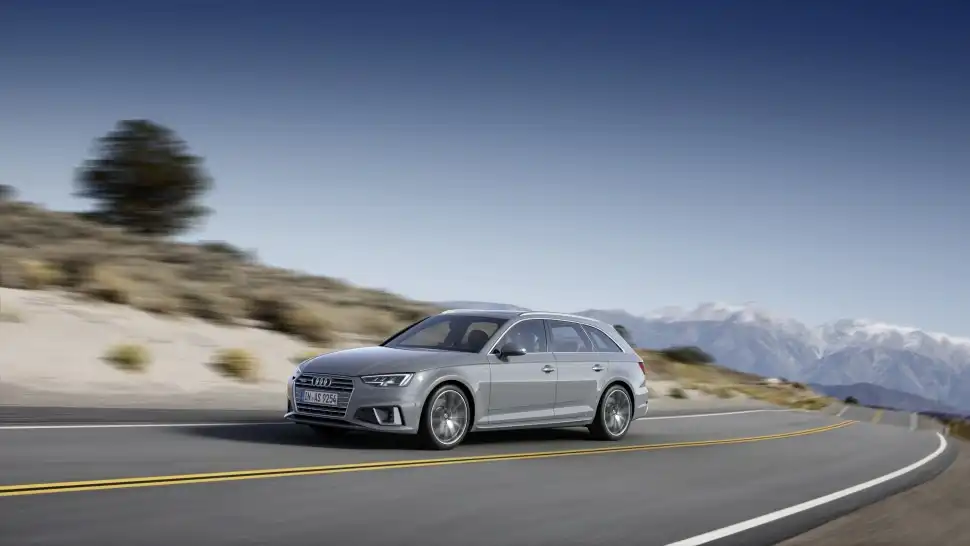
The Audi A4 Avant 30 TDI (122 hp) S tronic, produced from 2018 to 2019, represents a key variant within the B9 (8W) generation of Audi’s popular compact executive estate car. This model, introduced with the facelift of the B9 platform, was designed to offer a balance of fuel efficiency, practicality, and comfort, targeting buyers seeking a versatile family vehicle with lower running costs. Positioned as an entry-level diesel option in the A4 Avant range, it sat below the more powerful 40 TDI and petrol-powered variants, offering a compelling alternative for those prioritizing economy over outright performance. The “30 TDI” designation reflects Audi’s power-based naming convention, indicating a power output within a specific bracket.
Technical Specifications
| Brand | Audi |
| Model | A4 |
| Generation | A4 Avant (B9 8W, facelift 2018) |
| Type (Engine) | 30 TDI (122 Hp) S tronic |
| Start of production | 2018 |
| End of production | 2019 |
| Powertrain Architecture | Internal Combustion engine |
| Body type | Station wagon (estate) |
| Seats | 5 |
| Doors | 5 |
| Fuel consumption (urban) | 4.9-5.0 l/100 km (48-47 US mpg, 57.6-56.5 UK mpg, 20.4-20 km/l) |
| Fuel consumption (extra urban) | 3.8-4.0 l/100 km (61.9-58.8 US mpg, 74.3-70.6 UK mpg, 26.3-25 km/l) |
| Fuel consumption (combined) | 4.2-4.4 l/100 km (56-53.5 US mpg, 67.3-64.2 UK mpg, 23.8-22.7 km/l) |
| CO2 emissions | 111-114 g/km |
| Fuel Type | Diesel |
| Acceleration 0 – 100 km/h | 11 sec |
| Acceleration 0 – 62 mph | 11 sec |
| Acceleration 0 – 60 mph | 10.5 sec |
| Maximum speed | 198 km/h (123.03 mph) |
| Emission standard | Euro 6d – TEMP |
| Weight-to-power ratio | 12.5 kg/Hp, 80.3 Hp/tonne |
| Weight-to-torque ratio | 5.6 kg/Nm, 177.6 Nm/tonne |
| Power | 122 Hp @ 3500-4000 rpm |
| Torque | 270 Nm @ 1500-3000 rpm (199.14 lb.-ft. @ 1500-3000 rpm) |
| Engine layout | Front, Longitudinal |
| Engine Model/Code | DEUC |
| Engine displacement | 1968 cm3 (120.09 cu. in.) |
| Number of cylinders | 4 |
| Engine configuration | Inline |
| Number of valves per cylinder | 4 |
| Fuel injection system | Diesel Commonrail |
| Engine aspiration | Turbocharger, Intercooler |
| Engine oil capacity | 4.7 l (4.97 US qt | 4.14 UK qt) |
| Kerb Weight | 1520 kg (3351.03 lbs.) |
| Max. weight | 2150 kg (4739.94 lbs.) |
| Max load | 630 kg (1388.91 lbs.) |
| Trunk (boot) space – minimum | 505 l (17.83 cu. ft.) |
| Fuel tank capacity | 40 l (10.57 US gal | 8.8 UK gal) |
| Max. roof load | 90 kg (198.42 lbs.) |
| Permitted trailer load with brakes (8%) | 1700 kg (3747.86 lbs.) |
| Permitted trailer load with brakes (12%) | 1500 kg (3306.93 lbs.) |
| Permitted trailer load without brakes | 750 kg (1653.47 lbs.) |
| Permitted towbar download | 80 kg (176.37 lbs.) |
| Length | 4738 mm (186.54 in.) |
| Width | 1842 mm (72.52 in.) |
| Width including mirrors | 2022 mm (79.61 in.) |
| Height | 1435 mm (56.5 in.) |
| Wheelbase | 2820 mm (111.02 in.) |
| Front track | 1572 mm (61.89 in.) |
| Rear (Back) track | 1555 mm (61.22 in.) |
| Front overhang | 880 mm (34.65 in.) |
| Rear overhang | 1038 mm (40.87 in.) |
| Drivetrain Architecture | Front wheel drive |
| Number of gears and type of gearbox | 7 gears, automatic transmission S tronic |
| Front suspension | Independent multi-link suspension |
| Rear suspension | Independent multi-link suspension |
| Front brakes | Ventilated discs |
| Rear brakes | Disc |
| Tires size | 205/60 R16 |
| Wheel rims size | 7J x 16 |
INTRODUCTION
The Audi A4 Avant 30 TDI S tronic, launched in 2018 as part of the B9 facelift, offered a practical and efficient option within the A4 Avant lineup. Built on the Volkswagen Group’s MLB Evo platform (shared with models like the VW Passat and Skoda Superb), the B9 A4 Avant aimed to improve upon its predecessor with enhanced technology, refinement, and fuel economy. The 30 TDI variant specifically targeted buyers seeking a balance between cost-effectiveness and usability, making it a popular choice for families and individuals prioritizing lower running costs. This model year saw updates to the exterior styling, infotainment system, and engine range, solidifying the A4 Avant’s position as a competitive player in the premium compact estate segment.
Powertrain & Engine Architecture
At the heart of the A4 Avant 30 TDI lies the DEUC engine, a 2.0-liter inline-four cylinder diesel engine. This engine is part of Volkswagen Group’s modular engine family, known for its compact dimensions and efficiency. The DEUC utilizes a common rail direct injection system, delivering fuel at extremely high pressures for optimized combustion. A single turbocharger with an intercooler provides forced induction, boosting power and torque. The engine features four valves per cylinder and is longitudinally mounted within the chassis. The S tronic transmission is a seven-speed dual-clutch transmission (DCT) offering quick and smooth gear changes. This transmission is known for its efficiency and responsiveness, contributing to the vehicle’s overall fuel economy. The engine produces 122 horsepower at 3500-4000 rpm and 270 Nm (199 lb-ft) of torque between 1500-3000 rpm.
Driving Characteristics
The A4 Avant 30 TDI S tronic delivers a comfortable and refined driving experience. While not overtly sporty, the engine provides adequate power for everyday driving and highway cruising. The S tronic transmission contributes to brisk acceleration, with the 0-60 mph sprint taking around 10.5 seconds. The gear ratios are tuned for fuel efficiency, with higher gears prioritizing economy at cruising speeds. Compared to the more powerful 40 TDI variant, the 30 TDI feels less urgent in acceleration, but the difference is often negligible in typical driving scenarios. The automatic transmission shifts smoothly and efficiently, minimizing disruptions to the driving experience. The front-wheel-drive configuration provides good traction in most conditions, although it may lack the all-weather capability of the quattro all-wheel-drive system available on higher-spec models.
Equipment & Trim Levels
The A4 Avant 30 TDI S tronic typically came equipped with a generous level of standard features. These included Audi’s MMI infotainment system with a 7-inch touchscreen display, Bluetooth connectivity, and a suite of driver-assistance systems such as lane departure warning and automatic emergency braking. Interior upholstery was typically cloth, with leather options available as an upgrade. Standard trim included aluminum or wood inlays, adding a touch of sophistication to the cabin. Optional extras included a larger touchscreen display, a premium sound system, heated seats, and a panoramic sunroof. The specific trim level (e.g., Sport, Technik, S line) determined the level of standard equipment and available options.
Chassis & Braking
The A4 Avant 30 TDI utilizes an independent multi-link suspension system at both the front and rear axles, providing a comfortable and controlled ride. The suspension is tuned to balance ride comfort with handling precision. The front brakes are ventilated discs, while the rear brakes are solid discs. Anti-lock braking system (ABS) and electronic stability control (ESC) are standard features, enhancing safety and stability. The steering is electric power-assisted, providing a light and responsive feel. The vehicle’s weight distribution is optimized for balanced handling, contributing to its predictable and stable cornering behavior.
Market Reception & Comparison
The A4 Avant 30 TDI S tronic was generally well-received by automotive critics, who praised its fuel efficiency, comfortable ride, and refined interior. It was often compared to rivals such as the BMW 3 Series Touring and Mercedes-Benz C-Class Estate. While the 30 TDI offered competitive fuel economy, it lagged behind some rivals in terms of outright performance. However, its lower price point and lower running costs made it an attractive option for budget-conscious buyers. Reliability reports suggest that the DEUC engine and S tronic transmission are generally reliable, although regular maintenance is essential to prevent potential issues.
Legacy
The Audi A4 Avant 30 TDI S tronic remains a popular choice in the used car market, offering a compelling combination of practicality, efficiency, and refinement. The DEUC engine is known for its durability, and the S tronic transmission, when properly maintained, can provide years of reliable service. These vehicles represent a good value proposition for buyers seeking a premium estate car with low running costs. As with any used vehicle, a thorough inspection and maintenance history check are recommended before purchase. The B9 A4 Avant, and specifically the 30 TDI variant, solidified Audi’s reputation for building high-quality, well-engineered vehicles that appeal to a wide range of buyers.