
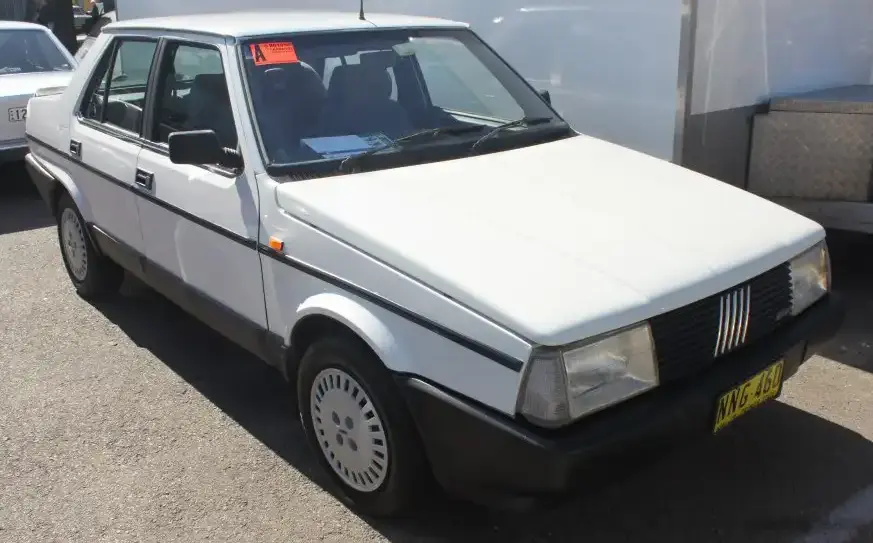
The Fiat Regata 100 Super 1.6, produced between 1983 and 1989, represented a mid-range offering within the Regata (Type 138) lineup. Positioned above the base models and below the more potent versions, the 100 Super aimed to provide a balance of performance, comfort, and fuel efficiency for the European market. The Regata itself was designed as a replacement for the Fiat 131, offering a more modern and spacious sedan option. This particular variant, with its 1.6-liter engine and 100 horsepower output, became a popular choice for drivers seeking a practical and reasonably spirited family car.
Technical Specifications
| Brand | Fiat |
| Model | Regata |
| Generation | Regata (138) |
| Type (Engine) | 100 Super 1.6 (100 Hp) |
| Start of production | 1983 |
| End of production | 1989 |
| Powertrain Architecture | Internal Combustion engine |
| Body type | Sedan |
| Seats | 5 |
| Doors | 4 |
| Fuel consumption (urban) | 10.4 l/100 km (22.6 US mpg, 27.2 UK mpg, 9.6 km/l) |
| Fuel consumption (extra urban) | 5.9 l/100 km (39.9 US mpg, 47.9 UK mpg, 16.9 km/l) |
| Fuel consumption (combined) | 8.1 l/100 km (29 US mpg, 34.9 UK mpg, 12.3 km/l) |
| Fuel Type | Petrol (Gasoline) |
| Acceleration 0 – 100 km/h | 10 sec |
| Acceleration 0 – 62 mph | 10 sec |
| Acceleration 0 – 60 mph | 9.5 sec |
| Maximum speed | 180 km/h (111.85 mph) |
| Weight-to-power ratio | 9.4 kg/Hp, 107 Hp/tonne |
| Weight-to-torque ratio | 7 kg/Nm, 142.2 Nm/tonne |
| Power | 100 Hp @ 5900 rpm |
| Power per litre | 63.1 Hp/l |
| Torque | 133 Nm @ 3800 rpm (98.1 lb.-ft. @ 3800 rpm) |
| Engine layout | Front, Transverse |
| Engine Model/Code | 149 A4.000 |
| Engine displacement | 1585 cm3 (96.72 cu. in.) |
| Number of cylinders | 4 |
| Engine configuration | Rotary (Wankel) |
| Cylinder Bore | 84 mm (3.31 in.) |
| Piston Stroke | 71.5 mm (2.81 in.) |
| Compression ratio | 9.3:1 |
| Number of valves per cylinder | 4 |
| Fuel injection system | Multi-port manifold injection |
| Engine aspiration | Naturally aspirated engine |
| Valvetrain | DOHC |
| Engine oil capacity | 4.6 l (4.86 US qt | 4.05 UK qt) |
| Coolant | 7 l (7.4 US qt | 6.16 UK qt) |
| Kerb Weight | 935 kg (2061.32 lbs.) |
| Max. weight | 1400 kg (3086.47 lbs.) |
| Max load | 465 kg (1025.15 lbs.) |
| Trunk (boot) space – minimum | 513 l (18.12 cu. ft.) |
| Fuel tank capacity | 55 l (14.53 US gal | 12.1 UK gal) |
| Permitted trailer load with brakes (12%) | 1000 kg (2204.62 lbs.) |
| Length | 4260 mm (167.72 in.) |
| Width | 1650 mm (64.96 in.) |
| Height | 1410 mm (55.51 in.) |
| Wheelbase | 2448 mm (96.38 in.) |
| Front track | 1414 mm (55.67 in.) |
| Rear (Back) track | 1412 mm (55.59 in.) |
| Front overhang | 820 mm (32.28 in.) |
| Rear overhang | 992 mm (39.06 in.) |
| Minimum turning circle (turning diameter) | 10.3 m (33.79 ft.) |
| Drivetrain Architecture | The Internal combustion engine (ICE) drives the front wheels of the vehicle. |
| Drive wheel | Front wheel drive |
| Number of gears and type of gearbox | 5 gears, manual transmission |
| Front suspension | Independent, type McPherson with coil spring and anti-roll bar |
| Rear suspension | Leaf spring |
| Front brakes | Disc |
| Rear brakes | Drum |
| Steering type | Steering rack and pinion |
| Power steering | Hydraulic Steering |
| Tires size | 165/65 R14 |
| Wheel rims size | 5.5J x 14 |
Powertrain & Engine Architecture
The heart of the Regata 100 Super was the Fiat 149 A4.000 1.6-liter inline-four cylinder engine. This engine featured a dual overhead camshaft (DOHC) valvetrain operating four valves per cylinder, contributing to its relatively high output for the time. Fuel delivery was handled by a multi-port fuel injection system, a significant upgrade over the carburetors found in earlier Fiat models. The engine produced 100 horsepower at 5900 rpm and 133 Nm (98.1 lb-ft) of torque at 3800 rpm. The engine’s 9.3:1 compression ratio was a compromise between performance and the ability to run on the available fuel grades in European markets. The engine was transversely mounted, driving the front wheels. The Regata 100 Super was typically equipped with a five-speed manual transmission, although an optional three-speed automatic transmission was available, albeit less common.
Driving Characteristics
The Regata 100 Super 1.6 offered a respectable driving experience for its class. Acceleration from 0 to 60 mph took around 9.5 seconds, and it could reach a top speed of 180 km/h (112 mph). While not a sports car, the 100 hp engine provided adequate power for everyday driving and overtaking maneuvers. The five-speed manual transmission allowed drivers to keep the engine in its optimal power band. The automatic transmission, while offering convenience, noticeably dulled performance due to its less efficient gear ratios and slower shift times. Handling was generally considered safe and predictable, though not particularly sporty, owing to the relatively simple suspension setup and the use of a leaf spring rear suspension.
Equipment & Trim Levels
The “Super” designation indicated a higher level of equipment compared to the base Regata models. Standard features typically included cloth upholstery, a basic stereo system, and power-assisted steering. Optional extras included air conditioning, electric windows, and a sunroof. The interior design was functional and straightforward, reflecting the car’s focus on practicality. The dashboard layout was typical of early 1980s Italian cars, with a combination of analog gauges and simple controls.
Chassis & Braking
The Regata 100 Super utilized a McPherson strut front suspension with coil springs and an anti-roll bar, providing a reasonable level of comfort and handling. The rear suspension employed a more traditional leaf spring setup, which was cost-effective but less sophisticated than independent rear suspension. Braking was accomplished via disc brakes on the front wheels and drum brakes on the rear. Power steering was standard, making the car easier to maneuver in tight spaces. Tire size was typically 165/65 R14.
Market Reception & Comparison
The Fiat Regata 100 Super 1.6 was generally well-received by automotive critics as a practical and affordable family sedan. It offered a good balance of performance, fuel economy, and comfort. Compared to its siblings, the base Regata models were less powerful and lacked some of the Super’s features, while the higher-performance versions (like those with larger engines) were more expensive and targeted a different audience. Fuel economy was a strong point, with combined fuel consumption around 8.1 l/100 km (29 US mpg). Reliability was generally good, although the leaf spring rear suspension could require maintenance over time.
Legacy
The Fiat Regata, and specifically the 100 Super 1.6 variant, remains a relatively common sight on European roads today, particularly among classic car enthusiasts. The 149 A4.000 engine is known for its durability and relative simplicity, making it relatively easy to maintain. While not a particularly collectible model, the Regata 100 Super represents a significant step forward in Fiat’s design and engineering, offering a comfortable and reliable transportation option for families in the 1980s. The used car market values these vehicles based on condition, with well-maintained examples commanding a modest premium.
