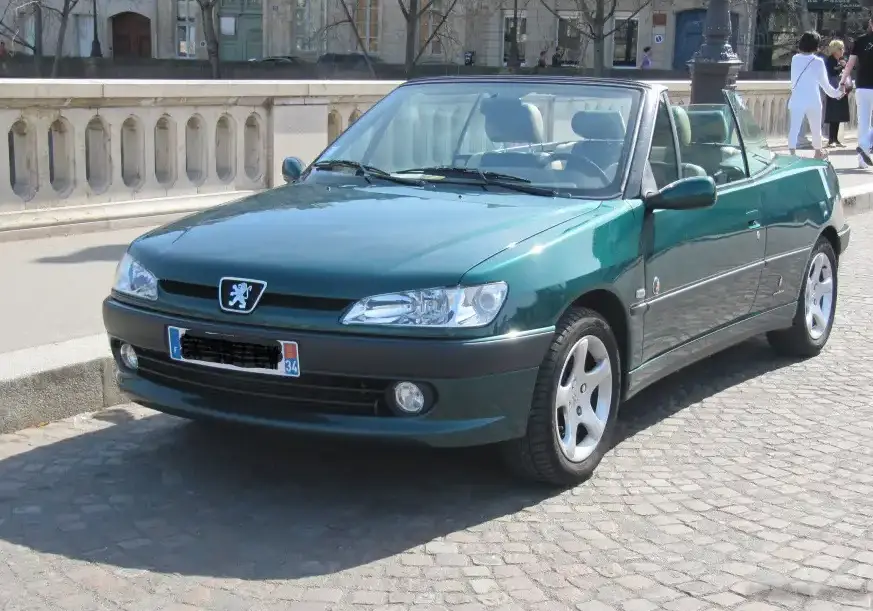
The Peugeot 306 Cabriolet, particularly the facelifted version introduced in 1997, represented a stylish and accessible entry into the world of open-top motoring. Produced from 1997 through 2002, the 2.0i 16V variant, boasting 133 horsepower, occupied a mid-range position within the 306 Cabriolet lineup. It offered a balance between performance and affordability, appealing to buyers seeking a more spirited driving experience than the base models, but without the higher price tag of the more potent options. This model was a key part of Peugeot’s strategy to offer a diverse range of vehicles within the popular compact class, catering to a broad spectrum of customer preferences.
Technical Specifications
| Brand | Peugeot |
| Model | 306 |
| Generation | 306 Cabrio (facelift 1997) |
| Type (Engine) | 2.0i 16V (133 Hp) |
| Start of production | 1997 |
| End of production | 2002 |
| Powertrain Architecture | Internal Combustion engine |
| Body type | Cabriolet |
| Seats | 4 |
| Doors | 2 |
| Fuel consumption (urban) | 12.9 l/100 km (18.2 US mpg, 21.9 UK mpg, 7.8 km/l) |
| Fuel consumption (extra urban) | 7.1 l/100 km (33.1 US mpg, 39.8 UK mpg, 14.1 km/l) |
| Fuel consumption (combined) | 9.2 l/100 km (25.6 US mpg, 30.7 UK mpg, 10.9 km/l) |
| CO2 emissions | 221 g/km |
| Fuel Type | Petrol (Gasoline) |
| Acceleration 0 – 100 km/h | 11.1 sec |
| Acceleration 0 – 62 mph | 11.1 sec |
| Acceleration 0 – 60 mph | 10.5 sec |
| Maximum speed | 196 km/h (121.79 mph) |
| Weight-to-power ratio | 9.5 kg/Hp, 104.7 Hp/tonne |
| Weight-to-torque ratio | 7.1 kg/Nm, 141.7 Nm/tonne |
| Power | 133 Hp @ 5500 rpm |
| Power per litre | 66.6 Hp/l |
| Torque | 180 Nm @ 4200 rpm (132.76 lb.-ft. @ 4200 rpm) |
| Engine layout | Front, Transverse |
| Engine Model/Code | RFV XU10J4R |
| Engine displacement | 1998 cm3 (121.93 cu. in.) |
| Number of cylinders | 4 |
| Engine configuration | Inline |
| Cylinder Bore | 86 mm (3.39 in.) |
| Piston Stroke | 86 mm (3.39 in.) |
| Compression ratio | 10.4:1 |
| Number of valves per cylinder | 4 |
| Fuel injection system | Multi-port manifold injection |
| Engine aspiration | Naturally aspirated engine |
| Valvetrain | DOHC |
| Engine oil capacity | 4.3 l (4.54 US qt | 3.78 UK qt) |
| Coolant | 7.5 l (7.93 US qt | 6.6 UK qt) |
| Kerb Weight | 1270 kg (2799.87 lbs.) |
| Max. weight | 1680 kg (3703.77 lbs.) |
| Max load | 410 kg (903.9 lbs.) |
| Trunk (boot) space – minimum | 274 l (9.68 cu. ft.) |
| Fuel tank capacity | 60 l (15.85 US gal | 13.2 UK gal) |
| Permitted trailer load with brakes (12%) | 1000 kg (2204.62 lbs.) |
| Permitted trailer load without brakes | 670 kg (1477.1 lbs.) |
| Length | 4179 mm (164.53 in.) |
| Width | 1680 mm (66.14 in.) |
| Height | 1356 mm (53.39 in.) |
| Wheelbase | 2540 mm (100 in.) |
| Front track | 1454-1465 mm (57.24 – 57.68 in.) |
| Rear (Back) track | 1420-1439 mm (55.91 – 56.65 in.) |
| Front overhang | 815 mm (32.09 in.) |
| Rear overhang | 824 mm (32.44 in.) |
| Ride height (ground clearance) | 120 mm (4.72 in.) |
| Drag coefficient (Cd) | 0.37 |
| Minimum turning circle (turning diameter) | 11.0 m (36.09 ft.) |
| Drivetrain Architecture | The Internal combustion engine (ICE) drives the front wheels of the vehicle. |
| Drive wheel | Front wheel drive |
| Number of gears and type of gearbox | 5 gears, manual transmission |
| Front suspension | Wishbone |
| Rear suspension | Trailing arm |
| Front brakes | Ventilated discs |
| Rear brakes | Disc |
| Assisting systems | ABS (Anti-lock braking system) |
| Steering type | Steering rack and pinion |
| Power steering | Hydraulic Steering |
| Tires size | 195/55 R15 V |
| Wheel rims size | 15 |
INTRODUCTION
The 1997 facelift of the Peugeot 306 Cabriolet brought with it revised styling, improved safety features, and updated engine options. The 2.0i 16V model, powered by the RFV engine, was a significant step up from the base 1.6-liter variants. It was positioned as a more premium offering, appealing to drivers who desired a blend of open-air enjoyment and respectable performance. Built on the 306 platform, this Cabriolet shared its underpinnings with other 306 models, but distinguished itself with its folding soft top and reinforced chassis for increased rigidity. The 306 Cabriolet was primarily marketed in Europe, where compact convertibles enjoyed considerable popularity.
Powertrain & Engine Architecture
At the heart of the 2.0i 16V Cabriolet lies the RFV XU10J4R engine, a naturally aspirated, 1998cc inline-four cylinder powerplant. This engine is a member of Peugeot-Citroën’s XU series, known for its robustness and relatively simple design. The ‘16V’ designation indicates the engine features four valves per cylinder, enhancing breathing and contributing to its higher power output. Fuel delivery is managed by a multi-port fuel injection system, ensuring precise fuel metering for optimal combustion. The engine utilizes a double overhead camshaft (DOHC) valvetrain, further optimizing valve timing and control. The 306 Cabriolet 2.0i 16V typically came equipped with a 5-speed manual transmission, although automatic options were available in some markets. The automatic transmission, while offering convenience, generally resulted in slightly reduced acceleration and fuel economy compared to the manual counterpart.
Driving Characteristics
The 2.0i 16V Cabriolet offered a noticeably more engaging driving experience than the lower-powered versions. With 133 horsepower and 180 Nm (132.76 lb-ft) of torque, it provided sufficient power for comfortable cruising and spirited acceleration. While not a sports car, the 2.0i 16V could reach 0-60 mph in around 10.5 seconds and achieve a top speed of approximately 121.79 mph. The 5-speed manual transmission allowed drivers to fully exploit the engine’s powerband, while the automatic option provided smoother shifts but at the expense of some responsiveness. The Cabriolet’s suspension, tuned for comfort, offered a reasonably compliant ride, although body roll was noticeable during cornering. The open-top configuration naturally added to the sense of freedom and enjoyment, enhancing the overall driving experience.
Equipment & Trim Levels
The 2.0i 16V Cabriolet typically came well-equipped, reflecting its mid-range positioning. Standard features often included power steering, central locking, electric windows, and an upgraded audio system. Interior upholstery was typically cloth, although leather options were available. The dashboard layout was functional and straightforward, with clear instrumentation. Optional extras could include air conditioning, alloy wheels, and a more sophisticated sound system. The level of equipment varied depending on the specific market and the chosen options package.
Chassis & Braking
The 306 Cabriolet’s chassis was reinforced compared to the standard 306 hatchback to compensate for the loss of a fixed roof. This reinforcement ensured adequate torsional rigidity, minimizing body flex and maintaining handling precision. The front suspension utilized a wishbone setup, while the rear employed a trailing arm configuration. Braking duties were handled by ventilated discs at the front and discs at the rear, providing adequate stopping power. An Anti-lock Braking System (ABS) was standard, enhancing safety by preventing wheel lockup during hard braking.
Market Reception & Comparison
The Peugeot 306 Cabriolet 2.0i 16V was generally well-received by automotive critics. It was praised for its stylish design, comfortable ride, and respectable performance. Compared to the base 1.6-liter models, the 2.0i 16V offered a significant improvement in acceleration and overall driving enjoyment. However, it was often seen as slightly less refined than some of its competitors, such as the Renault Megane Cabriolet. Fuel economy was reasonable for a vehicle of its type, but not exceptional. Reliability was generally good, although regular maintenance was essential to prevent issues.
Legacy
The Peugeot 306 Cabriolet 2.0i 16V remains a popular choice among enthusiasts and classic car collectors. The RFV engine is known for its durability, and well-maintained examples can still provide years of reliable service. However, like any older vehicle, it is susceptible to age-related issues, such as corrosion and wear and tear on rubber components. The 306 Cabriolet represents a charming and affordable entry into the world of classic convertibles, offering a unique blend of style, performance, and open-air enjoyment. In the used car market, prices vary depending on condition, mileage, and originality, but well-preserved examples command a premium.