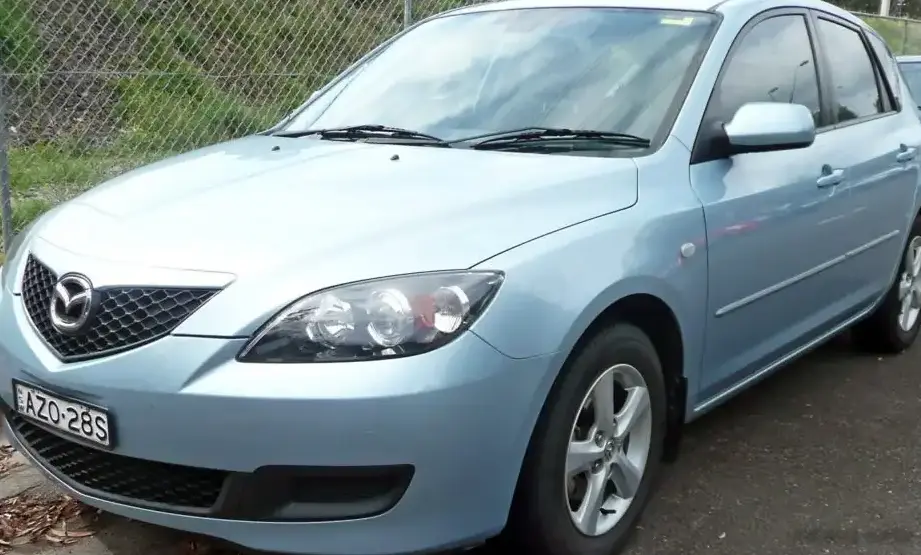
The Mazda 3 II Hatchback, specifically the 1.6 CD variant producing 115 horsepower, was a key model in Mazda’s European lineup from 2010 to 2011. Falling within the second generation (BL) of the Mazda 3, this hatchback aimed to provide an economical and practical option for buyers seeking a compact, fuel-efficient vehicle. It occupied a mid-range position within the broader Mazda 3 range, slotting below the more powerful 2.0-liter gasoline and diesel options, and above the base 1.4-liter gasoline engine. This model was primarily targeted at drivers prioritizing fuel economy and lower running costs, making it a popular choice for daily commutes and urban driving.
Technical Specifications
| Brand | Mazda |
| Model | 3 |
| Generation | II Hatchback (BL) |
| Type (Engine) | 1.6 CD (115 Hp) |
| Start of production | 2010 |
| End of production | 2011 |
| Powertrain Architecture | Internal Combustion engine |
| Body type | Hatchback |
| Seats | 5 |
| Doors | 5 |
| Fuel consumption (urban) | 5.3 l/100 km (44.4 US mpg, 53.3 UK mpg, 18.9 km/l) |
| Fuel consumption (extra urban) | 3.9 l/100 km (60.3 US mpg, 72.4 UK mpg, 25.6 km/l) |
| Fuel consumption (combined) | 4.4 l/100 km (53.5 US mpg, 64.2 UK mpg, 22.7 km/l) |
| CO2 emissions | 117 g/km |
| Fuel Type | Diesel |
| Acceleration 0 – 100 km/h | 11 sec |
| Acceleration 0 – 62 mph | 11 sec |
| Acceleration 0 – 60 mph | 10.5 sec |
| Maximum speed | 186 km/h (115.58 mph) |
| Emission standard | Euro 5 |
| Weight-to-power ratio | 10.9 kg/Hp, 91.6 Hp/tonne |
| Weight-to-torque ratio | 4.6 kg/Nm, 215.1 Nm/tonne |
| Power | 115 Hp @ 3600 rpm |
| Power per litre | 73.7 Hp/l |
| Torque | 270 Nm @ 1750-2500 rpm (199.14 lb.-ft. @ 1750-2500 rpm) |
| Engine layout | Front, Transverse |
| Engine displacement | 1560 cm3 (95.2 cu. in.) |
| Number of cylinders | 4 |
| Engine configuration | Inline |
| Cylinder Bore | 75 mm (2.95 in.) |
| Piston Stroke | 88.3 mm (3.48 in.) |
| Compression ratio | 16:1 |
| Number of valves per cylinder | 2 |
| Fuel injection system | Diesel Commonrail |
| Engine aspiration | Turbocharger, Intercooler |
| Valvetrain | DOHC |
| Engine oil capacity | 3.8 l (4.02 US qt | 3.34 UK qt) |
| Coolant | 8.5 l (8.98 US qt | 7.48 UK qt) |
| Kerb Weight | 1255 kg (2766.8 lbs.) |
| Max. weight | 1830 kg (4034.46 lbs.) |
| Max load | 575 kg (1267.66 lbs.) |
| Trunk (boot) space – minimum | 340 l (12.01 cu. ft.) |
| Trunk (boot) space – maximum | 1360 l (48.03 cu. ft.) |
| Fuel tank capacity | 55 l (14.53 US gal | 12.1 UK gal) |
| Permitted trailer load with brakes (12%) | 1300 kg (2866.01 lbs.) |
| Permitted trailer load without brakes | 600 kg (1322.77 lbs.) |
| Length | 4460 mm (175.59 in.) |
| Width | 1755 mm (69.09 in.) |
| Width including mirrors | 2002 mm (78.82 in.) |
| Height | 1470 mm (57.87 in.) |
| Wheelbase | 2640 mm (103.94 in.) |
| Front track | 1535 mm (60.43 in.) |
| Rear (Back) track | 1530 mm (60.24 in.) |
| Ride height (ground clearance) | 155 mm (6.1 in.) |
| Drag coefficient (Cd) | 0.30 |
| Minimum turning circle (turning diameter) | 10.4 m (34.12 ft.) |
| Drivetrain Architecture | The Internal combustion engine (ICE) drives the front wheels of the vehicle. |
| Drive wheel | Front wheel drive |
| Number of gears and type of gearbox | 6 gears, manual transmission |
| Front brakes | Ventilated discs |
| Rear brakes | Disc |
| Assisting systems | ABS (Anti-lock braking system) |
| Steering type | Steering rack and pinion |
| Power steering | Electric Steering |
| Tires size | 205/55 R16 |
| Wheel rims size | 16 |
Powertrain & Engine Architecture
The heart of this Mazda 3 variant is the 1.6-liter (1560 cc) four-cylinder diesel engine. This engine, often identified by internal codes like HL-DE, utilizes a common-rail direct injection system for optimized fuel delivery and combustion efficiency. The engine features a turbocharger with an intercooler, which significantly boosts power output and torque. The DOHC (Double Overhead Camshaft) valvetrain, with two valves per cylinder, contributes to efficient gas exchange. A compression ratio of 16:1 is typical for diesel engines, maximizing combustion efficiency. The engine produces 115 horsepower at 3600 rpm and a respectable 270 Nm (199 lb-ft) of torque between 1750 and 2500 rpm. This torque curve provides good low-end responsiveness, making it suitable for everyday driving. The engine is transversely mounted, driving the front wheels. The 6-speed manual transmission was the standard offering for this trim, providing a balance between fuel economy and driver control.
Driving Characteristics
The 1.6 CD with the 6-speed manual transmission offered a practical and economical driving experience. While not a performance-oriented setup, the engine’s torque delivery made it feel more responsive than its horsepower figure might suggest. Acceleration from 0-60 mph took around 10.5 seconds, and top speed was approximately 115.58 mph. The gear ratios were tuned for fuel efficiency, with taller gearing in the upper gears for relaxed highway cruising. Compared to the higher-output 2.0-liter diesel variants, this 1.6 CD felt less powerful, particularly during overtaking maneuvers. However, it offered a smoother and more refined driving experience, with less engine noise and vibration. The manual transmission provided good control, but the shift quality wasn’t as precise as some competitors.
Equipment & Trim Levels
The 1.6 CD trim typically included standard features such as air conditioning, power windows, power mirrors, a basic audio system with CD player, and ABS brakes. Safety features included front and side airbags. Interior upholstery was typically cloth, and the dashboard featured a functional, if somewhat basic, design. Optional extras included alloy wheels, a more advanced audio system, and parking sensors. Higher trim levels, such as the Sport or Luxury variants, added features like climate control, leather upholstery, and a sunroof.
Chassis & Braking
The Mazda 3 II Hatchback utilized a MacPherson strut front suspension and a multi-link rear suspension, providing a good balance between ride comfort and handling. The front brakes were ventilated discs, while the rear brakes were solid discs. ABS (Anti-lock Braking System) was standard. The suspension was tuned for comfort, but it still offered decent body control in corners. The electric power steering provided light and easy steering, making it ideal for urban driving.
Market Reception & Comparison
The Mazda 3 1.6 CD was generally well-received by critics for its fuel efficiency and practicality. It was often praised for its comfortable ride and decent handling. However, some reviewers noted that the engine lacked outright power compared to its rivals. Compared to other diesel hatchbacks in its class, such as the Volkswagen Golf and Ford Focus, the Mazda 3 offered a competitive fuel economy and a slightly more engaging driving experience. Reliability was generally good, although some owners reported issues with the diesel particulate filter (DPF).
Legacy
The 1.6 CD engine proved to be relatively reliable, although regular maintenance, including DPF regeneration, was crucial. In the used car market, these models are often sought after for their fuel efficiency and affordability. While not a particularly collectible variant, the 1.6 CD Mazda 3 II Hatchback remains a practical and economical choice for buyers seeking a compact diesel hatchback. Its blend of fuel efficiency, practicality, and reasonable running costs continues to make it a viable option in the used car market today.