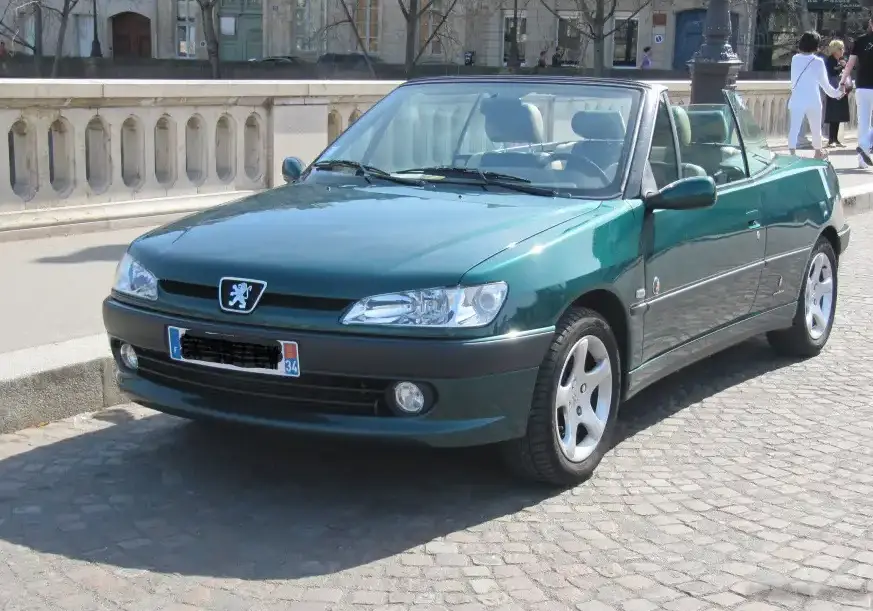
The Peugeot 306 Cabriolet, particularly the facelifted version introduced in 1997, represented a stylish and accessible entry into the world of open-top motoring. Produced from 1997 through 2002, the 2.0i 16V Automatic variant occupied a mid-range position within the 306 Cabriolet lineup, offering a balance between performance, comfort, and convenience. This model was primarily aimed at the European market, where compact convertibles were a popular choice, and provided a more refined experience than the base models while remaining more affordable than the top-of-the-line trims.
Technical Specifications
| Brand | Peugeot |
| Model | 306 |
| Generation | 306 Cabrio (facelift 1997) |
| Type (Engine) | 2.0i 16V (133 Hp) Automatic |
| Start of production | 1997 |
| End of production | 2002 |
| Powertrain Architecture | Internal Combustion engine |
| Body type | Cabriolet |
| Seats | 4 |
| Doors | 2 |
| Fuel consumption (urban) | 13.6 l/100 km (17.3 US mpg, 20.8 UK mpg, 7.4 km/l) |
| Fuel consumption (extra urban) | 7.1 l/100 km (33.1 US mpg, 39.8 UK mpg, 14.1 km/l) |
| Fuel consumption (combined) | 9.4 l/100 km (25 US mpg, 30.1 UK mpg, 10.6 km/l) |
| Fuel Type | Petrol (Gasoline) |
| Maximum speed | 195 km/h (121.17 mph) |
| Weight-to-power ratio | 9.5 kg/Hp, 104.7 Hp/tonne |
| Weight-to-torque ratio | 7.1 kg/Nm, 141.7 Nm/tonne |
| Power | 133 Hp @ 5500 rpm |
| Power per litre | 66.6 Hp/l |
| Torque | 180 Nm @ 4200 rpm (132.76 lb.-ft. @ 4200 rpm) |
| Engine layout | Front, Transverse |
| Engine Model/Code | RFV XU10J4R |
| Engine displacement | 1998 cm3 (121.93 cu. in.) |
| Number of cylinders | 4 |
| Engine configuration | Inline |
| Cylinder Bore | 86 mm (3.39 in.) |
| Piston Stroke | 86 mm (3.39 in.) |
| Compression ratio | 10.4:1 |
| Number of valves per cylinder | 4 |
| Fuel injection system | Multi-port manifold injection |
| Engine aspiration | Naturally aspirated engine |
| Valvetrain | DOHC |
| Engine oil capacity | 4.3 l (4.54 US qt | 3.78 UK qt) |
| Coolant | 7.5 l (7.93 US qt | 6.6 UK qt) |
| Kerb Weight | 1270 kg (2799.87 lbs.) |
| Max. weight | 1680 kg (3703.77 lbs.) |
| Max load | 410 kg (903.9 lbs.) |
| Trunk (boot) space – minimum | 274 l (9.68 cu. ft.) |
| Fuel tank capacity | 60 l (15.85 US gal | 13.2 UK gal) |
| Length | 4179 mm (164.53 in.) |
| Width | 1689 mm (66.5 in.) |
| Height | 1356 mm (53.39 in.) |
| Wheelbase | 2540 mm (100 in.) |
| Front track | 1454-1465 mm (57.24 – 57.68 in.) |
| Rear (Back) track | 1420-1439 mm (55.91 – 56.65 in.) |
| Front overhang | 815 mm (32.09 in.) |
| Rear overhang | 824 mm (32.44 in.) |
| Ride height (ground clearance) | 120 mm (4.72 in.) |
| Drag coefficient (Cd) | 0.37 |
| Minimum turning circle (turning diameter) | 11.0 m (36.09 ft.) |
| Drivetrain Architecture | The Internal combustion engine (ICE) drives the front wheels of the vehicle. |
| Drive wheel | Front wheel drive |
| Number of gears and type of gearbox | 4 gears, automatic transmission |
| Front suspension | Wishbone |
| Rear suspension | Trailing arm |
| Front brakes | Ventilated discs |
| Rear brakes | Disc |
| Assisting systems | ABS (Anti-lock braking system) |
| Steering type | Steering rack and pinion |
| Power steering | Hydraulic Steering |
| Tires size | 195/55 R15 V |
| Wheel rims size | 15 |
Powertrain & Engine Architecture
The heart of the 306 Cabriolet 2.0i 16V Automatic is the RFV XU10J4R engine, a 1.998-liter inline-four cylinder powerplant. This engine is a member of the XU series, known for its robustness and relatively simple design. It features a dual overhead camshaft (DOHC) valvetrain operating 16 valves (four per cylinder), and utilizes multi-port fuel injection for precise fuel delivery. The engine’s 10.4:1 compression ratio contributes to its respectable power output. The automatic transmission is a four-speed unit, designed to provide smooth and convenient gear changes. While not known for its sportiness, it was well-suited to the relaxed driving style typically associated with convertibles.
Driving Characteristics
The 133 horsepower and 180 Nm (133 lb-ft) of torque produced by the 2.0i 16V engine, coupled with the four-speed automatic transmission, resulted in a comfortable, rather than exhilarating, driving experience. Acceleration was adequate for everyday driving, with a 0-60 mph time estimated around 10-11 seconds. The automatic transmission, while convenient, did detract from the overall responsiveness compared to the five-speed manual version. Gear ratios were optimized for fuel efficiency and smooth cruising, rather than aggressive acceleration. The power delivery was linear, making it easy to modulate the throttle, but lacked the punch of higher-output variants.
Equipment & Trim Levels
The 2.0i 16V Automatic trim typically included features such as power windows, central locking, power steering, and an AM/FM radio. Upholstery was generally cloth, although leather options were available as an extra cost. Air conditioning was a common feature, and some models included alloy wheels and a more sophisticated audio system. The interior design was functional and relatively simple, prioritizing usability over luxury. Optional extras could include a sunroof (in addition to the convertible top), upgraded sound systems, and various cosmetic enhancements.
Chassis & Braking
The 306 Cabriolet utilized a front-wheel-drive layout with independent wishbone suspension at the front and a trailing arm setup at the rear. This suspension configuration provided a reasonable balance between ride comfort and handling. The braking system consisted of ventilated discs at the front and solid discs at the rear, equipped with an Anti-lock Braking System (ABS) as standard. The steering was rack and pinion, providing precise and responsive control. The relatively modest weight of the vehicle (around 1270 kg or 2799 lbs) helped to mitigate the performance limitations of the 133 hp engine.
Market Reception & Comparison
The 306 Cabriolet 2.0i 16V Automatic was generally well-received by automotive critics as a stylish and affordable convertible. However, the automatic transmission was often criticized for detracting from the driving experience compared to the manual version. Fuel economy was reasonable for a vehicle of its type, averaging around 25 mpg in combined driving. Compared to the more powerful 2.0i 16V manual, the automatic version offered less performance but greater convenience. The 1.6-liter models were more affordable but lacked the refinement and power of the 2.0-liter engine. Reliability was generally good, although regular maintenance was essential to prevent issues with the convertible top mechanism.
Legacy
The Peugeot 306 Cabriolet 2.0i 16V Automatic remains a popular choice among enthusiasts seeking a classic French convertible. The RFV XU10J4R engine is known for its durability, and with proper maintenance, can provide many years of reliable service. Parts availability is generally good, although some specific trim components may be difficult to find. Today, these vehicles are often sought after for their retro styling and enjoyable open-top driving experience, representing a relatively affordable entry point into the world of classic convertibles. The combination of a reliable engine, comfortable ride, and stylish design has ensured its continued appeal in the used car market.