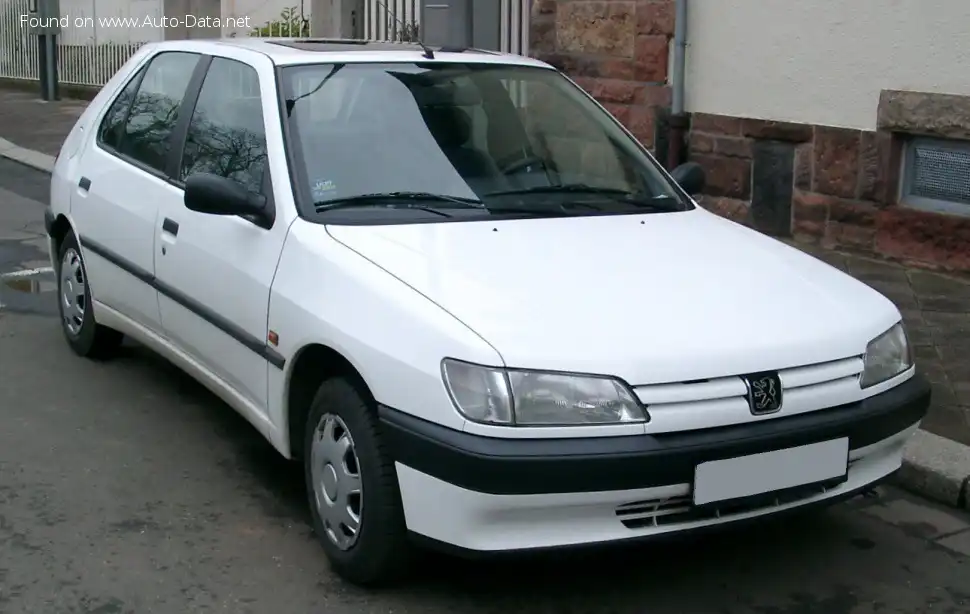
The Peugeot 306, produced between 1993 and 2002, was a small family car designed by Peugeot to replace the 205. The 306 represented a significant step forward for Peugeot in terms of design, comfort, and technology. Within the 306 range, the 1.1-liter (60 hp) variant, produced from 1993 to 1997, served as the entry-level model, aimed at budget-conscious buyers and those prioritizing fuel economy. This version was typically offered with a five-speed manual transmission, though a three-speed automatic was available in some markets. It occupied the base trim level, often designated as ‘Ambiance’ or similar, and was a common sight in Europe, particularly as a first car for new drivers.
Technical Specifications
| Brand | Peugeot |
| Model | 306 |
| Generation | 306 Hatchback (7A/C) |
| Type (Engine) | 1.1 (60 Hp) |
| Start of production | 1993 |
| End of production | 1997 |
| Powertrain Architecture | Internal Combustion engine |
| Body type | Hatchback |
| Seats | 5 |
| Doors | 3-5 |
| Fuel consumption (combined) | 6.7 l/100 km (35.1 US mpg, 42.2 UK mpg, 14.9 km/l) |
| Fuel Type | Petrol (Gasoline) |
| Acceleration 0 – 100 km/h | 18.4 sec |
| Acceleration 0 – 62 mph | 18.4 sec |
| Acceleration 0 – 60 mph | 17.5 sec |
| Maximum speed | 155 km/h (96.31 mph) |
| Weight-to-power ratio | 16.3 kg/Hp |
| Weight-to-torque ratio | 11.1 kg/Nm |
| Power | 60 Hp @ 5800 rpm |
| Power per litre | 53.4 Hp/l |
| Torque | 88 Nm @ 3200 rpm (64.91 lb.-ft. @ 3200 rpm) |
| Engine layout | Front, Transverse |
| Engine Model/Code | HDZ TU1M |
| Engine displacement | 1124 cm3 (68.59 cu. in.) |
| Number of cylinders | 4 |
| Engine configuration | Inline |
| Cylinder Bore | 72 mm (2.83 in.) |
| Piston Stroke | 69 mm (2.72 in.) |
| Compression ratio | 9.4:1 |
| Number of valves per cylinder | 2 |
| Fuel injection system | Carburettor |
| Engine aspiration | Naturally aspirated |
| Engine oil capacity | 3.2 l (3.38 US qt | 2.82 UK qt) |
| Coolant capacity | 6.5 l (6.87 US qt | 5.72 UK qt) |
| Kerb Weight | 980 kg (2160.53 lbs.) |
| Max. weight | 1490 kg (3284.89 lbs.) |
| Max load | 510 kg (1124.36 lbs.) |
| Trunk (boot) space – minimum | 338 l (11.94 cu. ft.) |
| Trunk (boot) space – maximum | 637 l (22.5 cu. ft.) |
| Fuel tank capacity | 60 l (15.85 US gal | 13.2 UK gal) |
| Length | 3995 mm (157.28 in.) |
| Width | 1692 mm (66.61 in.) |
| Height | 1380 mm (54.33 in.) |
| Wheelbase | 2580 mm (101.57 in.) |
| Front track | 1462 mm (57.56 in.) |
| Rear track | 1435 mm (56.5 in.) |
| Drivetrain | Front wheel drive |
| Number of gears | 5 |
| Gearbox type | Manual transmission |
| Front suspension | Wishbone |
| Rear suspension | Trailing arm |
| Front brakes | Disc |
| Rear brakes | Drum |
| Assisting systems | ABS (Anti-lock braking system) |
| Steering type | Steering rack and pinion |
| Power steering | Hydraulic |
| Tires size | 165/70 R13 |
Powertrain & Engine Architecture
The heart of the 306 1.1 was the HDZ engine, a member of Peugeot’s TU1M family. This 1124cc inline-four cylinder engine was a relatively simple design, utilizing a single overhead camshaft and two valves per cylinder. Crucially, this engine employed a carburetor for fuel delivery, a feature becoming increasingly rare in the 1990s as fuel injection became the standard. The carburetor, while simpler and cheaper to manufacture, offered less precise fuel control than injection systems, impacting both performance and emissions. The engine produced 60 horsepower at 5800 rpm and 88 Nm (65 lb-ft) of torque at 3200 rpm. The five-speed manual transmission was the most common pairing, offering a reasonable spread of gears for maximizing fuel efficiency and managing the engine’s limited power. A three-speed automatic transmission was also available, but it significantly hampered performance and fuel economy.
Driving Characteristics
The 306 1.1 was not a performance-oriented vehicle. Acceleration was leisurely, taking approximately 18.4 seconds to reach 62 mph (100 km/h). The engine felt strained at higher speeds, and overtaking required careful planning. The manual transmission allowed drivers to make the most of the available power, keeping the engine in its optimal rev range. The automatic transmission, while offering convenience, resulted in noticeably slower acceleration and a less engaging driving experience. The gear ratios were optimized for fuel economy rather than outright speed. Handling was generally competent, but the car’s relatively soft suspension and narrow tires limited grip. It was best suited for urban driving and shorter journeys.
Equipment & Trim Levels
The 1.1-liter 306 typically came with a basic level of equipment. Standard features often included power steering, central locking, and an AM/FM radio. Interior upholstery was typically cloth, and the dashboard was constructed from durable plastics. Optional extras included power windows, a sunroof, and upgraded audio systems. The ‘Ambiance’ trim level was the most common, offering a balance of affordability and practicality. Higher trim levels, such as ‘GL’ or ‘XT’, added features like alloy wheels, fog lights, and more luxurious interior trim.
Chassis & Braking
The 306 1.1 utilized a relatively simple chassis design. The front suspension featured independent wishbones, while the rear suspension employed a trailing arm setup. This configuration provided a comfortable ride, but didn’t offer particularly sporty handling. The braking system consisted of disc brakes on the front wheels and drum brakes on the rear. ABS (Anti-lock Braking System) was available as an option, enhancing safety in emergency braking situations. The car’s relatively light weight helped to compensate for the modest braking performance.
Market Reception & Comparison
The 306 1.1 was generally well-received as an affordable and practical small family car. Critics praised its fuel economy and comfortable ride, but noted its lack of performance. Compared to other engines in the 306 lineup, such as the 1.6-liter and 2.0-liter versions, the 1.1 was significantly slower and less refined. However, it was also considerably cheaper to buy and run. The 1.9-liter diesel (TDI) offered superior fuel economy and torque, but at a higher initial cost. The 1.1 appealed to buyers who prioritized economy and low running costs over performance.
Legacy
The Peugeot 306 1.1, while not a particularly exciting car, proved to be a reliable and durable vehicle. The HDZ engine, despite its carburetor fuel system, was generally robust and capable of high mileage with proper maintenance. Today, these cars are relatively rare, and well-maintained examples are sought after by enthusiasts and collectors. The 306 1.1 represents a simpler era of automotive engineering, and its affordability and practicality continue to appeal to budget-conscious buyers in the used car market. Parts availability is generally good, making it a relatively easy car to maintain and repair.