
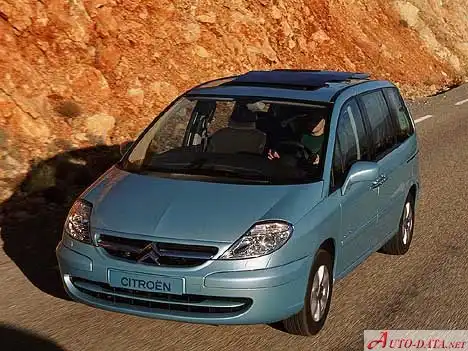
The Citroen C8 2.0 HDi 16V, produced between 2006 and 2008, represents the first phase of Citroen’s large MPV offering. Part of the U4 platform shared with the Peugeot 807 and Fiat Ulysse, the C8 aimed to provide a spacious and comfortable family vehicle. This particular variant, equipped with the 2.0-liter HDi diesel engine producing 120 horsepower, served as a mid-range option within the C8 lineup, positioned between the base petrol engines and the more powerful HDi variants. It was primarily marketed in Europe, where MPVs were a popular choice for families needing flexible seating and cargo capacity.
Technical Specifications
| Brand | Citroen |
| Model | C8 |
| Generation | C8 (Phase I) |
| Type (Engine) | 2.0 HDi 16V (120 Hp) |
| Start of production | 2006 |
| End of production | 2008 |
| Powertrain Architecture | Internal Combustion engine |
| Body type | Minivan, MPV |
| Seats | 7 |
| Doors | 5 |
| Fuel consumption (urban) | 8.8 l/100 km (26.7 US mpg, 32.1 UK mpg, 11.4 km/l) |
| Fuel consumption (extra urban) | 5.8 l/100 km (40.6 US mpg, 48.7 UK mpg, 17.2 km/l) |
| Fuel consumption (combined) | 6.9 l/100 km (34.1 US mpg, 40.9 UK mpg, 14.5 km/l) |
| CO2 emissions | 182 g/km |
| Fuel Type | Diesel |
| Acceleration 0 – 100 km/h | 12.9 sec |
| Acceleration 0 – 62 mph | 12.9 sec |
| Acceleration 0 – 60 mph | 12.3 sec |
| Maximum speed | 180 km/h (111.85 mph) |
| Emission standard | Euro 4 |
| Weight-to-power ratio | 14.5 kg/Hp, 69.1 Hp/tonne |
| Weight-to-torque ratio | 5.8 kg/Nm, 172.8 Nm/tonne |
| Power | 120 Hp @ 4000 rpm |
| Power per litre | 60.1 Hp/l |
| Torque | 300 Nm @ 2000 rpm (221.27 lb.-ft. @ 2000 rpm) |
| Engine layout | Front, Transverse |
| Engine Model/Code | RHK DW10UTED4 |
| Engine displacement | 1997 cm3 (121.86 cu. in.) |
| Number of cylinders | 4 |
| Engine configuration | Inline |
| Cylinder Bore | 85 mm (3.35 in.) |
| Piston Stroke | 88 mm (3.46 in.) |
| Compression ratio | 17.6:1 |
| Number of valves per cylinder | 4 |
| Fuel injection system | Diesel Commonrail |
| Engine aspiration | Turbocharger, Intercooler |
| Valvetrain | DOHC |
| Engine oil capacity | 6.3 l (6.66 US qt | 5.54 UK qt) |
| Coolant | 8 l (8.45 US qt | 7.04 UK qt) |
| Kerb Weight | 1736 kg (3827.22 lbs.) |
| Max. weight | 2530 kg (5577.7 lbs.) |
| Max load | 794 kg (1750.47 lbs.) |
| Trunk (boot) space – minimum | 225 l (7.95 cu. ft.) |
| Trunk (boot) space – maximum | 2948 l (104.11 cu. ft.) |
| Fuel tank capacity | 80 l (21.13 US gal | 17.6 UK gal) |
| Max. roof load | 100 kg (220.46 lbs.) |
| Permitted trailer load with brakes (12%) | 1800 kg (3968.32 lbs.) |
| Permitted trailer load without brakes | 750 kg (1653.47 lbs.) |
| Permitted towbar download | 72 kg (158.73 lbs.) |
| Length | 4727 mm (186.1 in.) |
| Width | 1854 mm (72.99 in.) |
| Width with mirrors folded | 1952 mm (76.85 in.) |
| Width including mirrors | 2205 mm (86.81 in.) |
| Height | 1766-1856 mm (69.53 – 73.07 in.) |
| Wheelbase | 2823 mm (111.14 in.) |
| Front track | 1570 mm (61.81 in.) |
| Rear (Back) track | 1548 mm (60.94 in.) |
| Front overhang | 1013 mm (39.88 in.) |
| Rear overhang | 891 mm (35.08 in.) |
| Minimum turning circle | 11.62 m (38.12 ft.) |
| Drivetrain Architecture | The Internal combustion engine (ICE) drives the front wheels of the vehicle. |
| Drive wheel | Front wheel drive |
| Number of gears and type of gearbox | 6 gears, manual transmission |
| Front suspension | Independent, type McPherson with coil spring and anti-roll bar |
| Rear suspension | Semi-independent, coil spring |
| Front brakes | Ventilated discs |
| Rear brakes | Disc |
| Assisting systems | ABS (Anti-lock braking system) |
| Steering type | Steering rack and pinion |
| Power steering | Hydraulic Steering |
| Tires size | 205/60 R16 |
| Wheel rims size | 6.5J x 16 |
Powertrain & Engine Architecture
The heart of this C8 variant is the DW10UTED4 engine, a 2.0-liter four-cylinder diesel engine. This engine is part of the PSA Group’s (Peugeot Citroen) HDi family, known for its fuel efficiency and reasonable performance. The ‘DW10’ designation indicates a 10-series engine with a displacement of approximately 2.0 liters. The ‘UTED4’ suffix denotes specific improvements and emissions control features. The engine utilizes a common rail direct injection system, delivering fuel directly into the cylinders at very high pressure for optimized combustion. A turbocharger with an intercooler is employed to increase power output by forcing more air into the engine. The engine features a double overhead camshaft (DOHC) valvetrain with four valves per cylinder, enhancing breathing and contributing to improved performance. The 6-speed manual transmission was the standard offering, providing a good balance between fuel economy and drivability.
Driving Characteristics
The 120 hp 2.0 HDi engine in the C8 provided adequate, but not exhilarating, performance. Acceleration from 0-60 mph took around 12.3 seconds, and top speed was limited to 111.85 mph. The engine’s 300 Nm (221 lb-ft) of torque, available from 2000 rpm, was the key to its usability. This torque allowed for relaxed cruising and effortless overtaking, even when fully loaded with passengers and luggage. Compared to the more powerful 2.2 HDi variants, the 2.0 HDi felt noticeably slower, particularly when accelerating onto highways or climbing hills. However, the 6-speed manual transmission helped to keep the engine in its optimal power band. The gear ratios were well-chosen for both fuel efficiency and everyday driving. The ride quality, typical of Citroen, was generally comfortable, thanks to the independent front suspension and semi-independent rear setup.
Equipment & Trim Levels
The C8 2.0 HDi 16V typically came with a reasonable level of standard equipment. This included power windows, central locking, air conditioning, and an audio system. Higher trim levels offered features such as alloy wheels, rear parking sensors, and upgraded interior trim. Interior upholstery was usually cloth, with options for leather available at an extra cost. The dashboard layout was functional and straightforward, with easy-to-read instruments. Optional extras included a navigation system, a panoramic sunroof, and a DVD entertainment system for rear passengers. The C8’s modular interior allowed for flexible seating configurations, with the ability to fold or remove individual seats to maximize cargo space.
Chassis & Braking
The C8’s chassis was designed to provide a comfortable and stable ride. The front suspension utilized McPherson struts with coil springs and an anti-roll bar, while the rear suspension employed a semi-independent coil spring setup. This configuration offered a good balance between ride comfort and handling. The braking system consisted of ventilated discs on the front wheels and solid discs on the rear. Anti-lock Braking System (ABS) was standard, enhancing safety during emergency braking. The steering was rack and pinion with hydraulic power assistance, providing precise and responsive steering feel.
Market Reception & Comparison
The Citroen C8 2.0 HDi 16V was generally well-received by critics as a practical and comfortable family vehicle. It was praised for its spacious interior, flexible seating, and fuel efficiency. However, some reviewers noted that the 2.0 HDi engine lacked the punch of the more powerful alternatives. Compared to the 2.2 HDi variants, the 2.0 HDi offered lower running costs but compromised on performance. It also provided a more affordable entry point into the C8 range. Fuel economy was a strong point, with combined figures around 34.1 US mpg. Reliability was generally good, although some owners reported issues with the electronic parking brake and the diesel particulate filter.
Legacy
The Citroen C8 2.0 HDi 16V remains a relatively common sight on European roads today. The DW10UTED4 engine is known for its durability, although regular maintenance is essential to prevent issues with the turbocharger and fuel injection system. The C8’s spacious interior and comfortable ride continue to appeal to families. In the used car market, this variant represents a good value proposition, offering a practical and affordable MPV with reasonable running costs. While not the most exciting vehicle to drive, the C8 2.0 HDi 16V remains a capable and reliable choice for those seeking a spacious and comfortable family vehicle.
