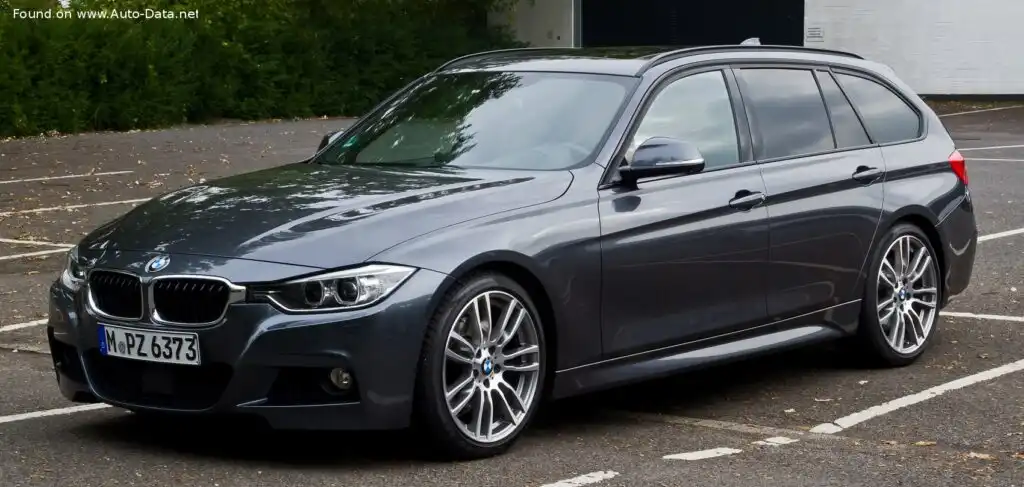
The BMW 3 Series Touring (F31) 316d, produced from 2012 to 2015, represents BMW’s entry point into the premium compact executive wagon segment. Positioned as a fuel-efficient and practical option within the broader F31 3 Series Touring range, the 316d utilized a 2.0-liter turbocharged diesel engine paired with an 8-speed automatic transmission. This configuration aimed to balance BMW’s renowned driving dynamics with everyday usability and lower running costs, appealing to buyers prioritizing economy and space over outright performance. It was part of the sixth generation of the 3 Series, built on the F30 platform, and shared its underpinnings with the 3 Series sedan and Gran Turismo models.
Technical Specifications
| Brand | BMW |
| Model | 3 Series |
| Generation | 3 Series Touring (F31) |
| Type (Engine) | 316d (116 Hp) |
| Start of production | 2012 |
| End of production | 2015 |
| Powertrain Architecture | Internal Combustion engine |
| Body type | Station wagon (estate) |
| Seats | 5 |
| Doors | 5 |
| Fuel consumption (urban) | 5.6-5.8 l/100 km (42 – 40.6 US mpg) |
| Fuel consumption (extra urban) | 3.9-4.1 l/100 km (60.3 – 57.4 US mpg) |
| Fuel consumption (combined) | 4.5-4.7 l/100 km (52.3 – 50 US mpg) |
| CO2 emissions | 119-123 g/km |
| Fuel Type | Diesel |
| Acceleration 0 – 100 km/h | 11.2 sec |
| Acceleration 0 – 62 mph | 11.2 sec |
| Acceleration 0 – 60 mph | 10.6 sec |
| Maximum speed | 200 km/h (124.27 mph) |
| Emission standard | Euro 5 |
| Weight-to-power ratio | 12.7 kg/Hp |
| Weight-to-torque ratio | 5.7 kg/Nm |
| Power | 116 Hp @ 4000 rpm |
| Torque | 260 Nm @ 1750-2500 rpm (191.77 lb.-ft.) |
| Engine layout | Front, Longitudinal |
| Engine Model/Code | N47D20C |
| Engine displacement | 1995 cm3 (121.74 cu. in.) |
| Number of cylinders | 4 |
| Engine configuration | Inline |
| Cylinder Bore | 84 mm (3.31 in.) |
| Piston Stroke | 90 mm (3.54 in.) |
| Compression ratio | 16.5:1 |
| Number of valves per cylinder | 4 |
| Fuel injection system | Diesel Commonrail |
| Engine aspiration | Twin-power turbo, Intercooler |
| Engine oil capacity | 5.2 l (5.49 US qt | 4.58 UK qt) |
| Coolant | 7 l (7.4 US qt | 6.16 UK qt) |
| Kerb Weight | 1475 kg (3251.82 lbs.) |
| Max. weight | 2025 kg (4464.36 lbs.) |
| Max load | 550 kg (1212.54 lbs.) |
| Trunk (boot) space – minimum | 495 l (17.48 cu. ft.) |
| Trunk (boot) space – maximum | 1500 l (52.97 cu. ft.) |
| Fuel tank capacity | 57 l (15.06 US gal | 12.54 UK gal) |
| Max. roof load | 75 kg (165.35 lbs.) |
| Permitted trailer load with brakes (12%) | 1600 kg (3527.4 lbs.) |
| Permitted trailer load without brakes | 745 kg (1642.44 lbs.) |
| Permitted towbar download | 75 kg (165.35 lbs.) |
| Length | 4624 mm (182.05 in.) |
| Width | 1811 mm (71.3 in.) |
| Height | 1429 mm (56.26 in.) |
| Wheelbase | 2810 mm (110.63 in.) |
| Front track | 1543 mm (60.75 in.) |
| Rear track | 1583 mm (62.32 in.) |
| Ride height (ground clearance) | 140 mm (5.51 in.) |
| Drag coefficient (Cd) | 0.30 |
| Minimum turning circle | 11.3 m (37.07 ft.) |
| Drivetrain | Rear wheel drive |
| Number of gears | 8 |
| Gearbox type | Automatic |
| Front suspension | Independent torsion bar, double wishbone |
| Rear suspension | Independent multi-link suspension |
| Front brakes | Ventilated discs |
| Rear brakes | Ventilated discs |
| Assisting systems | ABS (Anti-lock braking system) |
| Steering type | Steering rack and pinion |
| Power steering | Electric |
| Tires size | 205/60 R16 92W; 225/55 R16; 225/50 R17; 255/45 R17; 225/45 R18; 255/40 R18; 225/40 R19; 255/35 R19 |
| Wheel rims size | 7J x 16; 7.5J x 16; 7.5J x 17; 8.5J x 17; 8J x 18; 8.5J x 18; 8J x 19; 8.5J x 19 |
Powertrain & Engine Architecture
The heart of the 316d Touring is the BMW N47D20C engine, a 2.0-liter inline-four cylinder diesel. This engine is a member of BMW’s modular engine family and features common-rail direct injection, a turbocharger with variable geometry, and four valves per cylinder. The N47 series, while generally reliable, became known for potential timing chain issues in some early production runs. The 316d’s engine produces 116 horsepower at 4,000 rpm and 260 Nm (191.77 lb-ft) of torque between 1,750 and 2,500 rpm. This torque delivery provides good low-end responsiveness, crucial for everyday driving. The engine is longitudinally mounted, driving the rear wheels. Paired with the engine is an 8-speed automatic transmission (8F20), known for its smooth shifts and efficiency. This transmission contributes significantly to the car’s fuel economy and relaxed cruising ability.
Driving Characteristics
The 316d Touring, with its 116 hp and automatic transmission, isn’t designed for outright speed. Acceleration from 0 to 60 mph takes around 10.6 seconds, and top speed is limited to 124.27 mph. However, the engine’s strong low-end torque makes it feel more responsive than the figures suggest. The 8-speed automatic transmission is well-programmed, providing smooth and timely gear changes. Compared to the more powerful 320d or 335i models, the 316d feels less urgent, but it offers a comfortable and refined driving experience. The automatic transmission, while convenient, does slightly diminish the engaging feel that the standard 6-speed manual gearbox provides. The gear ratios are optimized for fuel efficiency, meaning the engine doesn’t rev as high, and the focus is on maximizing torque for effortless cruising.
Equipment & Trim Levels
The 316d Touring typically came equipped with a reasonable level of standard equipment. This included automatic climate control, a BMW Professional radio system, alloy wheels, and a multi-function steering wheel. Interior upholstery was generally cloth, although leather options were available. Common optional extras included navigation, parking sensors, heated seats, and a panoramic sunroof. Trim levels varied slightly depending on the market, but generally followed a progression from base ‘SE’ to higher-spec ‘Sport’ or ‘Luxury’ trims. The ‘Sport’ trim added more aggressive styling cues and sportier suspension, while the ‘Luxury’ trim focused on enhanced comfort and premium materials.
Chassis & Braking
The F31 3 Series Touring utilizes a sophisticated chassis design. The front suspension features independent double wishbones with a torsion bar stabilizer, while the rear employs a multi-link independent suspension. This setup provides a good balance between ride comfort and handling precision. Braking is handled by ventilated discs on all four wheels, providing ample stopping power. Anti-lock Braking System (ABS) is standard, along with Electronic Stability Control (ESC). The 316d, being the entry-level model, typically had slightly smaller wheels and tires compared to the higher-spec variants, which could marginally affect grip levels.
Market Reception & Comparison
The 316d Touring was generally well-received by critics as a practical and economical option within the premium wagon segment. It was praised for its fuel efficiency, comfortable ride, and spacious interior. However, some reviewers noted that the engine lacked the outright performance of its more powerful siblings. Compared to the 320d, the 316d offered lower running costs but sacrificed some performance. Against competitors like the Audi A4 Avant and Mercedes-Benz C-Class Estate, the 316d held its own in terms of practicality and refinement, but the Audi often offered a more technologically advanced interior.
Legacy
The BMW 316d Touring (F31) remains a popular choice in the used car market, particularly for buyers seeking a fuel-efficient and reliable premium wagon. The N47 engine, despite its potential timing chain issues, has proven to be generally durable when properly maintained. Regular oil changes and adherence to BMW’s service schedule are crucial for long-term reliability. The 8-speed automatic transmission is also known for its robustness. Today, these vehicles represent a good value proposition, offering a blend of BMW’s driving dynamics, practicality, and affordability.