
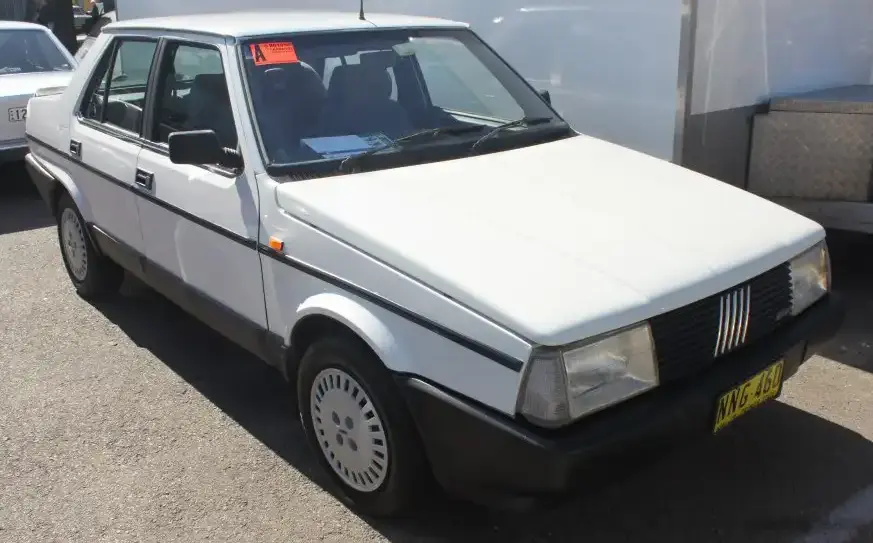
The Fiat Regata 75 1.5, produced between 1983 and 1987, represented an entry-level offering within the Regata (Type 138) lineup. Positioned as a practical and affordable family sedan, it served as a successor to the Fiat 132, aiming to provide a modern alternative in the competitive European mid-size car segment. The Regata, and specifically this 75 hp variant, was intended to appeal to buyers prioritizing fuel efficiency and everyday usability over outright performance. It was a key model for Fiat during a period of modernization and expansion of their product range.
Technical Specifications
| Brand | Fiat |
| Model | Regata |
| Generation | Regata (138) |
| Type (Engine) | 75 1.5 (75 Hp) |
| Start of production | 1983 |
| End of production | 1987 |
| Powertrain Architecture | Internal Combustion engine |
| Body type | Sedan |
| Seats | 5 |
| Doors | 4 |
| Fuel Type | Petrol (Gasoline) |
| Power | 75 Hp |
| Engine Model/Code | 138 C3.048 |
| Engine aspiration | Naturally aspirated engine |
| Trunk (boot) space – minimum | 513 l / 18.12 cu. ft. |
| Fuel tank capacity | 55 l / 14.53 US gal | 12.1 UK gal |
| Length | 4260 mm / 167.72 in. |
| Width | 1650 mm / 64.96 in. |
| Height | 1410 mm / 55.51 in. |
| Front overhang | 820 mm / 32.28 in. |
| Rear overhang | 992 mm / 39.06 in. |
Powertrain & Engine Architecture
The Regata 75 1.5 was powered by Fiat’s 138 C3.048 engine, a 1.5-liter inline-four cylinder gasoline engine. This engine was a relatively simple design, featuring a single overhead camshaft (SOHC) operating two valves per cylinder. Fuel delivery was managed by a Weber carburetor, a common setup for vehicles of this era, prioritizing simplicity and cost-effectiveness over the more advanced fuel injection systems. The engine produced 75 horsepower at approximately 5600 rpm and 98 lb-ft of torque at 3600 rpm. The engine block was cast iron, contributing to its durability, while the cylinder head was aluminum. The transmission paired with this engine was typically a three-speed automatic, although a five-speed manual was also available on other Regata models. The automatic transmission was designed for smooth, comfortable shifts, prioritizing ease of use over sporty performance. It was a conventional hydraulic automatic, lacking the electronic controls found in later transmissions.
Driving Characteristics
The driving experience in the Regata 75 1.5 Automatic was characterized by its relaxed and unhurried nature. The 75 horsepower engine, coupled with the three-speed automatic transmission, provided adequate, but not exhilarating, performance. Acceleration was modest, and overtaking required careful planning. The automatic transmission’s gear ratios were geared towards fuel economy and smooth cruising rather than rapid acceleration. The gear changes were noticeable, but generally smooth. The Regata’s suspension, consisting of MacPherson struts at the front and a twist-beam axle at the rear, provided a comfortable ride, absorbing bumps and imperfections in the road reasonably well. However, handling was not particularly sharp, with noticeable body roll in corners. Compared to the more powerful Regata 100 or the diesel variants, the 75 1.5 Automatic felt significantly slower and less responsive. The manual transmission versions of the 1.5 offered a more engaging driving experience, allowing the driver to better utilize the engine’s available power.
Equipment & Trim Levels
The Regata 75 1.5 typically represented the base trim level. Standard equipment included cloth upholstery, basic instrumentation (speedometer, fuel gauge, temperature gauge), and a four-spoke steering wheel. The interior was functional and durable, but lacked the refinement of higher-spec models. Optional extras included a radio, upgraded upholstery, and power windows. The dashboard layout was straightforward and easy to use, with clearly labeled controls. Air conditioning was often an optional extra, and not typically included as standard on the base model. The exterior featured steel wheels with hubcaps, and relatively simple trim. The overall impression was one of practicality and affordability, rather than luxury or style.
Chassis & Braking
The Regata 75 1.5 utilized a relatively conventional chassis design. The front suspension employed MacPherson struts, providing a good balance of ride comfort and handling. The rear suspension featured a twist-beam axle, a cost-effective and space-efficient solution. Braking was initially provided by front disc brakes and rear drum brakes. Later models may have featured rear disc brakes as standard. The braking system was adequate for the vehicle’s weight and performance, but lacked the stopping power of more modern systems. Steering was rack and pinion, providing reasonable precision and feedback. The Regata’s overall weight was moderate, contributing to its relatively good fuel economy. Stabilizer bars were typically fitted to the front suspension to reduce body roll, but were not always standard on the base model.
Market Reception & Comparison
The Fiat Regata 75 1.5 Automatic was generally well-received as a practical and affordable family car. Critics praised its comfortable ride, fuel efficiency, and spacious interior. However, it was often criticized for its lack of performance and somewhat dated styling. Compared to rivals such as the Ford Escort and Opel Ascona, the Regata offered a competitive price point, but lacked the same level of refinement and driving dynamics. The 1.8 liter and diesel variants of the Regata offered superior performance and fuel economy, respectively, appealing to different segments of the market. The Regata 75 1.5 Automatic was primarily targeted at buyers who prioritized comfort, practicality, and affordability over sporty handling or rapid acceleration. Fuel economy was a key selling point, particularly in Europe where gasoline prices were relatively high.
Legacy
The Fiat Regata 75 1.5, while not a particularly groundbreaking vehicle, played an important role in Fiat’s lineup during the 1980s. The 138 C3.048 engine proved to be reasonably reliable, and many examples are still on the road today. However, age and neglect have taken their toll, and finding well-maintained examples is becoming increasingly difficult. The automatic transmission, while durable, can be prone to wear and tear with high mileage. The Regata’s simple design and readily available parts make it relatively easy to maintain and repair. In the used car market, the Regata 75 1.5 is typically valued as an affordable and practical classic, appealing to enthusiasts and those seeking a simple, reliable mode of transportation. It represents a snapshot of 1980s European automotive design and engineering, offering a glimpse into a bygone era of motoring.
