
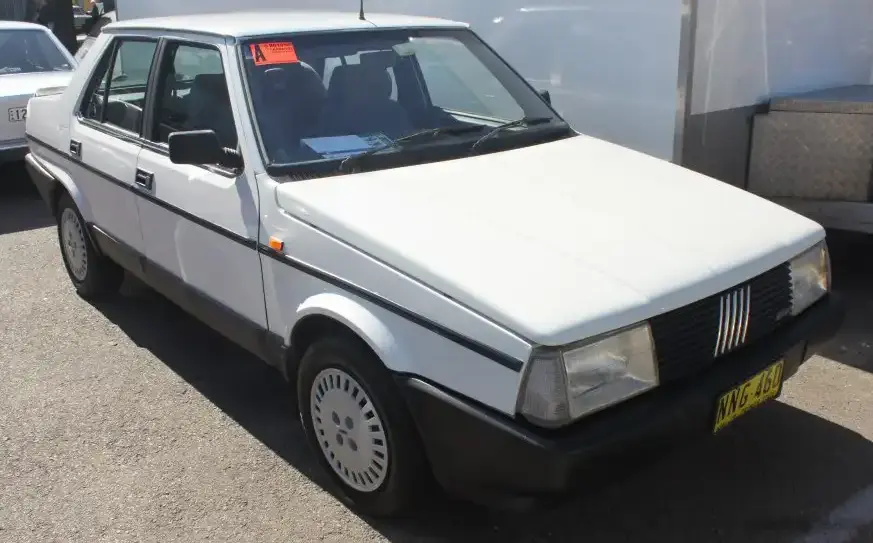
The Fiat Regata 75 i.e. 1.5 (75 hp) CAT, produced between 1985 and 1989, represented a mid-range offering within the Regata (Type 138) lineup. Positioned above the base models and below the more powerful 100 i.e. variant, this version aimed to balance affordability with a reasonable level of performance and refinement. The Regata itself was Fiat’s replacement for the aging Fiat 134, offering a more modern design and improved mechanicals. It was primarily a European market vehicle, intended to compete with other compact sedans like the Volkswagen Jetta and Opel Kadett.
Technical Specifications
| Brand | Fiat |
| Model | Regata |
| Generation | Regata (138) |
| Type (Engine) | 75 i.e. 1.5 (75 Hp) CAT |
| Start of production | 1985 |
| End of production | 1989 |
| Powertrain Architecture | Internal Combustion engine |
| Body type | Sedan |
| Seats | 5 |
| Doors | 4 |
| Fuel consumption (urban) | 9.4 l/100 km (25 US mpg, 30.1 UK mpg) |
| Fuel consumption (extra urban) | 5.9 l/100 km (39.9 US mpg, 47.9 UK mpg) |
| Fuel consumption (combined) | 7.7 l/100 km (30.5 US mpg, 36.7 UK mpg) |
| Fuel Type | Petrol (Gasoline) |
| Acceleration 0 – 100 km/h | 12 sec |
| Acceleration 0 – 62 mph | 12 sec |
| Acceleration 0 – 60 mph | 11.4 sec |
| Maximum speed | 165 km/h (102.53 mph) |
| Weight-to-power ratio | 12.1 kg/Hp |
| Weight-to-torque ratio | 8.4 kg/Nm |
| Power | 75 Hp @ 5500 rpm |
| Power per litre | 50.1 Hp/l |
| Torque | 108 Nm @ 3000 rpm (79.66 lb.-ft. @ 3000 rpm) |
| Engine layout | Front, Transverse |
| Engine Model/Code | 149A3.000 |
| Engine displacement | 1498 cm3 (91.41 cu. in.) |
| Number of cylinders | 4 |
| Engine configuration | Inline |
| Number of valves per cylinder | 2 |
| Fuel injection system | Multi-port manifold injection |
| Engine aspiration | Naturally aspirated engine |
| Valvetrain | SOHC |
| Engine oil capacity | 4.1 l (4.33 US qt, 3.61 UK qt) |
| Coolant capacity | 7 l (7.4 US qt, 6.16 UK qt) |
| Kerb Weight | 910 kg (2006.21 lbs) |
| Trunk (boot) space (minimum) | 513 l (18.12 cu. ft.) |
| Fuel tank capacity | 55 l (14.53 US gal, 12.1 UK gal) |
| Permitted trailer load with brakes (12%) | 1000 kg (2204.62 lbs) |
| Length | 4260 mm (167.72 in) |
| Width | 1650 mm (64.96 in) |
| Height | 1410 mm (55.51 in) |
| Wheelbase | 2455 mm (96.65 in) |
| Front overhang | 820 mm (32.28 in) |
| Rear overhang | 992 mm (39.06 in) |
| Minimum turning circle | 10.3 m (33.79 ft) |
| Drivetrain Architecture | Front wheel drive |
| Number of gears and type of gearbox | 5 gears, manual transmission |
| Front suspension | Independent, McPherson with coil spring and anti-roll bar |
| Rear suspension | Leaf spring |
| Front brakes | Disc |
| Rear brakes | Drum |
| Steering type | Steering rack and pinion |
| Tires size | 165/70 R13 |
Powertrain & Engine Architecture
The heart of the Regata 75 i.e. was the Fiat 149A3.000, a 1.5-liter inline-four cylinder engine. This engine featured a single overhead camshaft (SOHC) valvetrain operating two valves per cylinder. Crucially, this version incorporated Bosch multi-port fuel injection and a catalytic converter (hence the “i.e.” and “CAT” designation), making it a relatively modern engine for its time, and meeting increasingly stringent emissions regulations. The engine produced 75 horsepower at 5500 rpm and 108 Nm (79.66 lb-ft) of torque at 3000 rpm. The engine’s design was relatively simple and robust, prioritizing reliability over outright performance. The five-speed manual transmission was the standard offering, providing a reasonable spread of gears for both city driving and highway cruising.
Driving Characteristics
The Regata 75 i.e. offered a comfortable, if not particularly exciting, driving experience. Acceleration from 0 to 60 mph took around 11.4 seconds, and top speed was approximately 102.53 mph. The 1.5-liter engine provided adequate power for everyday driving, but it wasn’t overly eager to rev. The five-speed gearbox allowed drivers to keep the engine in its optimal power band, but the overall experience was geared towards fuel efficiency and ease of use rather than sporty handling. Compared to the more powerful 100 i.e. version, the 75 i.e. felt noticeably slower, especially when fully loaded or climbing hills. However, the difference in fuel economy was significant, making the 75 i.e. a more practical choice for many buyers.
Equipment & Trim Levels
The Regata 75 i.e. typically came equipped with features considered standard for a mid-range European sedan in the mid-1980s. This included cloth upholstery, a basic instrument cluster, and manual windows and door locks. Optional extras included a sunroof, upgraded stereo system, and central locking. The interior design was functional and straightforward, prioritizing practicality over luxury. Trim levels varied slightly depending on the market, but generally, the 75 i.e. offered a step up in terms of interior appointments compared to the base Regata models.
Chassis & Braking
The Regata utilized a front-engine, front-wheel-drive layout. The front suspension employed an independent McPherson strut design with coil springs and an anti-roll bar, providing a comfortable ride and reasonable handling. The rear suspension, however, utilized a simpler leaf spring setup, which was more cost-effective but less sophisticated. Braking was accomplished via disc brakes at the front and drum brakes at the rear. The braking system was adequate for the car’s weight and performance, but it lacked the stopping power of more modern systems. Steering was via a rack and pinion system, providing reasonably precise control.
Market Reception & Comparison
The Fiat Regata 75 i.e. was generally well-received by automotive critics as a practical and affordable family sedan. It was praised for its fuel efficiency, comfortable ride, and relatively spacious interior. However, it was often criticized for its lack of performance and somewhat dated styling. Compared to the more powerful 100 i.e. version, the 75 i.e. offered better fuel economy and a lower purchase price, making it a more attractive option for budget-conscious buyers. Against competitors like the Volkswagen Jetta and Opel Kadett, the Regata offered a comparable level of practicality and affordability, but often lacked the brand prestige of its German rivals.
Legacy
The Fiat Regata 75 i.e. 1.5, while not a particularly iconic model, represents a significant step forward in Fiat’s engineering and design. The 149A3.000 engine proved to be a reliable and durable unit, and many examples are still on the road today. In the used car market, the Regata 75 i.e. is often sought after by enthusiasts looking for a classic Italian sedan that is relatively easy to maintain and repair. Its simplicity and robust construction make it a good choice for those who appreciate classic automotive engineering. While not a performance car, the Regata 75 i.e. offers a charming and practical driving experience that is reminiscent of a bygone era.
