
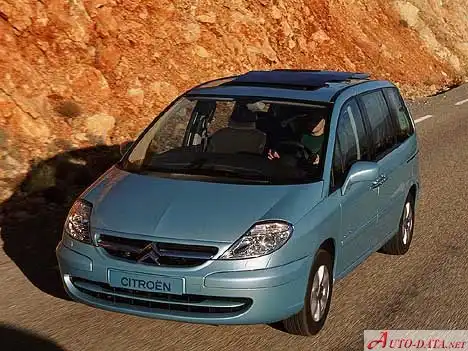
The Citroen C8 2.0i 16V Automatic, produced between 2002 and 2005, represents a key variant within the first generation (Phase I) of Citroen’s large MPV offering. Sharing a platform – the PSA Group’s 1HX0 – with the Peugeot 807 and Fiat Ulysse, the C8 aimed to provide a spacious and comfortable family vehicle. This particular 2.0-liter, 136 horsepower configuration, paired with a four-speed automatic transmission, served as a mid-range option, positioned between the base models and the more powerful V6 variants. It was primarily marketed in Europe, offering a balance of affordability and usability for families needing seven-passenger capacity and ample cargo space.
Technical Specifications
| Brand | Citroen |
| Model | C8 |
| Generation | C8 (Phase I) |
| Type (Engine) | 2.0i 16V (136 Hp) Automatic |
| Start of production | 2002 |
| End of production | 2005 |
| Powertrain Architecture | Internal Combustion engine |
| Body type | Minivan, MPV |
| Seats | 7 |
| Doors | 5 |
| Fuel consumption (urban) | 13.3 l/100 km (17.7 US mpg, 21.2 UK mpg, 7.5 km/l) |
| Fuel consumption (extra urban) | 7.5 l/100 km (31.4 US mpg, 37.7 UK mpg, 13.3 km/l) |
| Fuel consumption (combined) | 9.6 l/100 km (24.5 US mpg, 29.4 UK mpg, 10.4 km/l) |
| CO2 emissions | 229 g/km |
| Fuel Type | Petrol (Gasoline) |
| Acceleration 0 – 100 km/h | 12.9 sec |
| Acceleration 0 – 62 mph | 12.9 sec |
| Acceleration 0 – 60 mph | 12.3 sec |
| Maximum speed | 184 km/h (114.33 mph) |
| Emission standard | Euro 4 |
| Weight-to-power ratio | 12.2 kg/Hp, 82 Hp/tonne |
| Weight-to-torque ratio | 8.7 kg/Nm, 114.5 Nm/tonne |
| Power | 136 Hp @ 6000 rpm |
| Power per litre | 68.1 Hp/l |
| Torque | 190 Nm @ 4100 rpm (140.14 lb.-ft. @ 4100 rpm) |
| Engine layout | Front, Transverse |
| Engine Model/Code | RFN EW10 J4-L4 |
| Engine displacement | 1997 cm3 (121.86 cu. in.) |
| Number of cylinders | 4 |
| Engine configuration | Inline |
| Cylinder Bore | 85 mm (3.35 in.) |
| Piston Stroke | 88 mm (3.46 in.) |
| Compression ratio | 10.8:1 |
| Number of valves per cylinder | 4 |
| Fuel injection system | Multi-port manifold injection |
| Engine aspiration | Naturally aspirated engine |
| Engine oil capacity | 4.3 l (4.54 US qt | 3.78 UK qt) |
| Coolant | 7.2 l (7.61 US qt | 6.34 UK qt) |
| Kerb Weight | 1659 kg (3657.47 lbs.) |
| Max. weight | 2435 kg (5368.26 lbs.) |
| Max load | 776 kg (1710.79 lbs.) |
| Trunk (boot) space – minimum | 225 l (7.95 cu. ft.) |
| Trunk (boot) space – maximum | 2948 l (104.11 cu. ft.) |
| Fuel tank capacity | 80 l (21.13 US gal | 17.6 UK gal) |
| Max. roof load | 100 kg (220.46 lbs.) |
| Permitted trailer load with brakes (12%) | 900 kg (1984.16 lbs.) |
| Permitted trailer load without brakes | 500 kg (1102.31 lbs.) |
| Permitted towbar download | 40 kg (88.18 lbs.) |
| Length | 4727 mm (186.1 in.) |
| Width | 1854 mm (72.99 in.) |
| Width with mirrors folded | 1952 mm (76.85 in.) |
| Width including mirrors | 2205 mm (86.81 in.) |
| Height | 1766-1856 mm (69.53 – 73.07 in.) |
| Wheelbase | 2823 mm (111.14 in.) |
| Front track | 1570 mm (61.81 in.) |
| Rear (Back) track | 1548 mm (60.94 in.) |
| Front overhang | 1013 mm (39.88 in.) |
| Rear overhang | 891 mm (35.08 in.) |
| Minimum turning circle | 11.62 m (38.12 ft.) |
| Drivetrain Architecture | The Internal combustion engine (ICE) drives the front wheels of the vehicle. |
| Drive wheel | Front wheel drive |
| Number of gears and type of gearbox | 4 gears, automatic transmission |
| Front suspension | Independent, type McPherson with coil spring and anti-roll bar |
| Rear suspension | Semi-independent, coil spring |
| Front brakes | Ventilated discs |
| Rear brakes | Disc |
| Assisting systems | ABS (Anti-lock braking system) |
| Steering type | Steering rack and pinion |
| Power steering | Hydraulic Steering |
| Tires size | 205/65 R15 |
| Wheel rims size | 6.5J x 15 |
Powertrain & Engine Architecture
The C8 2.0i 16V utilizes the PSA Group’s RFN engine code, a 1.997-liter inline-four cylinder gasoline engine. This engine, part of the EW10 family, features a cast iron block and aluminum cylinder head. It employs multi-point fuel injection and a dual overhead camshaft (DOHC) valvetrain with four valves per cylinder, contributing to its relatively high output for its displacement. The 136 horsepower peak is achieved at 6000 rpm, while the 190 Nm (140 lb-ft) of torque is available at 4100 rpm. The engine is transversely mounted in the front of the vehicle. The four-speed automatic transmission, while providing convenience, is a somewhat dated design by modern standards. It lacks the efficiency and smoothness of more contemporary automatic gearboxes with more ratios.
Driving Characteristics
The 2.0i Automatic C8 offers adequate, but not particularly exhilarating, performance. The 0-60 mph time of around 12.3 seconds reflects this. The four-speed automatic transmission contributes to a noticeable lack of urgency, especially during overtaking maneuvers. Gear ratios are spaced to prioritize fuel economy and smooth cruising rather than rapid acceleration. Compared to the more powerful 2.9-liter V6 versions, the 2.0i feels significantly underpowered, particularly when fully loaded with passengers and luggage. The manual transmission variants of the 2.0i offered a more engaging driving experience and slightly improved fuel economy. However, the automatic was favored by buyers prioritizing ease of use and comfort.
Equipment & Trim Levels
The 2.0i Automatic C8 typically came equipped with features such as air conditioning, power windows, central locking, and an RDS radio. Higher trim levels, often denoted by additional packages, added features like alloy wheels, rear parking sensors, and upgraded interior trim. Interior upholstery was generally cloth, with options for leather available at extra cost. Dashboard configuration was relatively straightforward, prioritizing functionality over stylistic flair. Optional extras included a sunroof, navigation system (a rarity for the time), and a DVD entertainment system for rear passengers.
Chassis & Braking
The C8’s chassis features an independent McPherson strut suspension at the front and a semi-independent coil spring suspension at the rear. This setup provides a reasonably comfortable ride, although it can feel somewhat wallowy when cornering, especially with a full load. Front brakes are ventilated discs, while rear brakes are solid discs. ABS (Anti-lock Braking System) is standard. The steering is hydraulic power-assisted rack and pinion, offering reasonable precision but lacking significant feedback. Stabilizer bars are fitted to both the front and rear axles to reduce body roll.
Market Reception & Comparison
The Citroen C8 2.0i Automatic was generally well-received as a practical and spacious family vehicle. Critics praised its comfortable ride and generous interior space. However, the engine was often criticized for being underpowered, particularly when compared to the V6 options. Fuel economy, while acceptable, wasn’t a standout feature. Compared to rivals like the Renault Espace and Volkswagen Sharan, the C8 offered a competitive package in terms of price and features, but often lagged behind in terms of driving dynamics and perceived build quality. The 2.0i Automatic was seen as a sensible choice for buyers prioritizing affordability and ease of use over performance.
Legacy
The RFN engine, while generally reliable, is known to be susceptible to timing belt failure if not maintained properly. Regular servicing, including timely replacement of the timing belt, is crucial for long-term reliability. The four-speed automatic transmission, while durable, can exhibit wear and tear over time, leading to harsh shifting or slippage. Today, the C8 2.0i Automatic can be found on the used car market at very affordable prices. It represents a budget-friendly option for those needing a spacious seven-seater, but potential buyers should be aware of the potential maintenance costs associated with its age and mileage. Its enduring appeal lies in its practicality and the sheer amount of space it offers for the money.
