
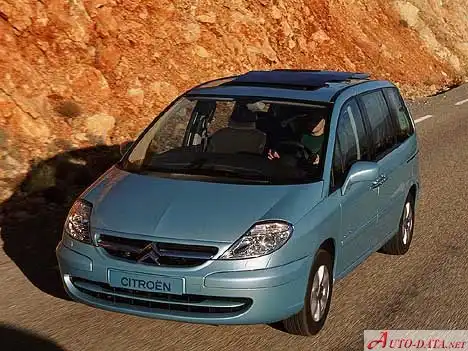
Technical Specifications
| Brand | Citroen |
| Model | C8 |
| Generation | C8 (Phase I) |
| Type (Engine) | 2.0i 16V (140 Hp) |
| Start of production | 2005 |
| End of production | 2008 |
| Powertrain Architecture | Internal Combustion engine |
| Body type | Minivan, MPV |
| Seats | 7 |
| Doors | 5 |
| Fuel consumption (urban) | 12 l/100 km (19.6 US mpg, 23.5 UK mpg, 8.3 km/l) |
| Fuel consumption (extra urban) | 7.3 l/100 km (32.2 US mpg, 38.7 UK mpg, 13.7 km/l) |
| Fuel consumption (combined) | 9 l/100 km (26.1 US mpg, 31.4 UK mpg, 11.1 km/l) |
| CO2 emissions | 213 g/km |
| Fuel Type | Petrol (Gasoline) |
| Acceleration 0 – 100 km/h | 11.6 sec |
| Acceleration 0 – 62 mph | 11.6 sec |
| Acceleration 0 – 60 mph | 11 sec |
| Maximum speed | 188 km/h (116.82 mph) |
| Emission standard | Euro 4 |
| Weight-to-power ratio | 11.7 kg/Hp, 85.8 Hp/tonne |
| Weight-to-torque ratio | 8.2 kg/Nm, 122.6 Nm/tonne |
| Power | 140 Hp @ 6000 rpm |
| Power per litre | 70.1 Hp/l |
| Torque | 200 Nm @ 4000 rpm (147.51 lb.-ft. @ 4000 rpm) |
| Engine layout | Front, Transverse |
| Engine Model/Code | RFJ EW10A |
| Engine displacement | 1997 cm3 (121.86 cu. in.) |
| Number of cylinders | 4 |
| Engine configuration | Inline |
| Cylinder Bore | 85 mm (3.35 in.) |
| Piston Stroke | 88 mm (3.46 in.) |
| Compression ratio | 10.8:1 |
| Number of valves per cylinder | 4 |
| Fuel injection system | Multi-port manifold injection |
| Engine aspiration | Naturally aspirated engine |
| Engine oil capacity | 5 l (5.28 US qt | 4.4 UK qt) |
| Coolant | 7 l (7.4 US qt | 6.16 UK qt) |
| Kerb Weight | 1631 kg (3595.74 lbs.) |
| Max. weight | 2405 kg (5302.12 lbs.) |
| Max load | 774 kg (1706.38 lbs.) |
| Trunk (boot) space – minimum | 225 l (7.95 cu. ft.) |
| Trunk (boot) space – maximum | 2948 l (104.11 cu. ft.) |
| Fuel tank capacity | 80 l (21.13 US gal | 17.6 UK gal) |
| Max. roof load | 100 kg (220.46 lbs.) |
| Permitted trailer load with brakes (12%) | 1700 kg (3747.86 lbs.) |
| Permitted trailer load without brakes | 750 kg (1653.47 lbs.) |
| Permitted towbar download | 76 kg (167.55 lbs.) |
| Length | 4727 mm (186.1 in.) |
| Width | 1854 mm (72.99 in.) |
| Width with mirrors folded | 1952 mm (76.85 in.) |
| Width including mirrors | 2205 mm (86.81 in.) |
| Height | 1766-1856 mm (69.53 – 73.07 in.) |
| Wheelbase | 2823 mm (111.14 in.) |
| Front track | 1570 mm (61.81 in.) |
| Rear (Back) track | 1548 mm (60.94 in.) |
| Front overhang | 1013 mm (39.88 in.) |
| Rear overhang | 891 mm (35.08 in.) |
| Minimum turning circle (turning diameter) | 11.62 m (38.12 ft.) |
| Drivetrain Architecture | The Internal combustion engine (ICE) drives the front wheels of the vehicle. |
| Drive wheel | Front wheel drive |
| Number of gears and type of gearbox | 5 gears, manual transmission |
| Front suspension | Independent, type McPherson with coil spring and anti-roll bar |
| Rear suspension | Semi-independent, coil spring |
| Front brakes | Ventilated discs |
| Rear brakes | Disc |
| Assisting systems | ABS (Anti-lock braking system) |
| Steering type | Steering rack and pinion |
| Power steering | Hydraulic Steering |
| Tires size | 205/65 R15 |
| Wheel rims size | 6.5J x 15 |
The Citroen C8 2.0i 16V, produced between 2005 and 2008, represents the initial phase (Phase I) of Citroen’s foray into the large MPV (Multi-Purpose Vehicle) segment. Developed in collaboration with Peugeot and Fiat – resulting in the Peugeot 807 and Fiat Ulysse respectively – the C8 aimed to provide a spacious and comfortable family vehicle. This particular 2.0-liter, 140 horsepower variant occupied a mid-range position within the C8 lineup, offering a balance between affordability and performance, positioned below the more powerful 2.2-liter petrol and 2.0-liter HDi diesel options. The C8 was built on the PSA Group’s 1HX0 platform, shared with its Peugeot and Fiat siblings, and was primarily marketed in Europe.
Powertrain & Engine Architecture
The C8 2.0i 16V utilizes the PSA Group’s EW10A engine, specifically the RFJ variant. This is a 1.997-liter (121.86 cubic inches) inline-four cylinder engine. It features a naturally aspirated configuration with a multi-port fuel injection system. The engine produces 140 horsepower at 6000 rpm and 200 Nm (147.51 lb-ft) of torque at 4000 rpm. The engine’s 16 valves (four per cylinder) contribute to its breathing efficiency. The engine code RFJ indicates a specific calibration for the C8 application. The engine is transversely mounted in the front of the vehicle. The C8 2.0i 16V was typically paired with a five-speed manual transmission, although a four-speed automatic transmission was also available, impacting acceleration and fuel economy. The automatic transmission, while offering convenience, generally resulted in slightly slower acceleration times and increased fuel consumption compared to the manual version.
Driving Characteristics
The 2.0i 16V C8 offered adequate, but not particularly exhilarating, performance. With 140 horsepower propelling a relatively heavy vehicle (around 3600 lbs), acceleration from 0 to 60 mph took approximately 11 seconds. The engine felt most comfortable in the mid-range, providing sufficient power for everyday driving and highway cruising. The automatic transmission, when equipped, offered smooth shifts but could sometimes feel hesitant during quick acceleration maneuvers. Compared to the more powerful 2.2-liter petrol engine, the 2.0i felt noticeably less responsive. However, it offered a more refined driving experience than the diesel variants, with less engine noise and vibration. The gear ratios in the five-speed manual were well-spaced, allowing the driver to keep the engine in its optimal power band.
Equipment & Trim Levels
The C8 2.0i 16V typically came with a reasonable level of standard equipment. This included power windows, central locking, air conditioning, and an audio system. Higher trim levels, such as the Exclusive, added features like alloy wheels, rear parking sensors, a sunroof, and upgraded interior trim. Interior upholstery was typically cloth, with options for leather available on higher-spec models. The dashboard layout was functional and straightforward, prioritizing ease of use. Optional extras included a navigation system, a DVD player for the rear passengers, and various comfort and convenience packages.
Chassis & Braking
The C8’s chassis featured an independent McPherson strut suspension at the front and a semi-independent coil spring suspension at the rear. This setup provided a comfortable ride, absorbing bumps and imperfections in the road surface effectively. The front brakes were ventilated discs, offering good stopping power, while the rear brakes were solid discs. Anti-lock Braking System (ABS) was standard, enhancing safety. The C8’s steering was hydraulic power-assisted, providing a light and responsive feel. Stabilizer bars were fitted to both the front and rear axles to reduce body roll during cornering.
Market Reception & Comparison
The Citroen C8 2.0i 16V was generally well-received by critics as a practical and comfortable family vehicle. However, it wasn’t considered a standout performer in its class. The 2.0-liter engine was seen as adequate for most drivers, but some reviewers felt it was underpowered for a vehicle of the C8’s size and weight. Fuel economy was reasonable, but not class-leading. Compared to the 2.0-liter HDi diesel variant, the petrol engine offered less fuel efficiency but a quieter and more refined driving experience. The C8 faced competition from other large MPVs such as the Renault Espace, Volkswagen Sharan, and Ford Galaxy.
Legacy
The Citroen C8 2.0i 16V, while not the most sought-after variant, remains a relatively reliable and affordable MPV in the used car market. The EW10A engine is known for its durability, provided it has been properly maintained. Common issues include occasional problems with the electronic throttle control and the cooling system. The automatic transmission, if not serviced regularly, can experience wear and tear. Overall, the C8 2.0i 16V represents a practical and spacious family vehicle that offers good value for money, particularly for those seeking a comfortable and reliable MPV without the need for high performance.
