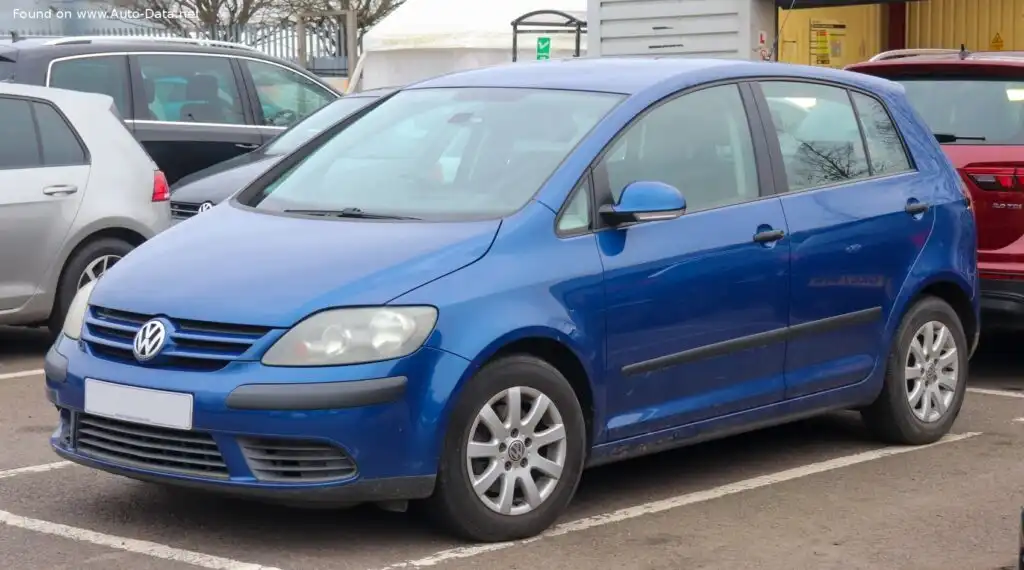
The Volkswagen Golf V Plus 1.4 TSI (122 hp) was a compact minivan produced between June 2007 and November 2008, representing a practical and versatile iteration of the fifth-generation Golf (Golf V) platform – internally designated the 1HX0/A3. Positioned as a slightly more spacious and family-oriented alternative to the standard Golf hatchback, the Golf V Plus aimed to bridge the gap between the traditional hatchback and larger MPV offerings. This particular variant, powered by the 1.4-liter TSI engine paired with a six-speed manual transmission, occupied a mid-range position within the Golf V Plus lineup, offering a balance of fuel efficiency, performance, and affordability.
Technical Specifications
| Brand | Volkswagen |
| Model | Golf |
| Generation | Golf V Plus |
| Type (Engine) | 1.4 TSI (122 Hp) |
| Start of production | June, 2007 |
| End of production | November, 2008 |
| Powertrain Architecture | Internal Combustion engine |
| Body type | Minivan |
| Seats | 5 |
| Doors | 5 |
| Fuel consumption (urban) | 8.6 l/100 km (27.4 US mpg, 32.8 UK mpg, 11.6 km/l) |
| Fuel consumption (extra urban) | 5.5 l/100 km (42.8 US mpg, 51.4 UK mpg, 18.2 km/l) |
| Fuel consumption (combined) | 6.6 l/100 km (35.6 US mpg, 42.8 UK mpg, 15.2 km/l) |
| Fuel Type | Petrol (Gasoline) |
| Acceleration 0 – 100 km/h | 10.1 sec |
| Acceleration 0 – 62 mph | 10.1 sec |
| Acceleration 0 – 60 mph | 9.6 sec |
| Maximum speed | 194 km/h (120.55 mph) |
| Emission standard | Euro 4 |
| Weight-to-power ratio | 10.8 kg/Hp, 92.6 Hp/tonne |
| Weight-to-torque ratio | 6.6 kg/Nm, 151.7 Nm/tonne |
| Power | 122 Hp @ 5000 rpm |
| Power per litre | 87.8 Hp/l |
| Torque | 200 Nm @ 1500-4000 rpm (147.51 lb.-ft. @ 1500-4000 rpm) |
| Engine layout | Front, Transverse |
| Engine Model/Code | CAXA |
| Engine displacement | 1390 cm3 (84.82 cu. in.) |
| Number of cylinders | 4 |
| Engine configuration | Inline |
| Cylinder Bore | 76.5 mm (3.01 in.) |
| Piston Stroke | 75.6 mm (2.98 in.) |
| Number of valves per cylinder | 4 |
| Fuel injection system | Direct injection |
| Engine aspiration | Turbocharger, Intercooler |
| Valvetrain | DOHC |
| Engine oil capacity | 3.6 l (3.8 US qt | 3.17 UK qt) |
| Kerb Weight | 1318 kg (2905.69 lbs.) |
| Trunk (boot) space – minimum | 395 l (13.95 cu. ft.) |
| Trunk (boot) space – maximum | 1450 l (51.21 cu. ft.) |
| Fuel tank capacity | 55 l (14.53 US gal | 12.1 UK gal) |
| Length | 4206 mm (165.59 in.) |
| Width | 1759 mm (69.25 in.) |
| Height | 1580 mm (62.2 in.) |
| Wheelbase | 2578 mm (101.5 in.) |
| Front track | 1539 mm (60.59 in.) |
| Rear (Back) track | 1528 mm (60.16 in.) |
| Drivetrain Architecture | The Internal combustion engine (ICE) drives the front wheels of the vehicle. |
| Drive wheel | Front wheel drive |
| Number of gears and type of gearbox | 6 gears, manual transmission |
| Front suspension | Spring Strut |
| Rear suspension | Coil spring |
| Front brakes | Ventilated discs |
| Rear brakes | Disc |
| Assisting systems | ABS (Anti-lock braking system) |
| Steering type | Steering rack and pinion |
| Tires size | 195/65 R15H |
| Wheel rims size | 6J x 15 |
Powertrain & Engine Architecture
At the heart of the Golf V Plus 1.4 TSI was the CAXA engine code, a 1.4-liter inline-four cylinder gasoline engine. This engine was a key component of Volkswagen’s New Engine Family (NEF), known for its advanced technology and efficiency. The “TSI” designation stands for Turbocharged Stratified Injection, highlighting the engine’s core features. It employed direct fuel injection, delivering fuel directly into the combustion chamber for improved combustion efficiency and reduced emissions. A single turbocharger, often with an intercooler, provided forced induction, boosting power output. The engine utilized a dual overhead camshaft (DOHC) valvetrain with four valves per cylinder, optimizing airflow for enhanced performance. The six-speed manual transmission offered precise gear changes and contributed to the vehicle’s overall responsiveness.
Driving Characteristics
The 122 hp output of the 1.4 TSI engine, coupled with the six-speed manual transmission, provided adequate performance for everyday driving. Acceleration from 0 to 60 mph took approximately 9.6 seconds, and the vehicle reached a top speed of 194 km/h (120.55 mph). While not a sports car, the engine delivered a usable amount of torque (200 Nm or 147.51 lb-ft) across a broad rev range (1500-4000 rpm), making it suitable for both city driving and highway cruising. Compared to the more powerful 1.6L or 2.0L TSI variants, this engine prioritized fuel economy over outright speed. The manual transmission allowed for greater driver control, but the gear ratios were tuned for efficiency rather than aggressive acceleration.
Equipment & Trim Levels
The Golf V Plus 1.4 TSI typically came with a reasonable level of standard equipment. This included power windows, central locking, air conditioning, and an audio system. Interior upholstery was generally cloth, with options for upgraded materials. The dashboard layout was functional and straightforward, typical of Volkswagen’s design philosophy at the time. Optional extras included alloy wheels, a sunroof, parking sensors, and a more advanced audio system with navigation. The Golf V Plus aimed for a balance between practicality and comfort, offering a well-equipped interior without the premium price tag of higher-end trims.
Chassis & Braking
The Golf V Plus utilized a front-wheel-drive layout with a MacPherson strut suspension in the front and a coil spring suspension in the rear. The suspension was tuned for comfort and stability, providing a reasonably smooth ride. Braking duties were handled by ventilated discs at the front and solid discs at the rear. Anti-lock Braking System (ABS) was standard, enhancing safety during emergency braking situations. The chassis was designed to accommodate the slightly increased weight and dimensions of the Golf V Plus compared to the standard Golf hatchback.
Market Reception & Comparison
The Golf V Plus 1.4 TSI was generally well-received by automotive critics as a practical and fuel-efficient option in the compact minivan segment. It was praised for its spacious interior, comfortable ride, and refined engine. However, some reviewers noted that the 1.4 TSI engine could feel underpowered when fully loaded or driving uphill. Compared to the higher-output TSI engines, the 1.4 TSI offered better fuel economy but less exhilarating performance. Against competitors like the Renault Scenic and Opel Zafira, the Golf V Plus offered a more premium feel and a reputation for reliability.
Legacy
The 1.4 TSI engine, in various iterations, proved to be a reliable and durable powertrain. While some early versions experienced minor issues with the turbocharger or fuel injectors, these were generally addressed through software updates and improved component designs. Today, the Golf V Plus 1.4 TSI remains a popular choice in the used car market, particularly for buyers seeking a practical, fuel-efficient, and well-built compact minivan. Its relatively simple mechanical design and readily available parts contribute to its affordability and ease of maintenance. The Golf V Plus 1.4 TSI represents a solid example of Volkswagen’s engineering prowess and its commitment to providing versatile and reliable vehicles.