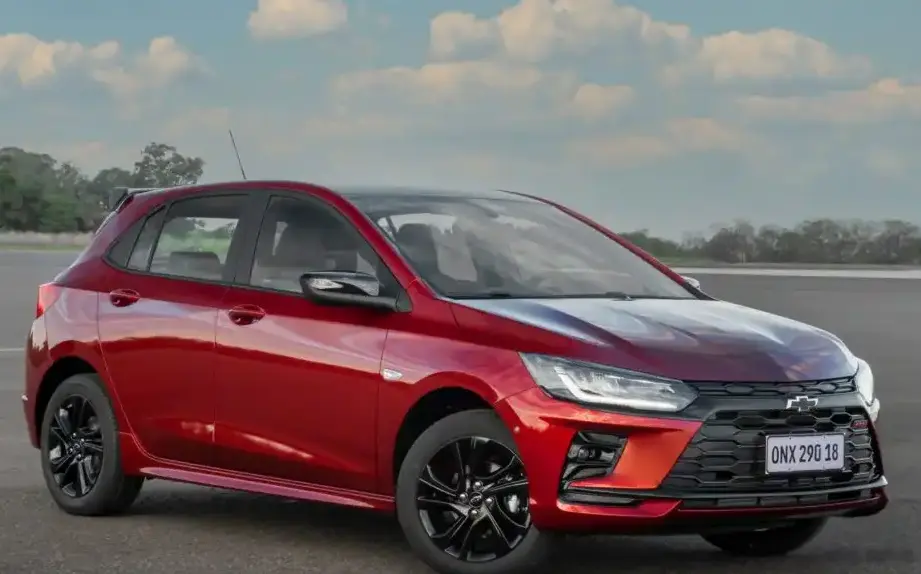
The Chevrolet Onix II, specifically the 1.0T (115 hp) Ethanol Automatic variant introduced with the 2025 facelift, represents a significant offering in the South American subcompact hatchback market. Launched in July 2025, this model builds upon the success of the second-generation Onix, aiming to provide an efficient and technologically equipped option for consumers. Positioned as a mid-range trim, it slots between the base 1.0L engine options and the more powerful 1.2T variants. The Onix II competes directly with vehicles like the Fiat Argo, Volkswagen Polo, and Hyundai HB20, offering a compelling blend of fuel economy, features, and value.
Technical Specifications
| Brand | Chevrolet |
| Model | Onix |
| Generation | Onix II (facelift 2025) |
| Type (Engine) | 1.0T (115 Hp) Ethanol Automatic |
| Start of production | July, 2025 |
| Powertrain Architecture | Internal Combustion engine |
| Body type | Hatchback |
| Seats | 5 |
| Doors | 5 |
| Fuel consumption (economy) – urban | 8.3 l/100 km (28.3 US mpg, 34 UK mpg, 12 km/l) |
| Fuel consumption (economy) – urban (Ethanol – E100) | 11.6 l/100 km |
| Fuel consumption (economy) – extra urban | 6.5 l/100 km (36.2 US mpg, 43.5 UK mpg, 15.4 km/l) |
| Fuel consumption (economy) – extra urban (Ethanol – E100) | 9.2 l/100 km |
| CO2 emissions | 121 g/km |
| CO2 emissions (Ethanol – E100) | 113 g/km |
| Fuel Type | Petrol / Ethanol – E100 |
| Acceleration 0 – 100 km/h | 10.5 sec |
| Acceleration 0 – 62 mph | 10.5 sec |
| Acceleration 0 – 60 mph | 10 sec |
| Maximum speed | 180 km/h (111.85 mph) |
| Weight-to-power ratio | 9.4 kg/Hp, 106 Hp/tonne |
| Weight-to-torque ratio | 6.8 kg/Nm, 147.5 Nm/tonne |
| Power | 115 Hp @ 5500 rpm |
| Power per litre | 115.1 Hp/l |
| Torque | 160 Nm @ 2000-4500 rpm (118.01 lb.-ft. @ 2000-4500 rpm) |
| Torque (Ethanol – E100) | 165 Nm @ 2000-4500 rpm |
| Maximum engine speed | 6000 rpm |
| Engine layout | Front, Transverse |
| Engine displacement | 999 cm3 (60.96 cu. in.) |
| Number of cylinders | 3 |
| Engine configuration | Inline |
| Cylinder Bore | 74 mm (2.91 in.) |
| Piston Stroke | 77.49 mm (3.05 in.) |
| Compression ratio | 10.5:1 |
| Number of valves per cylinder | 4 |
| Fuel injection system | Multi-port manifold injection |
| Engine aspiration | Turbocharger, Intercooler |
| Valvetrain | DOHC |
| Engine oil capacity | 3.75 l (3.96 US qt, 3.3 UK qt) |
| Coolant | 5.4 l (5.71 US qt, 4.75 UK qt) |
| Kerb Weight | 1085-1118 kg (2392.02 – 2464.77 lbs.) |
| Max. weight | 1460-1493 kg (3218.75 – 3291.5 lbs.) |
| Max load | 375 kg (826.73 lbs.) |
| Trunk (boot) space – minimum | 303 l (10.7 cu. ft.) |
| Trunk (boot) space – maximum | 1151 l (40.65 cu. ft.) |
| Fuel tank capacity | 44 l (11.62 US gal, 9.68 UK gal) |
| Length | 4169 mm (164.13 in.) |
| Width | 1746 mm (68.74 in.) |
| Width including mirrors | 2044 mm (80.47 in.) |
| Height | 1473-1474 mm (57.99 – 58.03 in.) |
| Wheelbase | 2551 mm (100.43 in.) |
| Front track | 1500 mm (59.06 in.) |
| Rear (Back) track | 1504 mm (59.21 in.) |
| Front overhang | 888 mm (34.96 in.) |
| Rear overhang | 730 mm (28.74 in.) |
| Ride height (ground clearance) | 157 mm (6.18 in.) |
| Drag coefficient (Cd) | 0.346-0.371 |
| Minimum turning circle (turning diameter) | 10.4 m (34.12 ft.) |
| Approach angle | 14° |
| Drivetrain Architecture | The Internal combustion engine (ICE) drives the front wheels of the vehicle. |
| Drive wheel | Front wheel drive |
| Number of gears and type of gearbox | 6 gears, automatic transmission |
| Front suspension | Independent, type McPherson with coil spring and anti-roll bar |
| Rear suspension | Semi-independent, coil spring, Torsion |
| Front brakes | Ventilated discs |
| Rear brakes | Drum |
| Assisting systems | ABS (Anti-lock braking system) |
| Steering type | Steering rack and pinion |
| Power steering | Electric Steering |
| Tires size | 185/65 R15; 195/55 R16 |
| Wheel rims size | 6J x 15; 6.5J x 16 |
Powertrain & Engine Architecture
The heart of this Onix variant is the GM-developed 1.0L turbocharged three-cylinder engine, designated as the X10XE. This engine is notable for its compact size and efficiency, utilizing a single-scroll turbocharger and intercooler to boost power output. The engine employs multi-point fuel injection and a double overhead camshaft (DOHC) valvetrain with four valves per cylinder. Its ability to run on both gasoline and ethanol (up to 100% E100) is a key feature in the Brazilian market, offering consumers flexibility based on fuel availability and pricing. The automatic transmission is a six-speed unit, providing smooth shifts and contributing to the vehicle’s overall drivability. The transmission is calibrated for fuel efficiency and comfortable urban driving, rather than outright performance.
Driving Characteristics
The 1.0T Automatic Onix delivers adequate performance for daily commuting and city driving. While not a sports car, the 115 horsepower and 160 Nm (118 lb-ft) of torque provide sufficient power for overtaking and merging onto highways. The automatic transmission is tuned for economy, meaning shifts are generally smooth but not particularly quick. Compared to the manual transmission versions of the same engine, the automatic sacrifices some responsiveness. The higher-output 1.2T engine offers a more engaging driving experience, but at the cost of increased fuel consumption. The turbocharger does provide a noticeable boost in power once it spools up, but there is some degree of turbo lag at lower engine speeds.
Equipment & Trim Levels
The 1.0T Automatic trim typically includes features such as air conditioning, power windows and locks, a touchscreen infotainment system with smartphone integration (Apple CarPlay and Android Auto), and basic safety equipment like dual airbags and ABS. Higher trim levels add features like alloy wheels, a rearview camera, parking sensors, and more advanced safety systems. Interior upholstery is typically cloth, with a focus on durability and practicality. Optional extras often include a sunroof, upgraded audio system, and automatic climate control.
Chassis & Braking
The Onix II utilizes a McPherson strut front suspension and a semi-independent torsion beam rear suspension. This setup provides a comfortable ride quality, well-suited for the often-rough road conditions found in Brazil. The braking system consists of ventilated discs on the front wheels and drum brakes on the rear. ABS (Anti-lock Braking System) is standard. The chassis is designed to balance handling with ride comfort, prioritizing stability and predictability over sporty handling characteristics.
Market Reception & Comparison
The Chevrolet Onix has consistently been a top-selling vehicle in Brazil, and the 1.0T Automatic variant has contributed to its success. Critics generally praise the Onix for its fuel efficiency, spacious interior, and value for money. However, some have noted that the automatic transmission can feel somewhat sluggish, and the interior materials are not as premium as some competitors. Compared to the 1.0L naturally aspirated versions, the 1.0T offers a significant performance upgrade. Against the 1.2T models, the 1.0T provides a more economical option, appealing to budget-conscious buyers.
Legacy
The 1.0T engine, and the Onix II platform as a whole, represent Chevrolet’s commitment to the South American market. The engine’s flexibility to run on both gasoline and ethanol is a significant advantage in a region where ethanol is widely available. While long-term reliability data is still emerging for the 2025 facelift, the previous generation Onix has proven to be a relatively reliable vehicle. The 1.0T engine, when properly maintained, is expected to offer good durability. On the used car market, the Onix II 1.0T Automatic is likely to hold its value well due to its fuel efficiency and practicality.