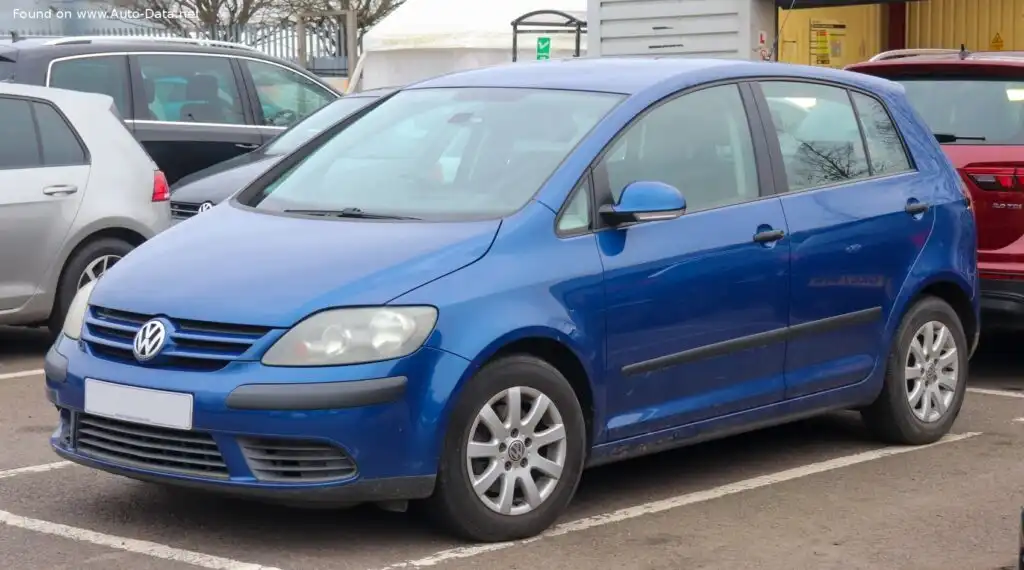
The Volkswagen Golf V Plus 1.4 TSI (122 hp) DSG was a compact minivan produced between June 2007 and November 2008, representing a practical variant within the fifth generation (Golf V) of the iconic Golf series. Positioned as a versatile, family-oriented vehicle, the Golf V Plus offered increased interior space and a higher seating position compared to the standard Golf hatchback, while still retaining the core Golf driving experience. It was marketed primarily in Europe as an alternative to traditional small MPVs, offering a blend of practicality and Volkswagen’s reputation for build quality. This particular configuration, pairing the 1.4 TSI engine with the Direct-Shift Gearbox (DSG), aimed to balance fuel efficiency with acceptable performance and convenience.
Technical Specifications
| Brand | Volkswagen |
| Model | Golf |
| Generation | Golf V Plus |
| Type (Engine) | 1.4 TSI (122 Hp) DSG |
| Start of production | June, 2007 |
| End of production | November, 2008 |
| Powertrain Architecture | Internal Combustion engine |
| Body type | Minivan |
| Seats | 5 |
| Doors | 5 |
| Fuel consumption (economy) – urban (NEDC) | 8.2 l/100 km (28.7 US mpg, 34.4 UK mpg, 12.2 km/l) |
| Fuel consumption (economy) – extra urban (NEDC) | 5.3 l/100 km (44.4 US mpg, 53.3 UK mpg, 18.9 km/l) |
| Fuel consumption (economy) – combined (NEDC) | 6.4 l/100 km (36.8 US mpg, 44.1 UK mpg, 15.6 km/l) |
| CO2 emissions (NEDC) | 149 g/km |
| Fuel Type | Petrol (Gasoline) |
| Acceleration 0 – 100 km/h | 10.1 sec |
| Acceleration 0 – 62 mph | 10.1 sec |
| Acceleration 0 – 60 mph | 9.6 sec |
| Maximum speed | 192 km/h (119.3 mph) |
| Emission standard | Euro 4 |
| Weight-to-power ratio | 11.1 kg/Hp, 89.8 Hp/tonne |
| Weight-to-torque ratio | 6.8 kg/Nm, 147.2 Nm/tonne |
| Power | 122 Hp @ 5000 rpm |
| Power per litre | 87.8 Hp/l |
| Torque | 200 Nm @ 1500-4000 rpm (147.51 lb.-ft. @ 1500-4000 rpm) |
| Engine layout | Front, Transverse |
| Engine Model/Code | CAXA |
| Engine displacement | 1390 cm3 (84.82 cu. in.) |
| Number of cylinders | 4 |
| Engine configuration | Inline |
| Cylinder Bore | 76.5 mm (3.01 in.) |
| Piston Stroke | 75.6 mm (2.98 in.) |
| Compression ratio | 9.7:1 |
| Number of valves per cylinder | 4 |
| Fuel injection system | Direct injection |
| Engine aspiration | Turbocharger, Intercooler |
| Valvetrain | DOHC |
| Engine oil capacity | 3.6 l (3.8 US qt | 3.17 UK qt) |
| Coolant | 5.6 l (5.92 US qt | 4.93 UK qt) |
| Kerb Weight | 1359 kg (2996.08 lbs.) |
| Max. weight | 1960 kg (4321.06 lbs.) |
| Max load | 601 kg (1324.98 lbs.) |
| Trunk (boot) space – minimum | 395 l (13.95 cu. ft.) |
| Trunk (boot) space – maximum | 1450 l (51.21 cu. ft.) |
| Fuel tank capacity | 55 l (14.53 US gal | 12.1 UK gal) |
| Permitted trailer load with brakes (12%) | 1300 kg (2866.01 lbs.) |
| Permitted trailer load without brakes | 710 kg (1565.28 lbs.) |
| Length | 4206 mm (165.59 in.) |
| Width | 1759 mm (69.25 in.) |
| Width including mirrors | 1956 mm (77.01 in.) |
| Height | 1580 mm (62.2 in.) |
| Wheelbase | 2578 mm (101.5 in.) |
| Front track | 1539 mm (60.59 in.) |
| Rear (Back) track | 1528 mm (60.16 in.) |
| Minimum turning circle (turning diameter) | 10.8 m (35.43 ft.) |
| Drivetrain Architecture | The Internal combustion engine (ICE) drives the front wheels of the vehicle. |
| Drive wheel | Front wheel drive |
| Number of gears and type of gearbox | 7 gears, automatic transmission DSG |
| Front suspension | Independent, type McPherson with coil spring and anti-roll bar |
| Rear suspension | Independent multi-link spring suspension with stabilizer |
| Front brakes | Ventilated discs |
| Rear brakes | Disc |
| Assisting systems | ABS (Anti-lock braking system) |
| Steering type | Steering rack and pinion |
| Power steering | Electric Steering |
| Tires size | 195/65 R15; 205/55 R16 |
| Wheel rims size | 6J x 15; 6J x 16 |
INTRODUCTION
The Golf V Plus 1.4 TSI (122 hp) DSG, produced from 2007 to 2008, was a key variant within the Golf V Plus range. Built on the A5 platform (also known as the 1HX0 chassis code), the Golf V Plus aimed to bridge the gap between the standard Golf and larger MPVs. It offered a more spacious interior and a higher driving position, appealing to families and those seeking a more versatile vehicle. The 1.4 TSI engine with the DSG transmission represented a mid-range offering, balancing performance, fuel economy, and driving convenience within the Plus lineup.
Powertrain & Engine Architecture
At the heart of this variant lies the 1.4-liter TSI (Turbocharged Stratified Injection) engine, specifically the CAXA engine code. This engine is a four-cylinder, inline configuration featuring direct fuel injection and a turbocharger with an intercooler. Direct injection allows for precise fuel delivery, improving efficiency and reducing emissions. The TSI engine utilizes a sophisticated valvetrain with Dual Overhead Camshafts (DOHC) and four valves per cylinder, optimizing airflow for increased power output. The turbocharger provides a significant boost in power, overcoming the limitations of the relatively small displacement.
The engine is paired with a 7-speed Dual-Shift Gearbox (DSG). This transmission combines the efficiency of a manual gearbox with the convenience of an automatic. It utilizes two separate clutches, allowing for seamless and rapid gear changes. The DSG’s programming is tuned for a balance between fuel economy and responsiveness, offering both automatic and manual shifting modes.
Driving Characteristics
The 122 hp output and 200 Nm (147.51 lb-ft) of torque delivered by the 1.4 TSI engine, coupled with the DSG transmission, provided adequate performance for everyday driving. Acceleration from 0-60 mph took approximately 9.6 seconds, and the top speed was 119.3 mph. While not a particularly sporty configuration, the turbocharger provided a noticeable boost in power during acceleration, making overtaking maneuvers relatively effortless. The DSG transmission contributed to smooth and quick gear changes, enhancing the overall driving experience. Compared to the higher-output 1.4 TSI (160 hp) or the diesel variants (like the 1.9 TDI), this version felt less eager to accelerate, but it offered better fuel economy and a more refined driving experience. The gear ratios in the DSG were optimized for both fuel efficiency and responsiveness, providing a good balance for typical driving conditions.
Equipment & Trim Levels
The Golf V Plus 1.4 TSI DSG typically came with a reasonable level of standard equipment. This included features like air conditioning, power windows, central locking, and an audio system. Interior upholstery was generally cloth, with options for upgraded materials available. Dashboard configuration was typical of the Golf V range, with a functional and ergonomic layout. Optional extras included alloy wheels, a sunroof, parking sensors, and a more advanced audio system with navigation. Trim levels varied depending on the market, but generally, this configuration sat in the mid-range of the Golf V Plus lineup, offering a good balance of features and price.
Chassis & Braking
The Golf V Plus utilized an independent suspension system on both the front and rear axles. The front suspension employed a McPherson strut design with coil springs and an anti-roll bar, while the rear featured a multi-link setup with a stabilizer bar. This suspension configuration provided a comfortable ride and good handling characteristics. Braking duties were handled by ventilated discs on the front wheels and solid discs on the rear. The vehicle was equipped with ABS (Anti-lock Braking System) as standard, enhancing braking performance and safety. The chassis was designed to accommodate the increased weight and dimensions of the Plus model, providing a stable and predictable driving experience.
Market Reception & Comparison
The Golf V Plus 1.4 TSI DSG received generally positive reviews from automotive critics. It was praised for its practicality, comfortable ride, and fuel efficiency. However, some critics noted that the 122 hp engine could feel underpowered when fully loaded or when driving on steep inclines. Compared to the 1.9 TDI diesel variant, the 1.4 TSI offered a quieter and smoother driving experience, but it lacked the diesel’s superior fuel economy and low-end torque. Against the more powerful 1.4 TSI (160 hp), the 122 hp version offered a lower price point and slightly better fuel consumption, making it an attractive option for budget-conscious buyers.
Legacy
The 1.4 TSI engine, particularly the CAXA code, proved to be a relatively reliable unit when properly maintained. The DSG transmission, while offering performance benefits, could be prone to issues if not serviced according to Volkswagen’s recommendations. Today, the Golf V Plus 1.4 TSI DSG can be found on the used car market at affordable prices. Its practicality and relatively low running costs make it an appealing option for those seeking a versatile and economical family vehicle. However, potential buyers should be aware of the potential maintenance costs associated with the DSG transmission and ensure that the vehicle has been regularly serviced.