
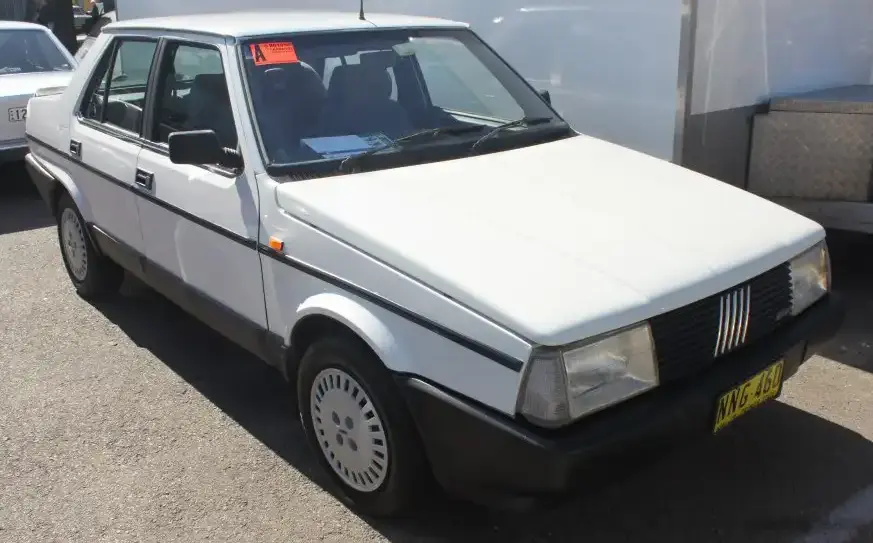
The Fiat Regata 90 i.e. 1.6, produced between 1987 and 1989, represented a mid-range offering within the Regata (Type 138) lineup. The Regata itself was designed as a replacement for the Fiat 134, aiming to provide a more modern and efficient sedan for the European market. This particular variant, with its 1.6-liter engine producing 90 horsepower, was positioned as a balance between affordability and performance, appealing to buyers seeking a comfortable and reasonably equipped family car. It occupied a space between the base models with smaller engines and the more powerful, albeit more expensive, versions.
Technical Specifications
| Brand | Fiat |
| Model | Regata |
| Generation | Regata (138) |
| Type (Engine) | 90 i.e. 1.6 (90 Hp) |
| Start of production | 1987 |
| End of production | 1989 |
| Powertrain Architecture | Internal Combustion engine |
| Body type | Sedan |
| Seats | 5 |
| Doors | 4 |
| Fuel Type | Petrol (Gasoline) |
| Power | 90 Hp |
| Engine Model/Code | 149 C2.000 |
| Engine aspiration | Naturally aspirated engine |
| Engine oil capacity | 4.1 l (4.33 US qt | 3.61 UK qt) |
| Coolant capacity | 7 l (7.4 US qt | 6.16 UK qt) |
| Trunk (boot) space – minimum | 513 l (18.12 cu. ft.) |
| Fuel tank capacity | 55 l (14.53 US gal | 12.1 UK gal) |
| Length | 4260 mm (167.72 in.) |
| Width | 1650 mm (64.96 in.) |
| Height | 1410 mm (55.51 in.) |
| Front overhang | 820 mm (32.28 in.) |
| Rear overhang | 992 mm (39.06 in.) |
Powertrain & Engine Architecture
The heart of the Regata 90 i.e. was the 149 C2.000 engine, a 1.6-liter inline-four cylinder gasoline engine. This engine featured Bosch mechanical fuel injection – a relatively advanced system for its time – contributing to improved fuel efficiency and reduced emissions compared to carbureted engines. The engine utilized a single overhead camshaft (SOHC) valvetrain, operating two valves per cylinder. The 1.6-liter engine produced 90 horsepower at approximately 5800 rpm and 137 Nm (101 lb-ft) of torque at 3600 rpm. The engine was paired with a three-speed automatic transmission, a relatively common choice for European buyers prioritizing comfort over outright performance. This transmission was known for its smooth operation, but wasn’t particularly geared for rapid acceleration.
Driving Characteristics
The Regata 90 i.e. with the automatic transmission offered a comfortable, if not particularly sporty, driving experience. Acceleration was adequate for everyday driving, with a 0-60 mph time estimated around 12-13 seconds. The three-speed automatic transmission, while smooth, meant that the engine often operated at higher revs during highway cruising, impacting fuel economy. Compared to the five-speed manual versions of the 1.6-liter engine, the automatic suffered a noticeable performance deficit. The manual transmission allowed for better control and more efficient use of the engine’s power band. The automatic was favored by drivers who preferred the convenience of not having to shift gears, particularly in urban environments.
Equipment & Trim Levels
The Regata 90 i.e. typically came equipped with features considered standard for a mid-range sedan in the late 1980s. This included cloth upholstery, a basic stereo system, and power steering. Higher trim levels offered options such as electric windows, central locking, and a sunroof. Interior appointments were generally functional and durable, reflecting the car’s intended role as a practical family vehicle. The dashboard layout was straightforward, with clearly marked gauges and controls. The 90 i.e. trim often included a slightly upgraded interior finish compared to the base models, with better quality fabrics and trim materials.
Chassis & Braking
The Regata utilized a relatively conventional chassis design, with independent front suspension using MacPherson struts and a solid rear axle with trailing arms. The suspension was tuned for comfort, providing a reasonably smooth ride over uneven surfaces. Braking was typically accomplished with disc brakes on the front wheels and drum brakes on the rear. The braking system was adequate for normal driving conditions, but lacked the stopping power of more modern systems. Stabilizer bars were often included as standard equipment, helping to reduce body roll during cornering. The Regata’s weight, around 1,100-1,200 kg (2,425-2,645 lbs), contributed to its moderate handling characteristics.
Market Reception & Comparison
The Fiat Regata 90 i.e. 1.6 Automatic was generally well-received as a practical and affordable family sedan. Critics praised its comfortable ride and relatively spacious interior. However, the automatic transmission was often criticized for its lack of responsiveness and impact on fuel economy. Compared to other cars in its class, such as the Opel Ascona or Ford Sierra, the Regata offered a competitive price point and a reputation for reliability. The 1.9-liter diesel versions of the Regata were popular with high-mileage drivers, while the more powerful 1.8-liter gasoline models appealed to those seeking greater performance. The 90 i.e. struck a balance between these extremes, offering a good compromise between economy, performance, and comfort.
Legacy
The Fiat Regata, and specifically the 90 i.e. 1.6 variant, has become a relatively sought-after classic car among enthusiasts. The 149 C2.000 engine is known for its durability and relative simplicity, making it easier to maintain than more complex modern engines. While rust can be a concern with older Italian cars, well-maintained examples of the Regata 90 i.e. can still provide reliable transportation today. The car represents a significant period in Fiat’s history, bridging the gap between older, rear-wheel-drive designs and more modern, front-wheel-drive platforms. In the used car market, prices for well-preserved Regata 90 i.e. models have been steadily increasing, reflecting a growing appreciation for classic Italian automobiles.
