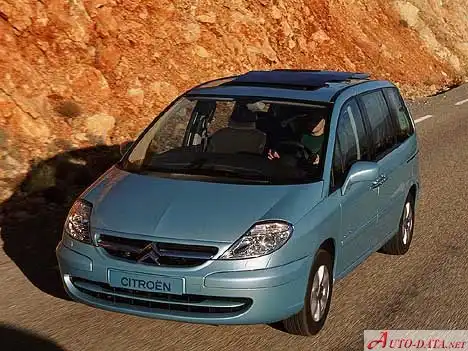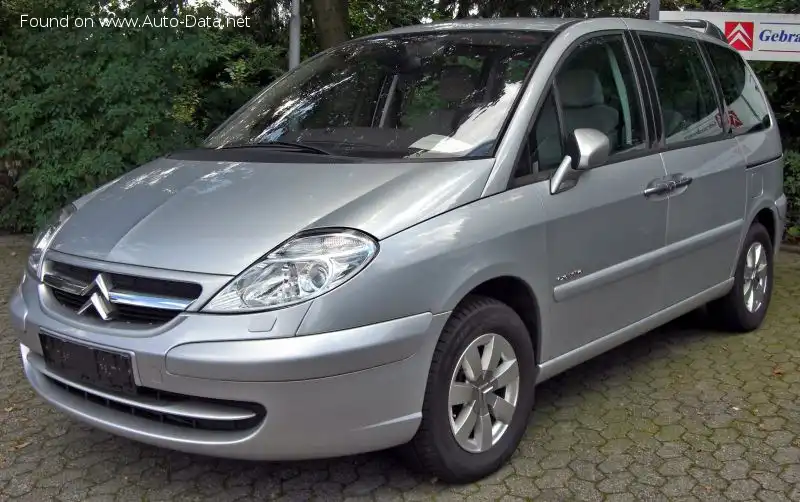
The Citroen C8 2.0 HDi 16V (120 hp) represents a specific configuration within the second generation (Phase II) of Citroen’s large MPV, produced from 2008 to 2009. Positioned as a mid-range offering in the C8 lineup, this variant aimed to balance fuel efficiency with acceptable performance for family transport. The C8, jointly developed with Peugeot and Fiat (resulting in the Peugeot 807 and Fiat Ulysse respectively), was Citroen’s entry into the large MPV segment, competing with vehicles like the Renault Espace and Volkswagen Sharan. This Phase II update brought styling revisions and improvements to interior features, building upon the foundation laid by the original C8 launched in 2002.
Technical Specifications
| Brand | Citroen |
| Model | C8 |
| Generation | C8 (Phase II, 2008) |
| Type (Engine) | 2.0 HDi 16V (120 Hp) |
| Start of production | 2008 |
| End of production | 2009 |
| Powertrain Architecture | Internal Combustion engine |
| Body type | Minivan, MPV |
| Seats | 7 |
| Doors | 5 |
| Fuel consumption (urban) | 8.8 l/100 km (26.7 US mpg, 32.1 UK mpg, 11.4 km/l) |
| Fuel consumption (extra urban) | 5.8 l/100 km (40.6 US mpg, 48.7 UK mpg, 17.2 km/l) |
| Fuel consumption (combined) | 6.9 l/100 km (34.1 US mpg, 40.9 UK mpg, 14.5 km/l) |
| CO2 emissions | 182 g/km |
| Fuel Type | Diesel |
| Acceleration 0 – 100 km/h | 12.9 sec |
| Acceleration 0 – 62 mph | 12.9 sec |
| Acceleration 0 – 60 mph | 12.3 sec |
| Maximum speed | 180 km/h (111.85 mph) |
| Emission standard | Euro 4 |
| Weight-to-power ratio | 16.5 kg/Hp, 60.7 Hp/tonne |
| Weight-to-torque ratio | 6.6 kg/Nm, 151.8 Nm/tonne |
| Power | 120 Hp @ 4000 rpm |
| Power per litre | 60.1 Hp/l |
| Torque | 300 Nm @ 2000 rpm (221.27 lb.-ft. @ 2000 rpm) |
| Engine layout | Front, Transverse |
| Engine Model/Code | RHK DW10UTED4 |
| Engine displacement | 1997 cm3 (121.86 cu. in.) |
| Number of cylinders | 4 |
| Engine configuration | Inline |
| Cylinder Bore | 85 mm (3.35 in.) |
| Piston Stroke | 88 mm (3.46 in.) |
| Compression ratio | 17.6:1 |
| Number of valves per cylinder | 4 |
| Fuel injection system | Diesel Commonrail |
| Engine aspiration | Turbocharger, Intercooler |
| Valvetrain | DOHC |
| Engine oil capacity | 6.3 l (6.66 US qt | 5.54 UK qt) |
| Coolant | 8 l (8.45 US qt | 7.04 UK qt) |
| Kerb Weight | 1976 kg (4356.33 lbs.) |
| Max. weight | 2530 kg (5577.7 lbs.) |
| Max load | 554 kg (1221.36 lbs.) |
| Trunk (boot) space – minimum | 225 l (7.95 cu. ft.) |
| Trunk (boot) space – maximum | 2948 l (104.11 cu. ft.) |
| Fuel tank capacity | 80 l (21.13 US gal | 17.6 UK gal) |
| Max. roof load | 100 kg (220.46 lbs.) |
| Permitted trailer load with brakes (12%) | 1800 kg (3968.32 lbs.) |
| Permitted trailer load without brakes | 750 kg (1653.47 lbs.) |
| Permitted towbar download | 72 kg (158.73 lbs.) |
| Length | 4727 mm (186.1 in.) |
| Width | 1854 mm (72.99 in.) |
| Width including mirrors | 2194 mm (86.38 in.) |
| Height | 1752-1856 mm (68.98 – 73.07 in.) |
| Wheelbase | 2823 mm (111.14 in.) |
| Front track | 1570 mm (61.81 in.) |
| Rear (Back) track | 1548 mm (60.94 in.) |
| Front overhang | 1013 mm (39.88 in.) |
| Rear overhang | 891 mm (35.08 in.) |
| Minimum turning circle | 11.71 m (38.42 ft.) |
| Drivetrain Architecture | Front wheel drive |
| Number of gears and type of gearbox | 6 gears, manual transmission |
| Front suspension | Independent, type McPherson with coil spring and anti-roll bar |
| Rear suspension | Semi-independent, coil spring |
| Front brakes | Ventilated discs |
| Rear brakes | Disc |
| Assisting systems | ABS (Anti-lock braking system) |
| Steering type | Steering rack and pinion |
| Power steering | Hydraulic Steering |
| Tires size | 205/60 R16 |
| Wheel rims size | 6.5J x 15 |
INTRODUCTION
The Citroen C8 2.0 HDi 16V, produced between 2008 and 2009, was a key variant within the Phase II refresh of the C8 MPV. This model aimed to provide a more economical option within the C8 range, appealing to families prioritizing fuel efficiency and practicality over outright performance. The 2.0 HDi engine, a staple in European diesel lineups, offered a balance between power and economy, making it a popular choice for long-distance travel and everyday use. The C8 itself was designed to offer a spacious and versatile interior, accommodating up to seven passengers and a significant amount of luggage. It was built on the PSA Group’s 1HX0 platform, shared with the Peugeot 807 and Fiat Ulysse.
Powertrain & Engine Architecture
The heart of this C8 variant is the DW10UTED4 engine, a 1997cc four-cylinder diesel engine. This engine utilizes a common rail direct injection system, delivering fuel at extremely high pressure for improved combustion efficiency and reduced emissions. The 16-valve DOHC (Double Overhead Camshaft) configuration, coupled with a turbocharger and intercooler, helps to maximize power output. The engine produces 120 horsepower at 4000 rpm and 300 Nm (221 lb-ft) of torque at 2000 rpm. This torque figure is particularly important for a vehicle of this size, providing good low-end grunt for effortless acceleration and towing capability. The engine’s design incorporates features like a variable geometry turbocharger to optimize performance across a wider rev range. The C8 2.0 HDi 16V was typically paired with a 6-speed manual transmission, although an automatic transmission was also available, albeit less common. The automatic transmission, a conventional torque converter type, was chosen for its smoothness and ease of use, particularly in urban driving conditions.
Driving Characteristics
The 2.0 HDi 16V engine, while not exceptionally powerful, provides adequate performance for the C8’s size and weight. Acceleration from 0-60 mph takes around 12.3 seconds, and top speed is limited to 111.85 mph. In real-world driving, the engine feels responsive enough for overtaking maneuvers and maintaining comfortable cruising speeds on the highway. The 6-speed manual transmission allows drivers to keep the engine in its optimal power band, maximizing efficiency and responsiveness. Compared to the more powerful 2.2 HDi variants, the 2.0 HDi feels noticeably less energetic, particularly when fully loaded with passengers and luggage. However, the trade-off is significantly improved fuel economy. The automatic transmission, while convenient, can feel slightly sluggish at times, and may result in slightly lower fuel economy compared to the manual version. The C8’s suspension is tuned for comfort, providing a smooth and compliant ride, even on uneven road surfaces.
Equipment & Trim Levels
The C8 2.0 HDi 16V typically came equipped with a reasonable level of standard features. These included air conditioning, power windows, central locking, and an audio system with CD player. Higher trim levels offered additional features such as alloy wheels, rear parking sensors, a sunroof, and upgraded interior trim. Interior upholstery was typically cloth, although leather options were available. The dashboard layout was functional and user-friendly, with clearly labeled controls. Optional extras included a navigation system, a DVD player for the rear passengers, and a panoramic sunroof. Safety features included ABS brakes, airbags, and electronic stability control.
Chassis & Braking
The C8’s chassis features an independent McPherson strut suspension at the front and a semi-independent coil spring suspension at the rear. This setup provides a good balance between ride comfort and handling. The front brakes are ventilated discs, while the rear brakes are solid discs. ABS (Anti-lock Braking System) is standard, providing enhanced braking performance in emergency situations. The steering is rack and pinion with hydraulic power assistance, offering a light and precise feel. The C8’s relatively long wheelbase contributes to its stability and comfortable ride.
Market Reception & Comparison
The Citroen C8 2.0 HDi 16V was generally well-received by critics as a practical and economical MPV. It was praised for its spacious interior, comfortable ride, and fuel efficiency. However, some critics noted that the 2.0 HDi engine lacked the punch of the more powerful alternatives. Compared to the 2.2 HDi variants, the 2.0 HDi offered significantly better fuel economy, but at the expense of performance. The 2.0 HDi was also more affordable to purchase and maintain. In terms of reliability, the DW10UTED4 engine is generally considered to be a robust and reliable unit, although regular maintenance is essential.
Legacy
The Citroen C8 2.0 HDi 16V remains a popular choice in the used car market, particularly for families seeking a spacious and economical MPV. The DW10UTED4 engine has proven to be durable and relatively easy to maintain, making it a cost-effective option for long-term ownership. However, potential buyers should be aware of the potential for common diesel engine issues, such as injector problems and turbocharger wear. Overall, the C8 2.0 HDi 16V represents a solid and practical MPV that continues to offer good value for money.