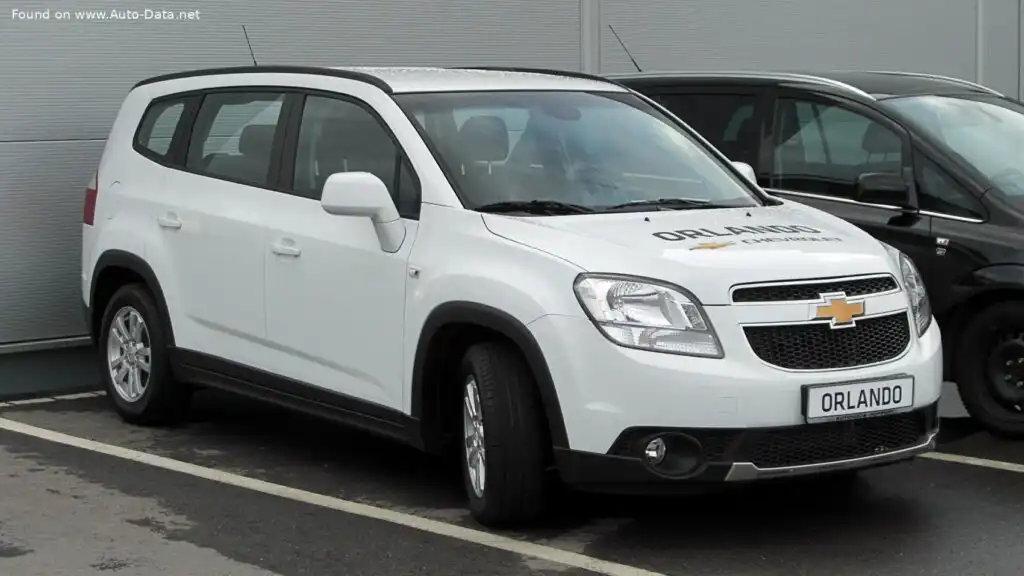
The Chevrolet Orlando 1.8L Automatic, produced from 2011 to 2018, was a seven-seat minivan marketed primarily in Europe, Asia, and select Commonwealth markets. Positioned as a budget-friendly family vehicle, the 1.8L variant with the automatic transmission represented a mid-range offering within the Orlando lineup, slotting below the more powerful 2.0L diesel and gasoline options. It was built on the GM Delta platform, shared with models like the Opel Astra and Buick Verano, aiming to provide practical space and affordability in a competitive segment. This version aimed to balance fuel efficiency with acceptable performance for everyday driving needs.
Technical Specifications
| Brand | Chevrolet |
| Model | Orlando |
| Generation | Orlando I |
| Type (Engine) | 1.8 (141 Hp) Automatic |
| Start of production | 2011 |
| End of production | 2018 |
| Powertrain Architecture | Internal Combustion engine |
| Body type | Minivan |
| Seats | 7 |
| Doors | 5 |
| Fuel consumption (urban) | 11 l/100 km (21.4 US mpg) |
| Fuel consumption (extra urban) | 6.1 l/100 km (38.6 US mpg) |
| Fuel consumption (combined) | 7.9 l/100 km (29.8 US mpg) |
| Fuel Type | Petrol (Gasoline) |
| Acceleration 0 – 100 km/h | 11.8 sec |
| Acceleration 0 – 62 mph | 11.8 sec |
| Acceleration 0 – 60 mph | 11.2 sec |
| Maximum speed | 185 km/h (114.95 mph) |
| Emission standard | Euro 5 |
| Weight-to-power ratio | 10.9 kg/Hp |
| Weight-to-torque ratio | 8.7 kg/Nm |
| Power | 141 Hp @ 6200 rpm |
| Torque | 176 Nm @ 3800 rpm (129.81 lb.-ft. @ 3800 rpm) |
| Engine layout | Front, Transverse |
| Engine Model/Code | 2H0, F18D4 |
| Engine displacement | 1796 cm3 (109.6 cu. in.) |
| Number of cylinders | 4 |
| Engine configuration | Inline |
| Cylinder Bore | 80.5 mm (3.17 in.) |
| Piston Stroke | 88.2 mm (3.47 in.) |
| Compression ratio | 10.5:1 |
| Number of valves per cylinder | 4 |
| Fuel injection system | Multi-port manifold injection |
| Engine aspiration | Naturally aspirated engine |
| Valvetrain | DOHC |
| Engine oil capacity | 4.5 l (4.76 US qt | 3.96 UK qt) |
| Coolant capacity | 5.6 l (5.92 US qt | 4.93 UK qt) |
| Kerb Weight | 1539 kg (3392.91 lbs.) |
| Max. weight | 2184 kg (4814.9 lbs.) |
| Max load | 645 kg (1421.98 lbs.) |
| Trunk (boot) space – minimum | 101 l (3.57 cu. ft.) |
| Trunk (boot) space – maximum | 1499 l (52.94 cu. ft.) |
| Fuel tank capacity | 64 l (16.91 US gal | 14.08 UK gal) |
| Length | 4652 mm (183.15 in.) |
| Width | 1836 mm (72.28 in.) |
| Height | 1633 mm (64.29 in.) |
| Wheelbase | 2760 mm (108.66 in.) |
| Front track | 1584 mm (62.36 in.) |
| Rear track | 1588 mm (62.52 in.) |
| Minimum turning circle | 11.3 m (37.07 ft.) |
| Drivetrain | Front wheel drive |
| Number of gears | 6 |
| Gearbox type | Automatic transmission |
| Front suspension | Independent type McPherson |
| Front brakes | Disc |
| Assisting systems | ABS (Anti-lock braking system) |
| Steering type | Steering rack and pinion |
| Power steering | Electric Steering |
INTRODUCTION
The Chevrolet Orlando 1.8L Automatic, launched in 2011, was a key component of Chevrolet’s attempt to gain a foothold in the compact MPV (Multi-Purpose Vehicle) segment. Designed as a more affordable and practical alternative to larger, more expensive minivans, the Orlando aimed to appeal to families needing flexible seating and cargo space. The 1.8L engine and automatic transmission combination was intended to provide a comfortable and convenient driving experience, particularly for urban and suburban commuters. Production continued until 2018, with minor updates to trim and features over its lifespan. It was a significant model for Chevrolet in markets where larger SUVs weren’t practical or preferred.
Powertrain & Engine Architecture
The Orlando 1.8L Automatic utilized the GM Family 0 engine, specifically the 2H0/F18D4 code. This 1.8-liter inline-four cylinder engine featured a double overhead camshaft (DOHC) valvetrain with four valves per cylinder. Fuel delivery was managed by a multi-port fuel injection system, providing adequate atomization for efficient combustion. The engine produced 141 horsepower at 6200 rpm and 176 Nm (129.81 lb-ft) of torque at 3800 rpm. The engine’s design prioritized fuel economy and smooth operation over outright performance. Paired with the engine was a six-speed automatic transmission, offering smooth gear changes and ease of use. This transmission was a crucial element in making the Orlando appealing to drivers seeking convenience, especially in congested city environments. The transmission’s gear ratios were tuned for a balance between acceleration and fuel efficiency.
Driving Characteristics
The 1.8L Automatic Orlando offered a comfortable, if not particularly sporty, driving experience. Acceleration from 0-60 mph took around 11.2 seconds, and top speed was limited to 185 km/h (114.95 mph). The automatic transmission contributed to a relaxed driving style, with smooth shifts and predictable behavior. Compared to the more powerful 2.0L gasoline and diesel variants, the 1.8L felt noticeably less responsive, especially when fully loaded with passengers and cargo. However, the lower engine output also translated to better fuel economy. The suspension, tuned for comfort, absorbed bumps and imperfections in the road well, making it a pleasant vehicle for long journeys. The steering was light and easy to use, ideal for maneuvering in tight spaces.
Equipment & Trim Levels
The Orlando 1.8L Automatic typically came standard with features like air conditioning, power windows and locks, a basic audio system with USB connectivity, and ABS brakes. Higher trim levels added features such as alloy wheels, fog lights, a more advanced audio system with Bluetooth connectivity, and rear parking sensors. Interior upholstery was typically cloth, with optional leather available on higher trims. The dashboard layout was functional and straightforward, with easy-to-read gauges and controls. Optional extras included a sunroof, navigation system, and a rear-seat entertainment system.
Chassis & Braking
The Orlando’s chassis featured an independent McPherson strut suspension at the front, providing a comfortable ride and decent handling. The rear suspension utilized a torsion beam setup, which was cost-effective but less sophisticated than a fully independent system. Brakes were disc brakes at the front and drum brakes at the rear, providing adequate stopping power for the vehicle’s weight class. ABS (Anti-lock Braking System) was standard, enhancing safety during emergency braking situations. The steering system employed an electric power steering rack and pinion, offering light and precise steering feel.
Market Reception & Comparison
The Chevrolet Orlando 1.8L Automatic received mixed reviews from automotive critics. It was praised for its spacious interior, flexible seating, and affordable price point. However, it was often criticized for its lackluster performance and somewhat unrefined driving experience compared to competitors like the Ford C-Max or Renault Scenic. Fuel economy was generally considered acceptable, but not class-leading. Compared to the 2.0L diesel version, the 1.8L offered lower running costs but significantly reduced performance. The 1.8L Automatic appealed to buyers prioritizing practicality and affordability over driving dynamics.
Legacy
The Chevrolet Orlando, while not a runaway sales success, established a presence for Chevrolet in the compact MPV segment. The 1.8L engine and automatic transmission combination proved to be relatively reliable, with few widespread mechanical issues reported. On the used car market, the Orlando 1.8L Automatic remains an affordable option for families seeking a spacious and practical vehicle. Maintenance costs are generally reasonable, and parts availability is good. While it may not offer the latest technology or the most engaging driving experience, the Orlando 1.8L Automatic continues to provide a functional and dependable transportation solution for budget-conscious buyers.