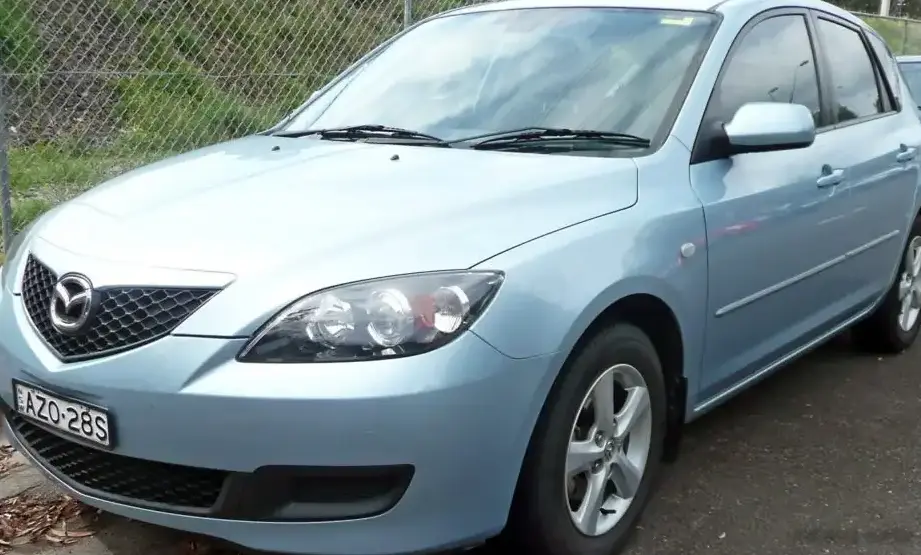
The Mazda 3 II Sedan (BL) 1.6i, producing 105 horsepower, was a key variant in Mazda’s second-generation 3 lineup, sold primarily in Europe and other international markets from 2009 to 2011. Positioned as an entry-level offering, it aimed to provide affordable and efficient transportation within the compact sedan segment. This model represented Mazda’s continued focus on sporty handling and attractive styling, even in its more economical trims. The BL generation Mazda 3, launched in 2009, was a significant redesign from the first generation, offering improved refinement, safety features, and a more contemporary interior.
Technical Specifications
| Brand | Mazda |
| Model | 3 |
| Generation | II Sedan (BL) |
| Type (Engine) | 1.6i (105 Hp) |
| Start of production | 2009 |
| End of production | 2011 |
| Powertrain Architecture | Internal Combustion engine |
| Body type | Sedan |
| Seats | 5 |
| Doors | 4 |
| Fuel consumption (urban) | 8.3 l/100 km (28.3 US mpg, 34 UK mpg, 12 km/l) |
| Fuel consumption (extra urban) | 5.2 l/100 km (45.2 US mpg, 54.3 UK mpg, 19.2 km/l) |
| Fuel consumption (combined) | 6.3 l/100 km (37.3 US mpg, 44.8 UK mpg, 15.9 km/l) |
| CO2 emissions | 149 g/km |
| Fuel Type | Petrol (Gasoline) |
| Acceleration 0 – 100 km/h | 12.2 sec |
| Acceleration 0 – 62 mph | 12.2 sec |
| Acceleration 0 – 60 mph | 11.6 sec |
| Maximum speed | 188 km/h (116.82 mph) |
| Emission standard | Euro 5 |
| Weight-to-power ratio | 11.1 kg/Hp, 89.7 Hp/tonne |
| Weight-to-torque ratio | 8.1 kg/Nm, 123.9 Nm/tonne |
| Power | 105 Hp @ 6000 rpm |
| Power per litre | 65.7 Hp/l |
| Torque | 145 Nm @ 4000 rpm (106.95 lb.-ft. @ 4000 rpm) |
| Engine layout | Front, Transverse |
| Engine Model/Code | Z668, Z682 |
| Engine displacement | 1598 cm3 (97.52 cu. in.) |
| Number of cylinders | 4 |
| Engine configuration | Inline |
| Cylinder Bore | 78 mm (3.07 in.) |
| Piston Stroke | 83.6 mm (3.29 in.) |
| Compression ratio | 10:1 |
| Number of valves per cylinder | 4 |
| Fuel injection system | Multi-port manifold injection |
| Engine aspiration | Naturally aspirated engine |
| Valvetrain | DOHC |
| Engine oil capacity | 3.9 l (4.12 US qt | 3.43 UK qt) |
| Coolant | 6 l (6.34 US qt | 5.28 UK qt) |
| Kerb Weight | 1170 kg (2579.41 lbs.) |
| Max. weight | 1745 kg (3847.07 lbs.) |
| Max load | 575 kg (1267.66 lbs.) |
| Trunk (boot) space – minimum | 430 l (15.19 cu. ft.) |
| Fuel tank capacity | 55 l (14.53 US gal | 12.1 UK gal) |
| Permitted trailer load with brakes (12%) | 930 kg (2050.3 lbs.) |
| Permitted trailer load without brakes | 550 kg (1212.54 lbs.) |
| Length | 4580 mm (180.31 in.) |
| Width | 1755 mm (69.09 in.) |
| Width including mirrors | 2002 mm (78.82 in.) |
| Height | 1470 mm (57.87 in.) |
| Wheelbase | 2640 mm (103.94 in.) |
| Front track | 1535 mm (60.43 in.) |
| Rear (Back) track | 1530 mm (60.24 in.) |
| Ride height (ground clearance) | 155 mm (6.1 in.) |
| Drag coefficient (Cd) | 0.28 |
| Minimum turning circle (turning diameter) | 10.4 m (34.12 ft.) |
| Drivetrain Architecture | The Internal combustion engine (ICE) drives the front wheels of the vehicle. |
| Drive wheel | Front wheel drive |
| Number of gears and type of gearbox | 5 gears, manual transmission |
| Front brakes | Ventilated discs |
| Rear brakes | Disc |
| Assisting systems | ABS (Anti-lock braking system) |
| Steering type | Steering rack and pinion |
| Power steering | Electric Steering |
| Tires size | 205/55 R16 |
| Wheel rims size | 16 |
Powertrain & Engine Architecture
The 1.6i variant of the Mazda 3 BL utilized Mazda’s Z668 or Z682 engine code, a 1.6-liter inline-four cylinder gasoline engine. This engine was a naturally aspirated powerplant featuring multi-point fuel injection and a double overhead camshaft (DOHC) valvetrain. The engine’s design prioritized fuel efficiency and smooth operation over outright performance. The 105 horsepower output was achieved at 6000 rpm, while peak torque of 145 Nm (106.95 lb-ft) arrived at 4000 rpm. The engine featured a compression ratio of 10:1. The engine was paired with a 5-speed manual transmission as standard, contributing to its affordability and simplicity. This transmission was chosen for its durability and relatively low cost, rather than for sporty performance.
Driving Characteristics
The 1.6i with the 5-speed manual transmission offered adequate, but not exhilarating, performance. Acceleration from 0 to 100 km/h (0-62 mph) took approximately 12.2 seconds. The engine felt somewhat strained when pushed hard, particularly during overtaking maneuvers. The gear ratios were tuned for fuel economy, meaning the engine often needed to be revved to maintain speed, especially when loaded with passengers or cargo. Compared to the higher-output 2.0-liter or 2.3-liter variants, the 1.6i felt noticeably slower and less responsive. However, the 1.6i provided a comfortable and predictable driving experience, making it well-suited for urban commuting and everyday driving.
Equipment & Trim Levels
The 1.6i trim level typically served as the base model in many European markets. Standard equipment generally included air conditioning, power windows, power door locks, and a basic audio system with CD player. Safety features such as ABS (Anti-lock Braking System) and front airbags were also standard. Optional extras often included alloy wheels, a more advanced audio system, and fog lights. Interior upholstery was typically cloth, and the dashboard featured a straightforward design with easy-to-use controls. The overall interior ambiance was functional and practical, rather than luxurious.
Chassis & Braking
The Mazda 3 BL 1.6i utilized a MacPherson strut front suspension and a multi-link rear suspension, providing a good balance between ride comfort and handling. The front brakes were ventilated discs, while the rear brakes were solid discs. The suspension was tuned to prioritize comfort and stability, rather than aggressive cornering. The steering was a rack-and-pinion system with electric power assistance, offering light and precise steering feel. The 1.6i models typically featured smaller wheels and tires (205/55 R16) compared to the higher-spec variants, contributing to a slightly less sporty ride.
Market Reception & Comparison
The Mazda 3 1.6i was generally well-received as an affordable and reliable compact sedan. Critics praised its attractive styling, comfortable ride, and good fuel economy. However, some reviewers noted its lack of power and somewhat basic interior. Compared to other 1.6-liter competitors, the Mazda 3 offered a more engaging driving experience and a more stylish design. In terms of fuel economy, the 1.6i performed competitively with other similarly sized engines, achieving around 6.3 l/100 km (37.3 US mpg) in combined driving conditions. Reliability was generally good, with few reported issues specific to the 1.6i powertrain.
Legacy
The Mazda 3 BL 1.6i remains a relatively common sight on used car markets today. The Z668/Z682 engine is known for its durability and relatively low maintenance costs. While not a performance standout, the 1.6i powertrain has proven to be reliable over the long term. These models represent a good value for buyers seeking an affordable and dependable compact sedan. Parts availability is generally good, and the relatively simple engine design makes it accessible for DIY repairs. The BL generation Mazda 3, including the 1.6i variant, helped solidify Mazda’s reputation for building stylish, fun-to-drive, and reliable vehicles.