Technical Specifications
| Brand | BMW |
| Model | 3 Series |
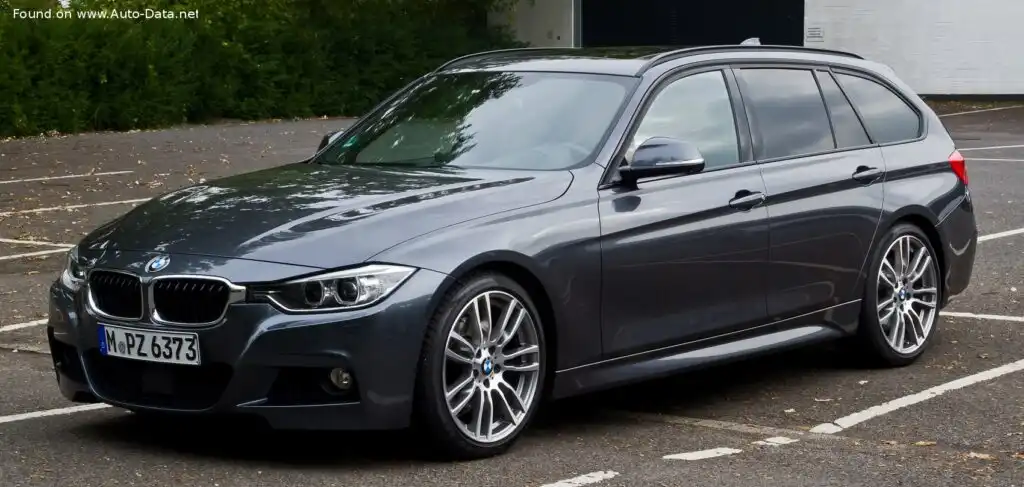
| Generation | 3 Series Touring (F31) |
| Type (Engine) | 320i (184 Hp) xDrive |
| Start of production | 2013 |
| End of production | 2015 |
| Powertrain Architecture | Internal Combustion engine |
| Body type | Station wagon (estate) |
| Seats | 5 |
| Doors | 5 |
| Fuel consumption (urban) | 9 l/100 km (26.1 US mpg, 31.4 UK mpg, 11.1 km/l) |
| Fuel consumption (extra urban) | 5.6 l/100 km (42 US mpg, 50.4 UK mpg, 17.9 km/l) |
| Fuel consumption (combined) | 6.8-6.9 l/100 km (34.6 – 34.1 US mpg, 41.5 – 40.9 UK mpg, 14.7 – 14.5 km/l) |
| CO2 emissions | 159-160 g/km |
| Fuel Type | Petrol (Gasoline) |
| Acceleration 0 – 100 km/h | 7.6 sec |
| Acceleration 0 – 62 mph | 7.6 sec |
| Acceleration 0 – 60 mph | 7.2 sec |
| Maximum speed | 225 km/h (139.81 mph) |
| Emission standard | Euro 5 |
| Weight-to-power ratio | 8.5 kg/Hp, 118.3 Hp/tonne |
| Weight-to-torque ratio | 5.8 kg/Nm, 173.6 Nm/tonne |
| Power | 184 Hp @ 5000-6250 rpm |
| Power per litre | 92.1 Hp/l |
| Torque | 270 Nm @ 1250 rpm (199.14 lb.-ft. @ 1250 rpm) |
| Engine layout | Front, Longitudinal |
| Engine Model/Code | N20B20B |
| Engine displacement | 1997 cm3 (121.86 cu. in.) |
| Number of cylinders | 4 |
| Engine configuration | Inline |
| Cylinder Bore | 84 mm (3.31 in.) |
| Piston Stroke | 90.1 mm (3.55 in.) |
| Compression ratio | 11:1 |
| Number of valves per cylinder | 4 |
| Fuel injection system | Direct injection |
| Engine aspiration | Twin-power turbo, Intercooler |
| Engine oil capacity | 5 l (5.28 US qt | 4.4 UK qt) |
| Coolant | 7 l (7.4 US qt | 6.16 UK qt) |
| Kerb Weight | 1555 kg (3428.19 lbs.) |
| Max. weight | 2105 kg (4640.73 lbs.) |
| Max load | 550 kg (1212.54 lbs.) |
| Trunk (boot) space – minimum | 495 l (17.48 cu. ft.) |
| Trunk (boot) space – maximum | 1500 l (52.97 cu. ft.) |
| Fuel tank capacity | 60 l (15.85 US gal | 13.2 UK gal) |
| Max. roof load | 75 kg (165.35 lbs.) |
| Permitted trailer load with brakes (12%) | 1700 kg (3747.86 lbs.) |
| Permitted trailer load without brakes | 750 kg (1653.47 lbs.) |
| Permitted towbar download | 75 kg (165.35 lbs.) |
| Length | 4624 mm (182.05 in.) |
| Width | 1811 mm (71.3 in.) |
| Height | 1434 mm (56.46 in.) |
| Wheelbase | 2810 mm (110.63 in.) |
| Front track | 1542 mm (60.71 in.) |
| Rear (Back) track | 1582 mm (62.28 in.) |
| Ride height (ground clearance) | 145 mm (5.71 in.) |
| Drag coefficient (Cd) | 0.33 |
| Minimum turning circle (turning diameter) | 11.3 m (37.07 ft.) |
| Drive wheel | All wheel drive (4×4) |
| Number of gears and type of gearbox | 6 gears, manual transmission |
| Front suspension | Independent coil spring |
| Rear suspension | Independent multi-link suspension |
| Front brakes | Ventilated discs |
| Rear brakes | Ventilated discs |
| Assisting systems | ABS (Anti-lock braking system) |
| Steering type | Steering rack and pinion |
| Power steering | Electric Steering |
| Tires size | 205/60 R16 92W; 225/55 R16; 225/50 R17; 255/45 R17; 225/45 R18; 255/40 R18; 225/40 R19; 255/35 R19 |
| Wheel rims size | 7J x 16; 7.5J x 16; 7.5J x 17; 8.5J x 17; 8J x 18; 8.5J x 18; 8J x 19; 8.5J x 19 |
The BMW 3 Series Touring (F31) 320i xDrive, produced from 2013 to 2015, represented BMW’s entry point into the premium compact executive wagon segment with all-wheel drive. Positioned as a practical and efficient option within the F31 generation, it offered a blend of BMW’s renowned driving dynamics and the versatility of a station wagon. This variant catered to buyers seeking a balance between performance, fuel economy, and all-weather capability. It sat below the more powerful 328i and 335i models, and offered a more accessible price point than its higher-performance siblings.
Powertrain & Engine Architecture
At the heart of the 320i xDrive lies the N20B20B 2.0-liter inline-four cylinder engine. This engine is a member of BMW’s highly regarded N20 family, known for its efficiency and performance. It utilizes direct fuel injection, a twin-scroll turbocharger, and variable valve timing (VANOS) and valve lift (Valvetronic) technologies to optimize power delivery and fuel economy. The engine produces 184 horsepower at 5000-6250 rpm and 270 Nm (199 lb-ft) of torque from as low as 1250 rpm. The engine’s longitudinal mounting and rear-wheel-drive bias, coupled with the xDrive system, contribute to balanced handling. The standard transmission was a 6-speed manual, but an 8-speed automatic transmission was also available, and was a popular choice for its smooth shifting and efficiency.
Driving Characteristics
The 320i xDrive offered a comfortable and composed driving experience. While not as overtly sporty as the higher-powered 3 Series variants, it provided ample power for everyday driving situations. The xDrive all-wheel-drive system enhanced traction, particularly on slippery surfaces, providing a surefooted feel. The 6-speed manual transmission allowed for engaging driver control, while the optional 8-speed automatic offered seamless gear changes and improved fuel efficiency. Acceleration from 0 to 60 mph took approximately 7.2 seconds. The steering was precise and well-weighted, typical of BMW, and the suspension provided a good balance between comfort and handling. Compared to the 328i, the 320i xDrive felt less urgent in its acceleration, but its lower weight and efficient engine contributed to better fuel economy.
Equipment & Trim Levels
The 320i xDrive came standard with a respectable array of features, including automatic climate control, power windows and locks, a multi-function steering wheel, and a BMW iDrive infotainment system. Upholstery was typically cloth, but leather options were available. Common optional extras included a sunroof, navigation system, upgraded audio system, and parking sensors. Higher trim levels added features like sport seats, aluminum interior trim, and a more comprehensive suite of driver-assistance systems. The interior design was functional and well-built, reflecting BMW’s commitment to quality.
Chassis & Braking
The F31 320i xDrive featured a MacPherson strut front suspension and a multi-link rear suspension, providing a comfortable ride and responsive handling. Ventilated disc brakes were standard on all four wheels, offering ample stopping power. The xDrive all-wheel-drive system utilized a multi-plate clutch to distribute torque between the front and rear axles, optimizing traction in various conditions. The steering system was a rack-and-pinion setup with electric power assistance. The chassis was designed to provide a balance between rigidity and weight reduction, contributing to the car’s overall dynamic performance.
Market Reception & Comparison
The 320i xDrive was generally well-received by automotive critics. It was praised for its comfortable ride, efficient engine, and all-weather capability. However, some reviewers noted that it lacked the outright performance of the more powerful 3 Series models. Compared to the 328i xDrive, the 320i offered a more affordable entry point into the 3 Series Touring range, but at the expense of some performance. Fuel economy was a strong point, with combined figures ranging from 34.6 to 34.1 US mpg. Reliability was generally good, although some owners reported minor issues with the electrical system.
Legacy
The F31 320i xDrive has proven to be a reliable and practical used car. The N20 engine, while not without its potential issues (such as oil leaks and timing chain wear), is generally considered durable when properly maintained. The xDrive system continues to provide excellent traction in all weather conditions. Today, these wagons represent a good value for buyers seeking a premium compact executive wagon with all-wheel drive. Their blend of practicality, comfort, and BMW’s renowned driving dynamics ensures they remain a popular choice in the used car market.