
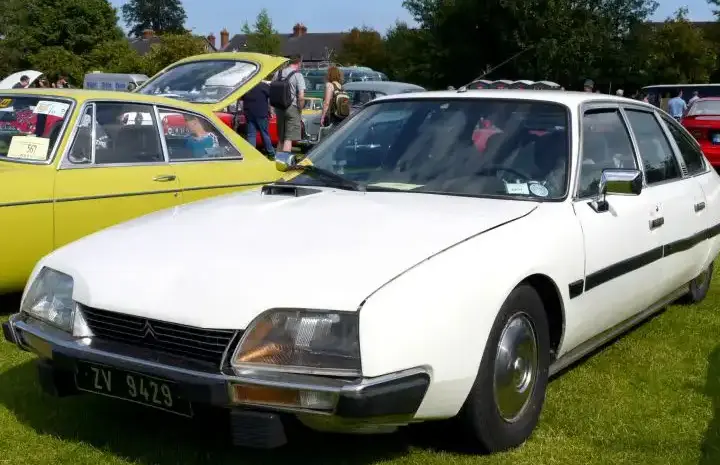
The Citroën CX I 2000, produced between 1979 and 1982, represented the entry point into the innovative CX range. Positioned as the most accessible model within the first generation (Series I) of the CX, it offered a blend of Citroën’s famed hydropneumatic suspension technology with a more conventional, and affordable, powertrain. The CX, succeeding the iconic DS, aimed to continue Citroën’s tradition of advanced engineering and distinctive styling. The 2000 variant, with its 2.0-liter engine, was primarily aimed at buyers seeking a comfortable and technologically advanced family car, particularly in European markets where fuel economy and practicality were highly valued. It was a key model in establishing the CX as a modern alternative to its predecessor.
Technical Specifications
| Brand | Citroen |
| Model | CX |
| Generation | CX I |
| Type (Engine) | 2000 (106 Hp) |
| Start of production | 1979 year |
| End of production | 1982 year |
| Powertrain Architecture | Internal Combustion engine |
| Body type | Hatchback |
| Seats | 5 |
| Doors | 5 |
| Fuel Type | Petrol (Gasoline) |
| Acceleration 0 – 100 km/h | 11.7 sec |
| Acceleration 0 – 62 mph | 11.7 sec |
| Acceleration 0 – 60 mph | 11.1 sec |
| Maximum speed | 176 km/h (109.36 mph) |
| Weight-to-power ratio | 11.6 kg/Hp, 86.2 Hp/tonne |
| Weight-to-torque ratio | 7.4 kg/Nm, 135 Nm/tonne |
| Power | 106 Hp @ 5500 rpm |
| Power per litre | 53.1 Hp/l |
| Torque | 166 Nm @ 3000 rpm (122.44 lb.-ft. @ 3000 rpm) |
| Engine layout | Front, Transverse |
| Engine Model/Code | M20.616 |
| Engine displacement | 1995 cm3 (121.74 cu. in.) |
| Number of cylinders | 4 |
| Engine configuration | Inline |
| Cylinder Bore | 88 mm (3.46 in.) |
| Piston Stroke | 82 mm (3.23 in.) |
| Compression ratio | 9.2:1 |
| Number of valves per cylinder | 2 |
| Fuel injection system | Carburettor |
| Engine aspiration | Naturally aspirated engine |
| Engine oil capacity | 5.3 l (5.6 US qt | 4.66 UK qt) |
| Coolant | 11 l (11.62 US qt | 9.68 UK qt) |
| Kerb Weight | 1230 kg (2711.69 lbs.) |
| Max. weight | 1710 kg (3769.9 lbs.) |
| Max load | 480 kg (1058.22 lbs.) |
| Trunk (boot) space – minimum | 325 l (11.48 cu. ft.) |
| Fuel tank capacity | 68 l (17.96 US gal | 14.96 UK gal) |
| Permitted trailer load with brakes (12%) | 900 kg (1984.16 lbs.) |
| Length | 4659 mm (183.43 in.) |
| Width | 1730 mm (68.11 in.) |
| Height | 1360 mm (53.54 in.) |
| Wheelbase | 2845 mm (112.01 in.) |
| Front track | 1474 mm (58.03 in.) |
| Rear (Back) track | 1360 mm (53.54 in.) |
| Front overhang | 1050 mm (41.34 in.) |
| Rear overhang | 764 mm (30.08 in.) |
| Ride height (ground clearance) | 155 mm (6.1 in.) |
| Drag coefficient (Cd) | 0.37 |
| Minimum turning circle (turning diameter) | 11.80 m (38.71 ft.) |
| Drivetrain Architecture | The Internal combustion engine (ICE) drives the front wheels of the vehicle. |
| Drive wheel | Front wheel drive |
| Number of gears and type of gearbox | 5 gears, manual transmission |
| Front brakes | Ventilated discs |
| Rear brakes | Disc |
| Steering type | Steering rack and pinion |
| Wheel rims size | 5.5J x 14 |
Powertrain & Engine Architecture
The Citroën CX I 2000 was powered by the M20.616 engine, a 1995cc inline-four cylinder petrol engine. This engine, while relatively simple in design, was known for its smoothness and durability. It utilized a single overhead camshaft (SOHC) valvetrain with two valves per cylinder. Fuel delivery was managed by a Solex C35 PHH carburetor, a common setup for European cars of the era. The carburetor, while less precise than fuel injection, offered a cost-effective solution for fuel management. The engine produced 106 horsepower at 5500 rpm and 166 Nm (122.44 lb-ft) of torque at 3000 rpm. The engine was transversely mounted, contributing to the CX’s compact engine bay and maximizing interior space. The transmission was a five-speed manual gearbox, providing a reasonable balance between performance and fuel economy. This configuration was a departure from the more complex and expensive fuel-injected and automatic transmission options available on higher-spec CX models.
Driving Characteristics
The CX I 2000, with its 106 hp and five-speed manual transmission, offered a comfortable but not particularly sporty driving experience. Acceleration to 60 mph took around 11.1 seconds, and top speed was approximately 109 mph. The engine felt relatively relaxed at cruising speeds, but required downshifting for brisk acceleration. The five-speed gearbox allowed for efficient highway cruising, while still providing enough gears for spirited driving on winding roads. Compared to the more powerful CX 2400 or the later turbocharged models, the 2000 felt noticeably slower. However, the real highlight of the driving experience was the CX’s hydropneumatic suspension. This system provided an incredibly smooth and comfortable ride, absorbing bumps and imperfections in the road with ease. The suspension also allowed for adjustable ride height, which could be useful for navigating difficult terrain or loading/unloading cargo. The steering, while precise, lacked the directness of some contemporary rivals.
Equipment & Trim Levels
The CX I 2000 was the base model, and as such, came with a relatively modest level of standard equipment. Interior upholstery was typically cloth, and the dashboard featured a simple, functional design. Standard features included power-assisted steering, front disc brakes, and the aforementioned hydropneumatic suspension. Optional extras included a sunroof, upgraded audio system, and more luxurious interior trim options. The CX I 2000 was designed to be a practical and affordable family car, so luxury features were kept to a minimum. The focus was on providing a comfortable and reliable driving experience, rather than opulent appointments.
Chassis & Braking
The CX featured a monocoque chassis, providing a strong and rigid platform for the hydropneumatic suspension. The front suspension utilized independent double wishbones, while the rear suspension employed a trailing arm design, both controlled by the hydropneumatic system. Braking was provided by ventilated discs on the front wheels and solid discs on the rear. The braking system was effective, but lacked the sophistication of some contemporary rivals. The CX I 2000 typically featured a smaller diameter stabilizer bar compared to higher-spec models, contributing to a slightly softer handling characteristic. The car’s relatively low weight (around 2712 lbs) helped to offset the modest power output.
Market Reception & Comparison
The Citroën CX I 2000 was generally well-received by critics, who praised its comfortable ride, innovative suspension, and distinctive styling. However, some critics noted its relatively modest performance and the complexity of the hydropneumatic system, which could be expensive to repair. Compared to other cars in its class, such as the Ford Taunus or Opel Rekord, the CX offered a more sophisticated and comfortable driving experience, but at a slightly higher price point. Fuel economy was reasonable for the era, but not exceptional. Reliability was generally good, but the hydropneumatic suspension required regular maintenance to prevent issues. The 2000 model was seen as a sensible choice for buyers who prioritized comfort and technology over outright performance.
Legacy
The Citroën CX I 2000, while not the most powerful or prestigious model in the CX range, played an important role in establishing the car’s reputation for innovation and comfort. The M20.616 engine proved to be a durable and reliable unit, and many examples are still on the road today. The hydropneumatic suspension, while complex, remains a defining feature of the CX and is highly regarded by enthusiasts. In the used car market, the CX I 2000 is often seen as a more affordable entry point into CX ownership, offering a taste of Citroën’s engineering prowess without the higher price tag of the more desirable models. Its simplicity and relative affordability make it a popular choice for those looking for a classic French car with a unique driving experience.
