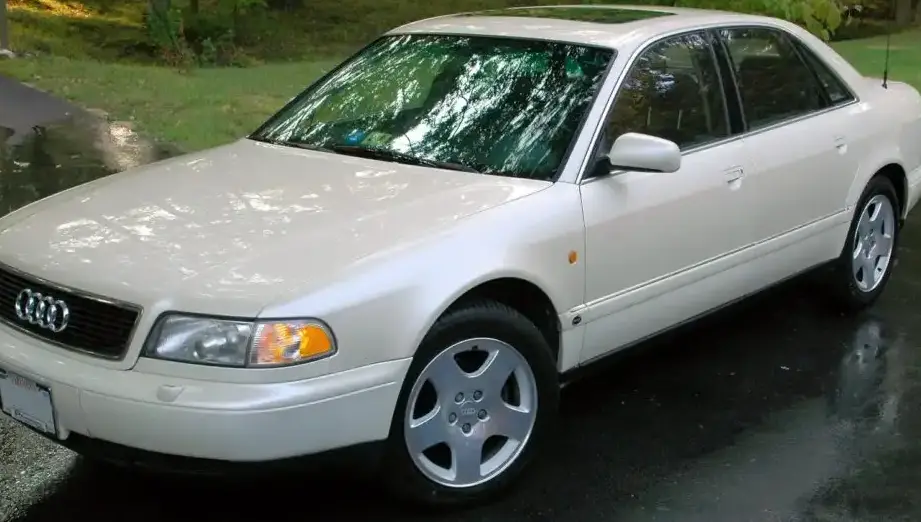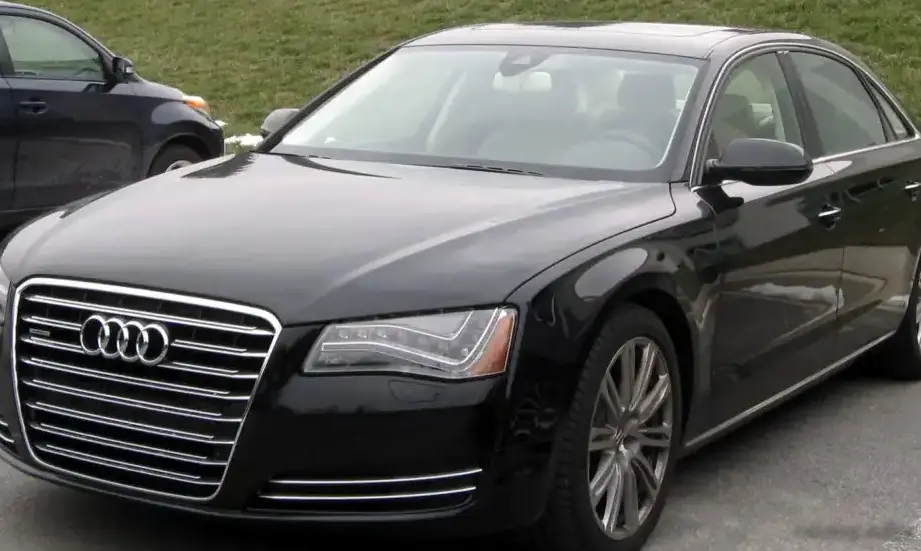
Technical Specifications
| Brand | Audi |
| Model | A8 |
| Generation | A8 (D4, 4H) |
| Type (Engine) | 3.0 TFSI V6 (333 Hp) quattro Tiptronic |
| Start of production | 2012 |
| End of production | 2014 |
| Powertrain Architecture | Internal Combustion engine |
| Body type | Sedan |
| Seats | 5 |
| Doors | 4 |
| Fuel consumption (economy) – urban (EPA) | 13.1 l/100 km (18 US mpg, 21.6 UK mpg, 7.6 km/l) |
| Fuel consumption (economy) – extra urban (EPA) | 8.4 l/100 km (28 US mpg, 33.6 UK mpg, 11.9 km/l) |
| Fuel consumption (economy) – combined (EPA) | 11.2 l/100 km (21 US mpg, 25.2 UK mpg, 8.9 km/l) |
| Fuel Type | Petrol (Gasoline) |
| Acceleration 0 – 60 mph | 5.5 sec |
| Maximum speed | 210 km/h (130.49 mph), Electronically limited |
| Emission standard | ULEV 2 |
| Weight-to-power ratio | 5.9 kg/Hp, 168.2 Hp/tonne |
| Weight-to-torque ratio | 4.5 kg/Nm, 222.2 Nm/tonne |
| Power | 333 Hp @ 5500 rpm |
| Power per litre | 111.2 Hp/l |
| Torque | 440 Nm @ 2900 rpm (324.53 lb.-ft. @ 2900 rpm) |
| Engine layout | Front, Longitudinal |
| Engine Model/Code | EA837 / CTUB |
| Engine displacement | 2995 cm3 (182.77 cu. in.) |
| Number of cylinders | 6 |
| Engine configuration | V-engine |
| Cylinder Bore | 84.5 mm (3.33 in.) |
| Piston Stroke | 89 mm (3.5 in.) |
| Compression ratio | 10.3:1 |
| Number of valves per cylinder | 4 |
| Fuel injection system | Direct injection |
| Engine aspiration | Supercharger, Intercooler |
| Valvetrain | DOHC |
| Engine oil capacity | 6.8 l (7.19 US qt | 5.98 UK qt) |
| Coolant | 11.5 l (12.15 US qt | 10.12 UK qt) |
| Kerb Weight | 1980-1984 kg (4365.15 – 4373.97 lbs.) |
| Trunk (boot) space – minimum | 510 l (18.01 cu. ft.) |
| Fuel tank capacity | 90 l (23.78 US gal | 19.8 UK gal) |
| Length | 5137 mm (202.24 in.) |
| Width | 1949 mm (76.73 in.) |
| Width including mirrors | 2111 mm (83.11 in.) |
| Height | 1460 mm (57.48 in.) |
| Wheelbase | 2992 mm (117.8 in.) |
| Front track | 1644 mm (64.72 in.) |
| Rear (Back) track | 1635 mm (64.37 in.) |
| Front overhang | 1003 mm (39.49 in.) |
| Rear overhang | 1142 mm (44.96 in.) |
| Drag coefficient (Cd) | 0.26 |
| Minimum turning circle (turning diameter) | 12.3 m (40.35 ft.) |
| Drivetrain Architecture | The Internal combustion engine (ICE) drives permanently the four wheels of the vehicle. |
| Drive wheel | All wheel drive (4×4) |
| Number of gears and type of gearbox | 8 gears, automatic transmission Tiptronic |
| Front suspension | Independent multi-link suspension, Transverse stabilizer, Air suspension |
| Rear suspension | Independent on trapezoidal lever, Air suspension, Transverse stabilizer |
| Front brakes | Ventilated discs, 356 mm |
| Rear brakes | Ventilated discs, 330 mm |
| Assisting systems | ABS (Anti-lock braking system) |
| Steering type | Steering rack and pinion |
| Power steering | Hydraulic Steering |
| Tires size | 255/45 R19; 265/40 R20 |
| Wheel rims size | 9J x 19; 9J x 20 |
The Audi A8 (D4) 3.0 TFSI quattro Tiptronic, produced from 2012 to 2014, represents a significant iteration of Audi’s flagship luxury sedan. Falling within the fourth generation of the A8 (internally designated D4, and utilizing the 4H platform), this variant occupied a crucial middle ground in the lineup, offering a compelling blend of performance, efficiency, and technology. It served as a popular alternative to the higher-performance 4.2-liter V8 and the fuel-efficient, but less powerful, diesel options available in European markets. In the US market, the 3.0 TFSI became the primary A8 offering, balancing luxury with a more accessible price point.
Powertrain & Engine Architecture
At the heart of the A8 3.0 TFSI lies the EA837 engine, a 3.0-liter naturally aspirated V6. This engine, designated CTUB in Audi nomenclature, is characterized by its direct fuel injection system and a robust valvetrain featuring double overhead camshafts (DOHC) and four valves per cylinder. A supercharger, coupled with an intercooler, provides forced induction, boosting power and torque across the rev range. The engine produces 333 horsepower at 5500 rpm and 440 Nm (324.53 lb-ft) of torque at 2900 rpm. This power is then channeled through Audi’s eight-speed Tiptronic automatic transmission, a torque-converter type known for its smooth shifts and responsiveness. The Tiptronic transmission allows for both fully automatic operation and manual gear selection via steering wheel-mounted paddles or the gear selector.
Driving Characteristics
The 3.0 TFSI automatic combination delivered a refined and capable driving experience. While not as overtly sporty as the V8 models, the 3.0-liter engine provided ample power for comfortable highway cruising and confident overtaking. The eight-speed Tiptronic transmission was well-matched to the engine’s characteristics, offering smooth and timely gear changes. The gear ratios were tuned for a balance of acceleration and fuel efficiency. Compared to the manual transmission options available in some markets, the Tiptronic prioritized ease of use and comfort over outright performance. The quattro all-wheel-drive system ensured excellent traction in all weather conditions, contributing to a secure and planted feel.
Equipment & Trim Levels
The A8 3.0 TFSI typically came well-equipped as standard. Interior features included leather upholstery, power-adjustable front seats with memory function, a multi-function steering wheel, and a premium audio system. Standard technology included Audi’s MMI infotainment system with a central display screen, navigation, and Bluetooth connectivity. Optional extras included features such as advanced driver-assistance systems (adaptive cruise control, lane keeping assist, blind spot monitoring), a panoramic sunroof, upgraded leather packages, and rear-seat entertainment. Trim levels varied slightly by market, but generally offered packages that bundled popular options together.
Chassis & Braking
The A8 D4 featured an advanced chassis design incorporating an independent multi-link suspension at all four corners, complemented by an adaptive air suspension system. This air suspension allowed for adjustable ride height and damping settings, providing a comfortable and controlled ride. The 3.0 TFSI models typically utilized ventilated disc brakes on all four wheels, with front discs measuring 356mm and rear discs measuring 330mm. Anti-lock braking system (ABS) was standard, along with electronic stability control. The suspension was tuned to accommodate the weight distribution of the V6 engine and provide a balanced handling experience.
Market Reception & Comparison
The A8 3.0 TFSI was generally well-received by automotive critics. It was praised for its refined ride, comfortable interior, and strong performance. Fuel economy was considered respectable for a large luxury sedan, although not class-leading. Compared to the A8 4.2 FSI, the 3.0 TFSI offered a more affordable entry point into the A8 range, albeit with slightly less power and performance. Against diesel-powered A8 models (popular in Europe), the 3.0 TFSI provided a gasoline alternative with a different driving character. Reliability reports suggest that the EA837 engine is generally robust, although preventative maintenance is crucial.
Legacy
The Audi A8 (D4) 3.0 TFSI quattro Tiptronic remains a desirable used luxury car. The EA837 engine has proven to be relatively reliable, although regular oil changes and adherence to the manufacturer’s maintenance schedule are essential. The Tiptronic transmission, while generally dependable, can require expensive repairs if neglected. Today, these A8s offer a compelling combination of luxury, technology, and performance at a more accessible price point than newer models. The D4 generation A8, and particularly the 3.0 TFSI variant, established Audi as a serious contender in the full-size luxury sedan segment, paving the way for future generations of the A8.