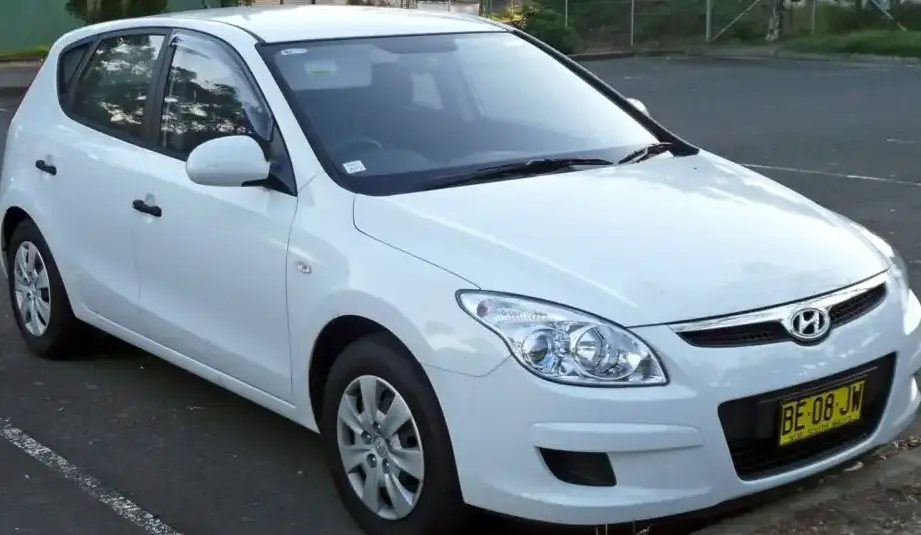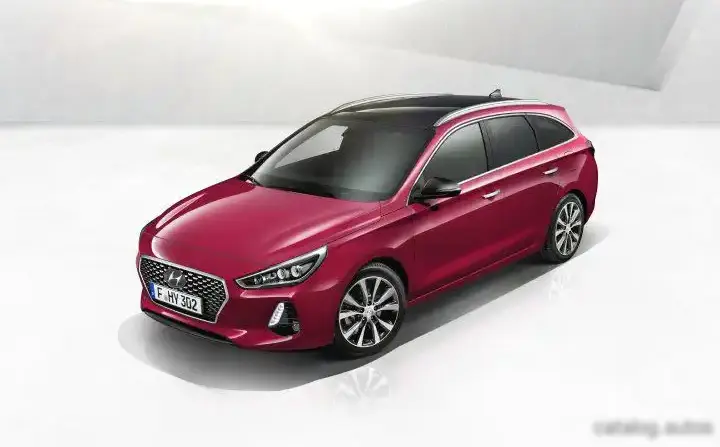
The Hyundai i30 III CW 1.4 T-GDI (140 hp) DCT is a front-wheel-drive, five-door station wagon (estate) that was produced from 2017 to 2019. It represents a key variant within the third generation (PD) of the Hyundai i30, known internally as the ‘i30 III CW’. This model aimed to provide a balance of fuel efficiency, practicality, and modern technology within the compact estate car segment, primarily targeting the European market. The “CW” designation specifically denotes the wagon body style, differentiating it from the five-door hatchback version. It was positioned as a mid-range offering, bridging the gap between the base engine options and the more performance-oriented trims.
Technical Specifications
| Brand | Hyundai |
| Model | i30 |
| Generation | i30 III CW |
| Type (Engine) | 1.4 T-GDI (140 Hp) DCT |
| Start of production | 2017 |
| End of production | 2019 |
| Powertrain Architecture | Internal Combustion engine |
| Body type | Station wagon (estate) |
| Seats | 5 |
| Doors | 5 |
| Fuel consumption (urban) | 6.2-6.4 l/100 km (37.9 – 36.8 US mpg) |
| Fuel consumption (extra urban) | 4.7-5.0 l/100 km (50 – 47 US mpg) |
| Fuel consumption (combined) | 5.2-5.5 l/100 km (45.2 – 42.8 US mpg) |
| CO2 emissions | 120-125 g/km |
| Fuel Type | Petrol (Gasoline) |
| Acceleration 0 – 100 km/h | 9.5 sec |
| Acceleration 0 – 62 mph | 9.5 sec |
| Acceleration 0 – 60 mph | 9 sec |
| Maximum speed | 203 km/h (126.14 mph) |
| Emission standard | Euro 6b |
| Weight-to-power ratio | 9.2 kg/Hp |
| Weight-to-torque ratio | 5.3 kg/Nm |
| Power | 140 Hp @ 6000 rpm |
| Torque | 242 Nm @ 1500 rpm (178.49 lb.-ft. @ 1500 rpm) |
| Engine layout | Front, Transverse |
| Engine Model/Code | Kappa II / G4LD |
| Engine displacement | 1353 cm3 (82.57 cu. in.) |
| Number of cylinders | 4 |
| Engine configuration | Inline |
| Cylinder Bore | 71.6 mm (2.82 in.) |
| Piston Stroke | 84 mm (3.31 in.) |
| Compression ratio | 10:1 |
| Number of valves per cylinder | 4 |
| Fuel injection system | Direct injection |
| Engine aspiration | Turbocharger, Intercooler |
| Engine oil capacity | 4.2 l (4.44 US qt | 3.7 UK qt) |
| Coolant capacity | 6.1 l (6.45 US qt | 5.37 UK qt) |
| Kerb Weight | 1294-1532 kg (2852.78 – 3377.48 lbs.) |
| Max. weight | 1880 kg (4144.69 lbs.) |
| Max load | 348-586 kg (767.21 – 1291.91 lbs.) |
| Trunk (boot) space – minimum | 602 l (21.26 cu. ft.) |
| Trunk (boot) space – maximum | 1650 l (58.27 cu. ft.) |
| Fuel tank capacity | 50 l (13.21 US gal | 11 UK gal) |
| Max. roof load | 80 kg (176.37 lbs.) |
| Permitted trailer load with brakes (12%) | 1400 kg (3086.47 lbs.) |
| Permitted towbar download | 80 kg (176.37 lbs.) |
| Length | 4585 mm (180.51 in.) |
| Width | 1795 mm (70.67 in.) |
| Height | 1465-1475 mm (57.68 – 58.07 in.) |
| Wheelbase | 2650 mm (104.33 in.) |
| Front track | 1573-1559 mm (61.93 – 61.38 in.) |
| Rear track | 1581-1567 mm (62.24 – 61.69 in.) |
| Front overhang | 905 mm (35.63 in.) |
| Rear overhang | 1030 mm (40.55 in.) |
| Ride height (ground clearance) | 140 mm (5.51 in.) |
| Drivetrain Architecture | Front wheel drive |
| Number of gears and type of gearbox | 7 gears, automatic transmission |
| Front suspension | Independent type McPherson |
| Rear suspension | Independent multi-link suspension |
| Front brakes | Ventilated discs |
| Rear brakes | Disc |
| Assisting systems | ABS (Anti-lock braking system) |
| Steering type | Steering rack and pinion |
| Power steering | Electric Steering |
| Tires size | 195/65 R15; 205/55 R16; 225/45 R17 |
| Wheel rims size | 6J x 15; 6.5J x 16; 7J x 17 |
Powertrain & Engine Architecture
The i30 CW 1.4 T-GDI utilizes Hyundai’s Kappa II engine family, specifically the G4LD code. This is a 1.353-liter, inline-four cylinder engine featuring direct fuel injection and a single scroll turbocharger with an intercooler. The direct injection system allows for precise fuel delivery, contributing to improved efficiency and reduced emissions. The engine produces 140 horsepower at 6000 rpm and 242 Nm (178.49 lb-ft) of torque at 1500 rpm. The engine’s relatively low-end torque delivery is a key characteristic. Paired with this engine is a seven-speed dual-clutch transmission (DCT). This DCT provides quicker and smoother gear changes compared to a traditional automatic transmission, enhancing both performance and fuel economy. The DCT’s programming prioritizes fuel efficiency in normal driving conditions, with sportier shift patterns available through selectable drive modes.
Driving Characteristics
The 1.4 T-GDI with the DCT offers a comfortable and refined driving experience. Acceleration from 0-60 mph takes approximately 9 seconds, which is adequate for everyday driving but doesn’t position it as a particularly sporty option. The DCT transmission contributes to a responsive feel, and the turbocharger provides a noticeable boost in power when accelerating. Compared to the base 1.0 T-GDI engine, the 1.4 T-GDI offers significantly more power and torque, resulting in more confident overtaking and highway cruising. However, it doesn’t match the performance of the higher-output engines available in the i30 range, such as the 1.6 T-GDI. The DCT’s gear ratios are tuned for a balance between fuel efficiency and performance, with taller gears for highway cruising and shorter gears for quicker acceleration. The steering is light and precise, making it easy to maneuver in urban environments.
Equipment & Trim Levels
The i30 CW 1.4 T-GDI DCT typically came equipped with a reasonable level of standard features. These included air conditioning, a touchscreen infotainment system with Apple CarPlay and Android Auto compatibility, Bluetooth connectivity, and a suite of safety features such as ABS, ESC (Electronic Stability Control), and multiple airbags. Higher trim levels offered additional features such as a larger touchscreen display, navigation system, heated seats, a panoramic sunroof, and advanced driver-assistance systems like lane departure warning and automatic emergency braking. Interior upholstery was typically cloth, with leather options available on higher trims. Dashboard configuration was generally consistent across trims, with a focus on a clean and modern design.
Chassis & Braking
The i30 CW features a McPherson strut front suspension and a multi-link rear suspension. This setup provides a good balance between ride comfort and handling. The suspension is tuned to prioritize comfort, but it still offers decent body control in corners. Braking duties are handled by ventilated discs at the front and solid discs at the rear. ABS (Anti-lock Braking System) is standard, providing enhanced braking performance in emergency situations. Stabilizer bars are fitted to both the front and rear axles to reduce body roll during cornering.
Market Reception & Comparison
The Hyundai i30 CW 1.4 T-GDI DCT was generally well-received by automotive critics. It was praised for its fuel efficiency, comfortable ride, and well-equipped interior. However, some critics noted that the engine could feel a bit strained when fully loaded or driving uphill. Compared to rivals like the Volkswagen Golf Estate and Ford Focus Estate, the i30 CW offered a competitive level of equipment and value for money. Its fuel economy was comparable to other 1.4-liter turbocharged engines in the segment, and its reliability record has been generally positive.
Legacy
The Kappa II 1.4 T-GDI engine and the seven-speed DCT transmission have proven to be relatively reliable powertrains. While some owners have reported minor issues with the DCT, such as occasional jerky shifts, these are generally not widespread. On the used car market, the i30 CW 1.4 T-GDI DCT represents a practical and affordable option for buyers looking for a fuel-efficient and spacious estate car. Its combination of modern technology, comfortable ride, and reasonable running costs make it a compelling choice in the compact estate segment. The engine’s longevity, when properly maintained, is considered good, making it a viable option for long-term ownership.