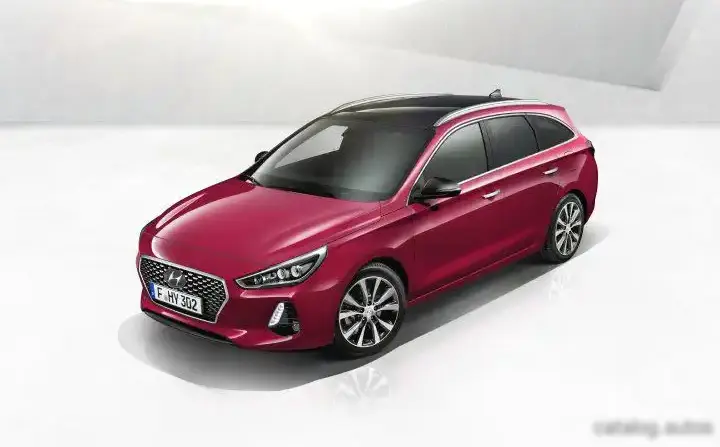
The Hyundai i30 III CW 1.6 CRDi (110 hp) is a compact station wagon (estate) produced by the South Korean manufacturer Hyundai between 2017 and 2019. Part of the third generation of the i30 (codenamed PD), the CW variant – denoting ‘Combined Wagon’ – offered increased practicality and cargo space compared to the standard hatchback. This particular engine and trim level represented a fuel-efficient, value-oriented option within the i30 lineup, aimed at buyers prioritizing economy and versatility over outright performance. It was positioned as an entry-to-mid-range offering, slotting below the more powerful petrol and diesel variants.
Technical Specifications
| Brand | Hyundai |
| Model | i30 |
| Generation | i30 III CW |
| Type (Engine) | 1.6 CRDi (110 Hp) |
| Start of production | 2017 |
| End of production | 2019 |
| Powertrain Architecture | Internal Combustion engine |
| Body type | Station wagon (estate) |
| Seats | 5 |
| Doors | 5 |
| Fuel consumption (urban) | 4.1-4.2 l/100 km (57.4 – 56 US mpg) |
| Fuel consumption (extra urban) | 3.5-3.6 l/100 km (67.2 – 65.3 US mpg) |
| Fuel consumption (combined) | 3.7-3.8 l/100 km (63.6 – 61.9 US mpg) |
| CO2 emissions | 96-99 g/km |
| Fuel Type | Diesel |
| Acceleration 0 – 100 km/h | 11.3 sec |
| Acceleration 0 – 62 mph | 11.3 sec |
| Acceleration 0 – 60 mph | 10.7 sec |
| Maximum speed | 188 km/h (116.82 mph) |
| Emission standard | Euro 6a |
| Weight-to-power ratio | 11.9 kg/Hp |
| Weight-to-torque ratio | 4.7 kg/Nm |
| Power | 110 Hp @ 4000 rpm |
| Torque | 280 Nm @ 1500-2500 rpm (206.52 lb.-ft. @ 1500-2500 rpm) |
| Engine layout | Front, Transverse |
| Engine Model/Code | D4FB |
| Engine displacement | 1582 cm3 (96.54 cu. in.) |
| Number of cylinders | 4 |
| Engine configuration | Inline |
| Cylinder Bore | 77.2 mm (3.04 in.) |
| Piston Stroke | 84.5 mm (3.33 in.) |
| Compression ratio | 16:1 |
| Number of valves per cylinder | 4 |
| Fuel injection system | Diesel Commonrail |
| Engine aspiration | Turbocharger, Intercooler |
| Engine oil capacity | 5.3 l (5.6 US qt | 4.66 UK qt) |
| Coolant capacity | 6.7 l (7.08 US qt | 5.9 UK qt) |
| Kerb Weight | 1310-1548 kg (2888.06 – 3412.76 lbs.) |
| Max. weight | 1900 kg (4188.78 lbs.) |
| Max load | 352-590 kg (776.03 – 1300.73 lbs.) |
| Trunk (boot) space – minimum | 602 l (21.26 cu. ft.) |
| Trunk (boot) space – maximum | 1650 l (58.27 cu. ft.) |
| Fuel tank capacity | 50 l (13.21 US gal | 11 UK gal) |
| Max. roof load | 80 kg (176.37 lbs.) |
| Permitted trailer load with brakes (12%) | 1500 kg (3306.93 lbs.) |
| Permitted towbar download | 80 kg (176.37 lbs.) |
| Length | 4585 mm (180.51 in.) |
| Width | 1795 mm (70.67 in.) |
| Height | 1465-1475 mm (57.68 – 58.07 in.) |
| Wheelbase | 2650 mm (104.33 in.) |
| Front track | 1573-1559 mm (61.93 – 61.38 in.) |
| Rear track | 1581-1567 mm (62.24 – 61.69 in.) |
| Front overhang | 905 mm (35.63 in.) |
| Rear overhang | 1030 mm (40.55 in.) |
| Ride height (ground clearance) | 140 mm (5.51 in.) |
| Drivetrain | Front wheel drive |
| Number of gears and type of gearbox | 6 gears, manual transmission |
| Front suspension | Independent type McPherson |
| Rear suspension | Independent multi-link suspension |
| Front brakes | Ventilated discs |
| Rear brakes | Disc |
| Assisting systems | ABS (Anti-lock braking system) |
| Steering type | Steering rack and pinion |
| Power steering | Electric Steering |
| Tires size | 195/65 R15; 205/55 R16; 225/45 R17 |
| Wheel rims size | 6.0J x 15; 6.5J x 16; 7.0J x 17 |
INTRODUCTION
The Hyundai i30 III CW 1.6 CRDi (110 hp) was introduced as part of the PD generation i30, launched in 2017. This generation represented a significant step forward for Hyundai in terms of design, quality, and technology. The CW (Combined Wagon) body style aimed to capitalize on the growing popularity of estate cars in Europe, offering a practical alternative to the hatchback with a substantially larger cargo area. The 1.6 CRDi engine, a mainstay of Hyundai’s diesel lineup, provided a balance of fuel efficiency and reasonable performance, making it a popular choice for fleet buyers and private customers alike. This variant was designed to appeal to those seeking a cost-effective and versatile family vehicle.
Powertrain & Engine Architecture
The i30 CW 1.6 CRDi utilizes the Hyundai D4FB engine, a 1.6-liter inline-four cylinder diesel engine. This engine is a common-rail direct injection (CRDi) unit, meaning fuel is delivered directly into the combustion chamber at extremely high pressure via a sophisticated common rail system. The D4FB features a turbocharger with an intercooler, which enhances power output and efficiency by forcing more air into the engine. The engine produces 110 horsepower at 4,000 rpm and 280 Nm (206.52 lb-ft) of torque between 1500 and 2500 rpm. The engine’s architecture includes four valves per cylinder and a compression ratio of 16:1. The 6-speed manual transmission was standard on this model, offering a relatively long gearing setup optimized for fuel economy. The transmission is a conventional manual gearbox with synchromesh on all forward gears and reverse.
Driving Characteristics
The 1.6 CRDi engine, paired with the manual transmission, provided adequate, though not exhilarating, performance. Acceleration from 0 to 100 km/h (0-62 mph) took approximately 11.3 seconds. The engine’s strength lay in its mid-range torque, making it suitable for everyday driving and overtaking maneuvers. However, it lacked the punch of the more powerful petrol or larger diesel engines available in the i30 range. The long gearing contributed to good fuel economy, but also meant the engine could feel strained when climbing hills or carrying a full load. Compared to the higher-output diesel variants, this 110 hp version felt noticeably less responsive. The manual transmission offered a precise shift action, but the gear ratios were spaced to prioritize economy over sporty driving.
Equipment & Trim Levels
The i30 CW 1.6 CRDi typically came equipped with a reasonable level of standard features. These included air conditioning, electric front windows, a USB audio connection, Bluetooth connectivity, and a basic infotainment system. Safety features such as ABS, ESC (Electronic Stability Control), and multiple airbags were also standard. Higher trim levels offered additional features such as alloy wheels, a touchscreen infotainment system with navigation, rear parking sensors, cruise control, and automatic climate control. Interior upholstery was typically cloth, with options for upgraded materials on higher trims. The dashboard layout was functional and user-friendly, with a focus on ergonomics.
Chassis & Braking
The i30 CW featured a McPherson strut front suspension and a multi-link rear suspension, providing a comfortable and controlled ride. The suspension was tuned to prioritize comfort over outright handling prowess. The front brakes were ventilated discs, while the rear brakes were solid discs. ABS (Anti-lock Braking System) was standard, enhancing braking performance and stability. The steering was electrically assisted, providing light and precise steering feel. The chassis was designed to accommodate the increased weight and length of the wagon body style, maintaining a stable and predictable driving experience.
Market Reception & Comparison
The Hyundai i30 CW 1.6 CRDi was generally well-received by automotive critics as a practical and fuel-efficient estate car. It was praised for its spacious interior, large cargo area, and comfortable ride. However, some critics noted that the 1.6 CRDi engine lacked the refinement and performance of some of its competitors. Compared to other trims in the i30 lineup, the 1.6 CRDi offered the best fuel economy but the lowest performance. The petrol engines provided more responsive acceleration, while the larger diesel engines offered greater torque and towing capacity. In terms of reliability, the D4FB engine proved to be generally robust, although regular maintenance was essential to prevent issues with the diesel particulate filter (DPF).
Legacy
The Hyundai i30 III CW 1.6 CRDi has proven to be a reliable and durable vehicle in the used car market. The D4FB engine, while not known for being particularly exciting, is generally considered to be a dependable unit. Common issues include DPF blockages (particularly on vehicles used primarily for short journeys) and wear and tear on suspension components. However, these are relatively minor issues that can be addressed with regular maintenance. The i30 CW 1.6 CRDi remains a popular choice for buyers seeking a practical, fuel-efficient, and affordable estate car.