Technical Specifications
| Brand | Audi |
| Model | A8 |
| Generation | A8 (D4,4H facelift 2013) |
| Type (Engine) | 2.0 (245 Hp) Hybrid Tiptronic |
| Start of production | 2013 |
| End of production | 2015 |
| Powertrain Architecture | FHEV (Full Hybrid Electric Vehicle) |
| Body type | Sedan |
| Seats | 5 |
| Doors | 4 |
| Fuel consumption (urban) | 6.1 l/100 km (38.6 US mpg, 46.3 UK mpg, 16.4 km/l) |
| Fuel consumption (extra urban) | 6.2 l/100 km (37.9 US mpg, 45.6 UK mpg, 16.1 km/l) |
| Fuel consumption (combined) | 6.2 l/100 km (37.9 US mpg, 45.6 UK mpg, 16.1 km/l) |
| CO2 emissions | 144 g/km |
| Fuel Type | Petrol (Gasoline) |
| Acceleration 0 – 100 km/h | 7.7 sec |
| Acceleration 0 – 62 mph | 7.7 sec |
| Acceleration 0 – 60 mph | 7.3 sec |
| Maximum speed | 235 km/h (146.02 mph) |
| Emission standard | Euro 6 |
| Weight-to-power ratio | 7.6 kg/Hp, 131 Hp/tonne |
| Weight-to-torque ratio | 3.9 kg/Nm, 256.7 Nm/tonne |
| Gross battery capacity | 1.25 kWh |
| Electric motor power | 54 Hp |
| Electric motor Torque | 210 Nm (154.89 lb.-ft.) |
| System power | 245 Hp |
| System torque | 480 Nm (354.03 lb.-ft.) |
| Engine Power | 211 Hp @ 4200-6000 rpm |
| Engine Torque | 350 Nm @ 1500-4200 rpm (258.15 lb.-ft. @ 1500-4200 rpm) |
| Engine layout | Front, Longitudinal |
| Engine Model/Code | CHJA |
| Engine displacement | 1984 cm3 (121.07 cu. in.) |
| Number of cylinders | 4 |
| Engine configuration | Inline |
| Cylinder Bore | 82.5 mm (3.25 in.) |
| Piston Stroke | 92.8 mm (3.65 in.) |
| Compression ratio | 9.6:1 |
| Number of valves per cylinder | 4 |
| Fuel injection system | Direct injection |
| Engine aspiration | Turbocharger, Intercooler |
| Engine oil capacity | 4.6 l (4.86 US qt | 4.05 UK qt) |
| Kerb Weight | 1870 kg (4122.64 lbs.) |
| Max. weight | 2510 kg (5533.6 lbs.) |
| Max load | 640 kg (1410.96 lbs.) |
| Trunk (boot) space – minimum | 335 l (11.83 cu. ft.) |
| Fuel tank capacity | 78 l (20.61 US gal | 17.16 UK gal) |
| Max. roof load | 100 kg (220.46 lbs.) |
| Length | 5135 mm (202.17 in.) |
| Width | 1949 mm (76.73 in.) |
| Height | 1460 mm (57.48 in.) |
| Wheelbase | 2992 mm (117.8 in.) |
| Front track | 1644 mm (64.72 in.) |
| Rear (Back) track | 1635 mm (64.37 in.) |
| Drag coefficient (Cd) | 0.26 |
| Minimum turning circle | 12.3 m (40.35 ft.) |
| Drive wheel | Front wheel drive |
| Number of gears | 8 |
| Gearbox type | automatic transmission Tiptronic |
| Front suspension | Independent multi-link suspension |
| Rear suspension | Independent on trapezoidal lever |
| Front brakes | Ventilated discs |
| Rear brakes | Ventilated discs |
| Assisting systems | ABS (Anti-lock braking system) |
| Steering type | Steering rack and pinion |
| Power steering | Electric Steering |
| Tires size | 235/55 R18 |
| Wheel rims size | 8.0J x 18 |
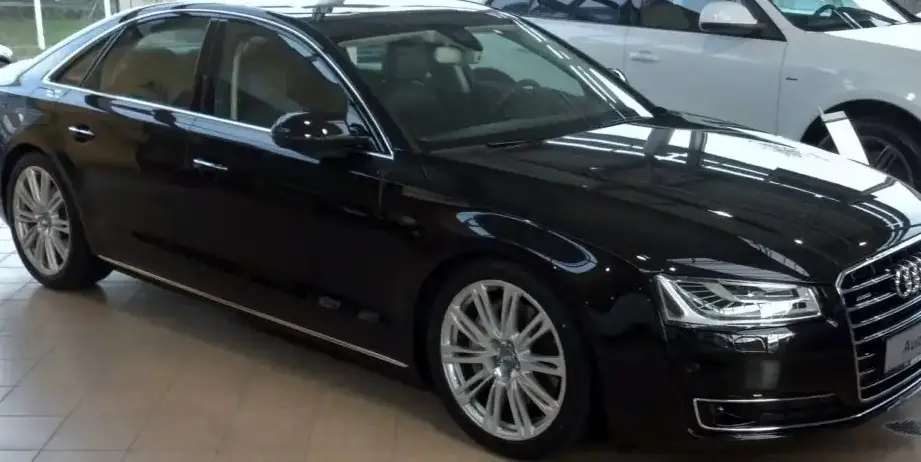
The Audi A8 (D4, 4H facelift) 2.0 TFSI Hybrid Tiptronic, produced from 2013 to 2015, represents a pivotal moment in Audi’s strategy to integrate fuel efficiency into its flagship luxury sedan. This variant served as the entry point into the D4 facelift A8 range, targeting buyers who desired a blend of prestige, advanced technology, and lower running costs. It employed a parallel full hybrid system, combining a turbocharged four-cylinder gasoline engine with an electric motor to deliver a unique driving experience. The model played a key role in expanding the A8’s market reach, particularly in regions with stringent environmental regulations and a growing demand for fuel economy, such as Europe and Asia, while upholding the luxury standards associated with the A8 name.
Powertrain & Engine Architecture
The core of the A8 2.0 TFSI Hybrid is the CHJA engine, a 1.984-liter inline-four cylinder gasoline engine featuring a turbocharger and direct fuel injection. This engine generates 211 horsepower and 350 Nm (258 lb-ft) of torque. The engine’s turbocharger is designed to provide a broad and flat torque curve, enhancing responsiveness across a wide range of engine speeds. Paired with this is an 8-speed Tiptronic automatic transmission, renowned for its smooth and efficient gear changes. The electric motor, integrated into the drivetrain, adds an extra 54 horsepower and 210 Nm (155 lb-ft) of torque. The hybrid system operates in a parallel configuration, allowing both the gasoline engine and electric motor to independently or jointly power the wheels. The 1.25 kWh lithium-ion battery pack is strategically positioned under the trunk floor, minimizing any compromise to passenger space. The system prioritizes electric drive at lower speeds and during coasting, seamlessly transitioning to gasoline power when increased power is needed.
Driving Characteristics
The 2.0 TFSI Hybrid A8 offers a distinct driving experience when compared to its more powerful counterparts, such as the 3.0 TDI or 4.2 FSI models. While it doesn’t provide the same level of exhilarating acceleration (0-60 mph in approximately 7.3 seconds), it delivers a refined and comfortable ride. The electric motor provides immediate torque, resulting in brisk acceleration from a standstill. The Tiptronic transmission is meticulously calibrated, offering smooth and precise gear changes. In hybrid mode, the car frequently operates silently on electric power, enhancing the sense of luxury and tranquility. The steering is light and precise, making it easy to navigate in urban environments. The gear ratios are optimized for fuel efficiency, which may result in the engine running at slightly higher revolutions per minute at highway speeds compared to the higher-output variants. Overall, the driving experience is geared towards comfort and efficiency rather than outright performance.
Equipment & Trim Levels
The 2.0 TFSI Hybrid typically came standard with a comprehensive suite of features expected in a luxury sedan. These included leather upholstery, tri-zone automatic climate control, a premium sound system, and Audi’s MMI infotainment system with a central display screen. Standard safety features encompassed multiple airbags, ABS, electronic stability control, and parking sensors. Optional extras included features such as adaptive cruise control, a head-up display, a panoramic sunroof, and upgraded leather packages. The interior trim was generally more understated compared to the higher-end A8 models, emphasizing elegant simplicity over opulent extravagance. Exterior styling remained largely consistent across the range, with subtle “Hybrid” badging serving to differentiate this variant.
Chassis & Braking
The A8 2.0 TFSI Hybrid utilizes a sophisticated chassis design focused on ride comfort and handling. It features an independent multi-link suspension at the front and an independent trapezoidal lever suspension at the rear. The suspension is tuned to provide a smooth and controlled ride, effectively absorbing bumps and imperfections in the road surface. Braking is handled by ventilated disc brakes on all four wheels, providing ample stopping power. The car is equipped with Audi’s ABS (Anti-lock Braking System) and electronic stability control, enhancing safety and stability. Due to the added weight of the hybrid system, the suspension components are slightly stiffer compared to the standard A8 models to maintain handling balance.
Market Reception & Comparison
The A8 2.0 TFSI Hybrid was generally well-received by automotive critics, who lauded its fuel efficiency and refined driving experience. However, some reviewers pointed out that it lacked the performance of the higher-powered A8 variants. Compared to the 3.0 TDI, the hybrid offered significantly improved fuel economy but less torque and acceleration. In contrast to the 4.2 FSI, the hybrid was considerably more economical but lacked the V8’s power and prestige. The hybrid’s appeal stemmed from its ability to deliver a luxurious and comfortable driving experience while minimizing environmental impact. Its fuel economy figures of around 38 mpg combined made it an attractive option for buyers prioritizing efficiency.
Legacy
The Audi A8 2.0 TFSI Hybrid Tiptronic represents a significant step in Audi’s development of hybrid technology. While not the fastest or most powerful A8 variant, it demonstrated the potential for combining luxury and efficiency. The CHJA engine and Tiptronic transmission proved to be relatively reliable, with few widespread issues reported. On the used car market, these models are often sought after by buyers looking for a fuel-efficient luxury sedan with a proven track record. The hybrid system’s longevity is generally good, although battery health should be assessed during a pre-purchase inspection. The A8 2.0 TFSI Hybrid remains a compelling option for those seeking a sophisticated and environmentally conscious luxury vehicle.