
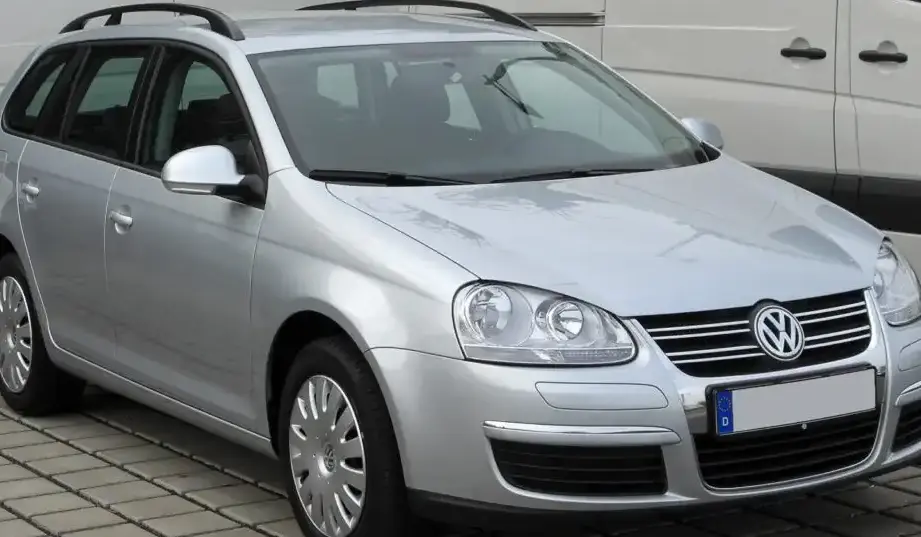
The Volkswagen Golf V Variant 1.6, producing 102 horsepower, was a station wagon (estate) model offered between March 2007 and May 2009. It represented an entry-level option within the Golf V Variant range, which was itself a practical and popular choice in the European market. Based on the Golf Mk5 (1HX0/A3 platform), the Variant offered increased cargo capacity compared to the hatchback, appealing to families and those requiring more versatile space. This particular 1.6-liter engine and five-speed manual transmission combination aimed for affordability and fuel efficiency, positioning it below the more powerful 1.9 TDI diesel and 2.0 FSI petrol variants.
Technical Specifications
| Brand | Volkswagen |
| Model | Golf |
| Generation | Golf V Variant |
| Type (Engine) | 1.6 (102 Hp) |
| Start of production | March, 2007 |
| End of production | May, 2009 |
| Powertrain Architecture | Internal Combustion engine |
| Body type | Station wagon (estate) |
| Seats | 5 |
| Doors | 5 |
| Fuel consumption (urban) | 9.9 l/100 km (23.8 US mpg, 28.5 UK mpg, 10.1 km/l) |
| Fuel consumption (extra urban) | 6 l/100 km (39.2 US mpg, 47.1 UK mpg, 16.7 km/l) |
| Fuel consumption (combined) | 7.4 l/100 km (31.8 US mpg, 38.2 UK mpg, 13.5 km/l) |
| Fuel Type | Petrol (Gasoline) |
| Acceleration 0 – 100 km/h | 12.3 sec |
| Acceleration 0 – 62 mph | 12.3 sec |
| Acceleration 0 – 60 mph | 11.7 sec |
| Maximum speed | 184 km/h (114.33 mph) |
| Emission standard | Euro 4 |
| Weight-to-power ratio | 12.5 kg/Hp, 79.8 Hp/tonne |
| Weight-to-torque ratio | 8.6 kg/Nm, 115.8 Nm/tonne |
| Power | 102 Hp @ 5600 rpm |
| Power per litre | 63.9 Hp/l |
| Torque | 148 Nm @ 3800 rpm (109.16 lb.-ft. @ 3800 rpm) |
| Engine layout | Front, Transverse |
| Engine Model/Code | BSE, BSF |
| Engine displacement | 1595 cm3 (97.33 cu. in.) |
| Number of cylinders | 4 |
| Engine configuration | Inline |
| Cylinder Bore | 81 mm (3.19 in.) |
| Piston Stroke | 77.4 mm (3.05 in.) |
| Compression ratio | 10.5:1 |
| Number of valves per cylinder | 2 |
| Fuel injection system | Multi-port manifold injection |
| Engine aspiration | Naturally aspirated engine |
| Valvetrain | OHC |
| Engine oil capacity | 4.5 l (4.76 US qt | 3.96 UK qt) |
| Coolant | 8 l (8.45 US qt | 7.04 UK qt) |
| Kerb Weight | 1278 kg (2817.51 lbs.) |
| Max. weight | 1900 kg (4188.78 lbs.) |
| Max load | 622 kg (1371.28 lbs.) |
| Trunk (boot) space – minimum | 505 l (17.83 cu. ft.) |
| Trunk (boot) space – maximum | 1495 l (52.8 cu. ft.) |
| Fuel tank capacity | 55 l (14.53 US gal | 12.1 UK gal) |
| Length | 4556 mm (179.37 in.) |
| Width | 1781 mm (70.12 in.) |
| Height | 1504 mm (59.21 in.) |
| Wheelbase | 2578 mm (101.5 in.) |
| Front track | 1535 mm (60.43 in.) |
| Rear (Back) track | 1508 mm (59.37 in.) |
| Minimum turning circle | 10.5 m (34.45 ft.) |
| Drivetrain Architecture | The Internal combustion engine (ICE) drives the front wheels of the vehicle. |
| Drive wheel | Front wheel drive |
| Number of gears | 5 gears, manual transmission |
| Assisting systems | ABS (Anti-lock braking system) |
| Tires size | 205/55 R16 |
| Wheel rims size | 6.5J x 16 |
Powertrain & Engine Architecture
The Golf V Variant 1.6 utilized the Volkswagen BSE or BSF engine code, a 1.6-liter inline-four cylinder petrol engine. This engine was a common sight in various Volkswagen Group vehicles of the era. It featured a naturally aspirated design with a multi-port fuel injection system, providing a balance between simplicity and efficiency. The engine employed an overhead camshaft (OHC) valvetrain with two valves per cylinder. The 1595cc displacement, combined with a 10.5:1 compression ratio, allowed for a respectable 102 horsepower at 5600 rpm and 148 Nm (109 lb-ft) of torque at 3800 rpm. The engine was transversely mounted in the front of the vehicle, driving the front wheels. The five-speed manual transmission was the standard offering, providing a relatively direct connection between the engine and the wheels. Gear ratios were tuned for fuel economy rather than outright performance.
Driving Characteristics
The 1.6-liter engine in the Golf V Variant, paired with the five-speed manual transmission, delivered a driving experience focused on practicality and economy. Acceleration was modest, taking approximately 12.3 seconds to reach 62 mph (100 km/h). The engine felt somewhat strained when pushed hard, particularly when fully loaded with passengers and cargo. The gear ratios were spaced to prioritize fuel efficiency, meaning frequent downshifts were often required for overtaking or climbing hills. Compared to the more powerful 2.0 FSI or the torquey 1.9 TDI variants, the 1.6 felt noticeably slower. However, the lighter engine weight contributed to a more nimble feel in city driving. The manual transmission offered a more engaging driving experience than an automatic would have, allowing the driver to maintain better control over the engine’s power band.
Equipment & Trim Levels
The 1.6-liter Golf V Variant typically came with a base level of equipment. Standard features generally included power windows, central locking, ABS anti-lock brakes, and a basic audio system. Interior upholstery was typically cloth, and the dashboard featured a functional, if somewhat understated, design. Optional extras included alloy wheels, air conditioning, a more advanced audio system with CD player, and parking sensors. Higher trim levels, available with the more powerful engines, offered features like climate control, leather upholstery, and upgraded infotainment systems, but these were generally not available or were significantly more expensive when paired with the 1.6-liter engine.
Chassis & Braking
The Golf V Variant 1.6 utilized a MacPherson strut front suspension and a multi-link rear suspension, providing a comfortable and controlled ride. The suspension was tuned for everyday driving, prioritizing comfort over sporty handling. Braking duties were handled by disc brakes on the front wheels and drum brakes on the rear wheels. ABS was standard, enhancing braking performance and stability. The stabilizer bar thickness was relatively modest, reflecting the car’s focus on comfort and economy rather than aggressive cornering. The weight distribution was fairly balanced, contributing to predictable handling characteristics.
Market Reception & Comparison
The Golf V Variant 1.6 was generally well-received as an affordable and practical family car. Critics praised its spacious interior, comfortable ride, and fuel efficiency. However, the engine’s lack of outright power was often noted. Compared to the 1.9 TDI, the 1.6 offered lower running costs in terms of fuel, but the TDI provided significantly more torque and better fuel economy overall. The 2.0 FSI offered more power and a more refined driving experience, but at a higher price point. The 1.6 appealed to buyers who prioritized affordability and practicality over performance.
Legacy
The BSE/BSF 1.6-liter engine, while not known for being particularly exciting, proved to be relatively reliable. Common issues included occasional oil leaks and sensor failures, but these were generally not major or expensive to repair. Today, the Golf V Variant 1.6 represents an affordable entry point into Volkswagen ownership. Used examples are readily available, and parts are relatively inexpensive. While it may not offer the performance of its more powerful siblings, its practicality, fuel efficiency, and relatively low maintenance costs make it a sensible choice for budget-conscious buyers seeking a versatile family vehicle.