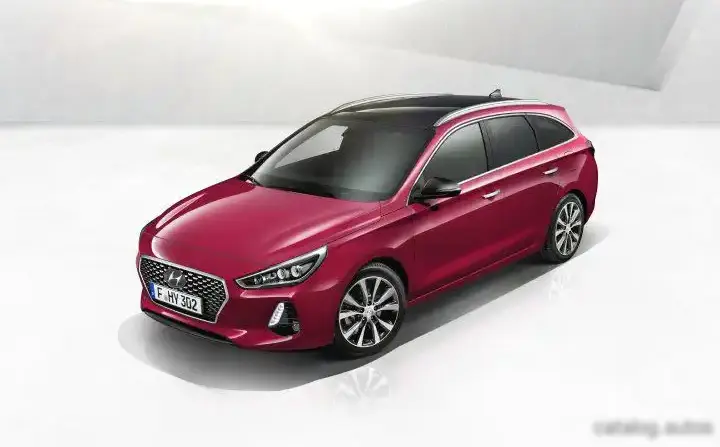
The Hyundai i30 III CW 1.6 CRDi (136 Hp) DCT is a station wagon (estate) variant produced between 2017 and 2019, falling within the third generation (PD) of the Hyundai i30. Positioned as a practical and fuel-efficient option, this model aimed to provide a balance between cargo space, reasonable performance, and modern technology. It was a key offering in the European market, where the station wagon body style remains popular, and represented Hyundai’s continued push towards offering a wider range of vehicles to appeal to diverse consumer needs. The “CW” designation specifically denotes the wagon body style, differentiating it from the five-door hatchback version of the i30 III.
Technical Specifications
| Brand | Hyundai |
| Model | i30 |
| Generation | i30 III CW |
| Type (Engine) | 1.6 CRDi (136 Hp) DCT |
| Start of production | 2017 |
| End of production | 2019 |
| Powertrain Architecture | Internal Combustion engine |
| Body type | Station wagon (estate) |
| Seats | 5 |
| Doors | 5 |
| Fuel consumption (urban) | 4.6-4.7 l/100 km (51.1 – 50 US mpg, 61.4 – 60.1 UK mpg, 21.7 – 21.3 km/l) |
| Fuel consumption (extra urban) | 3.9-4.1 l/100 km (60.3 – 57.4 US mpg, 72.4 – 68.9 UK mpg, 25.6 – 24.4 km/l) |
| Fuel consumption (combined) | 4.2-4.3 l/100 km (56 – 54.7 US mpg, 67.3 – 65.7 UK mpg, 23.8 – 23.3 km/l) |
| CO2 emissions | 108-112 g/km |
| Fuel Type | Diesel |
| Acceleration 0 – 100 km/h | 10.9 sec |
| Acceleration 0 – 62 mph | 10.9 sec |
| Acceleration 0 – 60 mph | 10.4 sec |
| Maximum speed | 198 km/h (123.03 mph) |
| Emission standard | Euro 6a |
| Weight-to-power ratio | 9.9 kg/Hp, 101.5 Hp/tonne |
| Weight-to-torque ratio | 4.5 kg/Nm, 223.9 Nm/tonne |
| Power | 136 Hp @ 4000 rpm |
| Power per litre | 86 Hp/l |
| Torque | 300 Nm @ 1750-2500 rpm (221.27 lb.-ft. @ 1750-2500 rpm) |
| Engine layout | Front, Transverse |
| Engine Model/Code | D4FB |
| Engine displacement | 1582 cm3 (96.54 cu. in.) |
| Number of cylinders | 4 |
| Engine configuration | Inline |
| Cylinder Bore | 77.2 mm (3.04 in.) |
| Piston Stroke | 84.5 mm (3.33 in.) |
| Compression ratio | 16:1 |
| Number of valves per cylinder | 4 |
| Fuel injection system | Diesel Commonrail |
| Engine aspiration | Turbocharger, Intercooler |
| Engine oil capacity | 5.3 l (5.6 US qt | 4.66 UK qt) |
| Coolant | 6.7 l (7.08 US qt | 5.9 UK qt) |
| Kerb Weight | 1340-1578 kg (2954.19 – 3478.89 lbs.) |
| Max. weight | 1940 kg (4276.97 lbs.) |
| Max load | 362-600 kg (798.07 – 1322.77 lbs.) |
| Trunk (boot) space – minimum | 602 l (21.26 cu. ft.) |
| Trunk (boot) space – maximum | 1650 l (58.27 cu. ft.) |
| Fuel tank capacity | 50 l (13.21 US gal | 11 UK gal) |
| Max. roof load | 80 kg (176.37 lbs.) |
| Permitted trailer load with brakes (12%) | 1500 kg (3306.93 lbs.) |
| Permitted towbar download | 80 kg (176.37 lbs.) |
| Length | 4585 mm (180.51 in.) |
| Width | 1795 mm (70.67 in.) |
| Height | 1465-1475 mm (57.68 – 58.07 in.) |
| Wheelbase | 2650 mm (104.33 in.) |
| Front track | 1573-1559 mm (61.93 – 61.38 in.) |
| Rear (Back) track | 1581-1567 mm (62.24 – 61.69 in.) |
| Front overhang | 905 mm (35.63 in.) |
| Rear overhang | 1030 mm (40.55 in.) |
| Ride height (ground clearance) | 140 mm (5.51 in.) |
| Drivetrain Architecture | The Internal combustion engine (ICE) drives the front wheels of the vehicle. |
| Drive wheel | Front wheel drive |
| Number of gears and type of gearbox | 7 gears, automatic transmission |
| Front suspension | Independent type McPherson |
| Rear suspension | Independent multi-link suspension |
| Front brakes | Ventilated discs |
| Rear brakes | Disc |
| Assisting systems | ABS (Anti-lock braking system) |
| Steering type | Steering rack and pinion |
| Power steering | Electric Steering |
| Tires size | 195/65 R15; 205/55 R16; 225/45 R17 |
| Wheel rims size | 6J x 15; 6.5J x 16; 7J x 17 |
INTRODUCTION
The Hyundai i30 III CW 1.6 CRDi (136 Hp) DCT, produced from 2017 to 2019, represents a significant offering in Hyundai’s European lineup. Built on the PD platform (internally designated as the i30 III), this variant combined the practicality of a station wagon with a relatively efficient diesel engine and a dual-clutch transmission (DCT). It was positioned as a mid-range trim, offering a step up from the base models in terms of performance and features, while remaining more accessible than the higher-powered engine options. The i30 CW aimed to compete with established European rivals like the Volkswagen Golf Estate, Ford Focus Estate, and Skoda Octavia Combi.
Powertrain & Engine Architecture
At the heart of the i30 CW 1.6 CRDi DCT lies the D4FB engine, a 1.6-liter inline-four cylinder diesel engine. This engine utilizes a second-generation common-rail direct injection system, delivering fuel at extremely high pressure for optimized combustion. A turbocharger with an intercooler is employed to boost power and torque, mitigating the typical turbo lag associated with smaller displacement engines. The engine produces 136 horsepower at 4,000 rpm and a substantial 300 Nm (221 lb-ft) of torque between 1750 and 2500 rpm. The DCT (Dual Clutch Transmission) is a 7-speed unit, offering quicker and smoother gear changes compared to a traditional automatic transmission. This transmission contributes to improved fuel efficiency and a more engaging driving experience. The engine also incorporates a diesel particulate filter (DPF) to meet stringent Euro 6a emission standards.
Driving Characteristics
The 1.6 CRDi DCT powertrain delivers a balanced driving experience. While not overtly sporty, the 136 hp output and 300 Nm of torque provide adequate performance for everyday driving and highway cruising. Acceleration from 0 to 100 km/h (0-62 mph) takes approximately 10.9 seconds. The DCT transmission contributes to responsive acceleration, particularly during overtaking maneuvers. Compared to the lower-powered 1.4-liter diesel variants, the 1.6 CRDi offers noticeably more punch. However, it falls short of the performance offered by the 1.6-liter turbocharged gasoline engine or the more powerful diesel options. The DCT’s gear ratios are tuned for fuel efficiency, with taller gearing in higher gears to reduce engine speed at cruising speeds. The wagon body style adds weight compared to the hatchback, slightly impacting acceleration and handling, but the independent rear suspension helps to maintain a relatively comfortable ride.
Equipment & Trim Levels
The i30 III CW 1.6 CRDi DCT typically came equipped with a respectable level of standard features. These generally included air conditioning, a touchscreen infotainment system with Bluetooth connectivity, power windows and mirrors, and alloy wheels. Safety features such as ABS, ESC (Electronic Stability Control), and multiple airbags were standard. Higher trim levels offered additional features like a larger touchscreen display, navigation system, rear parking sensors, cruise control, and automatic climate control. Interior upholstery was typically cloth, with options for leather upgrades. The dashboard layout was modern and functional, with a focus on ergonomics and ease of use.
Chassis & Braking
The i30 CW features a McPherson strut front suspension and a multi-link rear suspension, providing a good balance between ride comfort and handling. The front brakes are ventilated discs, while the rear brakes are solid discs. ABS (Anti-lock Braking System) is standard, along with ESC (Electronic Stability Control). Stabilizer bars are fitted to both the front and rear axles to reduce body roll during cornering. The suspension tuning is geared towards comfort, making it well-suited for long journeys. The steering is electrically assisted, providing light and precise control.
Market Reception & Comparison
The Hyundai i30 III CW 1.6 CRDi DCT was generally well-received by automotive critics. It was praised for its fuel efficiency, comfortable ride, and spacious interior. The DCT transmission was also noted as a positive feature, offering smooth and quick gear changes. However, some critics found the engine to be somewhat noisy and lacking in refinement compared to some of its rivals. Compared to the 1.4 CRDi variant, the 1.6 CRDi offered a significant performance boost, making it a more appealing option for drivers who frequently carry passengers or cargo. In terms of fuel economy, it was comparable to other diesel estate cars in its class. Reliability reports generally indicate good reliability for this powertrain, although DPF issues can occur with diesel engines if not properly maintained.
Legacy
The Hyundai i30 III CW 1.6 CRDi DCT has proven to be a reliable and practical used car option. The D4FB engine, while not without its potential issues (such as DPF clogging if primarily used for short trips), is generally considered durable. The DCT transmission, if properly maintained with regular fluid changes, is also relatively reliable. Today, these vehicles can be found at affordable prices, making them an attractive option for buyers seeking a spacious, fuel-efficient, and well-equipped estate car. The i30 CW helped to solidify Hyundai’s reputation for building quality and value-for-money vehicles in the European market.