
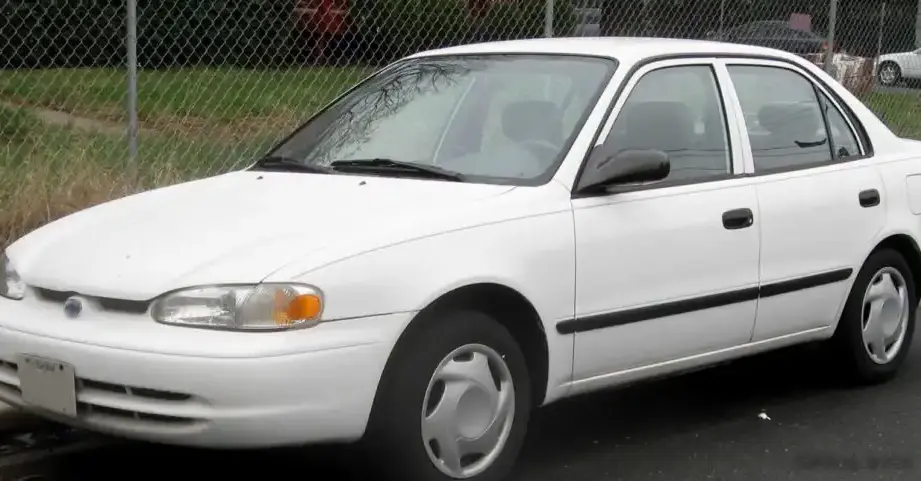
The Chevrolet Prizm 1.8 i 16V Automatic, produced between 1998 and 2001, represented a significant offering in the compact sedan segment for the American market. Essentially a rebadged Toyota Corolla, the Prizm was Chevrolet’s attempt to provide a reliable and affordable vehicle, leveraging Toyota’s manufacturing expertise. This particular variant, equipped with the 1.8-liter 16-valve engine and a four-speed automatic transmission, occupied a middle ground within the Prizm lineup, offering a balance between performance and fuel efficiency. It was positioned above the base model with the smaller engine, but below any potential, though ultimately unrealized, higher-performance trims. The Prizm was a key component of GM’s joint venture with Toyota, known as NUMMI (New United Motor Manufacturing, Inc.), and played a role in offering consumers a budget-friendly alternative to more established American brands.
Technical Specifications
| Brand | Chevrolet |
| Model | Prizm |
| Generation | Prizm |
| Type (Engine) | 1.8 i 16V (126 Hp) Automatic |
| Start of production | 1998 |
| End of production | 2001 |
| Powertrain Architecture | Internal Combustion engine |
| Body type | Sedan |
| Seats | 5 |
| Doors | 4 |
| Fuel consumption (urban) | 7.8 l/100 km (30.2 US mpg) |
| Fuel consumption (extra urban) | 5.9 l/100 km (39.9 US mpg) |
| Fuel consumption (combined) | 6.7 l/100 km (35.1 US mpg) |
| Fuel Type | Petrol (Gasoline) |
| Maximum speed | 190 km/h (118.06 mph) |
| Weight-to-power ratio | 8.7 kg/Hp |
| Weight-to-torque ratio | 6.4 kg/Nm |
| Power | 126 Hp @ 5800 rpm |
| Power per litre | 70.2 Hp/l |
| Torque | 170 Nm @ 4000 rpm (125.39 lb.-ft. @ 4000 rpm) |
| Engine layout | Front, Transverse |
| Engine Model/Code | LV6 |
| Engine displacement | 1794 cm3 (109.48 cu. in.) |
| Number of cylinders | 4 |
| Engine configuration | Inline |
| Cylinder Bore | 79 mm (3.11 in.) |
| Piston Stroke | 91.5 mm (3.6 in.) |
| Compression ratio | 10.1:1 |
| Number of valves per cylinder | 4 |
| Fuel injection system | Multi-port manifold injection |
| Engine aspiration | Naturally aspirated |
| Valvetrain | DOHC |
| Engine oil capacity | 3.7 l (3.91 US qt | 3.26 UK qt) |
| Coolant capacity | 6.1 l (6.45 US qt | 5.37 UK qt) |
| Kerb Weight | 1090 kg (2403.04 lbs.) |
| Trunk (boot) space (minimum) | 340 l (12.01 cu. ft.) |
| Fuel tank capacity | 50 l (13.21 US gal | 11 UK gal) |
| Length | 4430 mm (174.41 in.) |
| Width | 1695 mm (66.73 in.) |
| Height | 1365 mm (53.74 in.) |
| Wheelbase | 2465 mm (97.05 in.) |
| Front track | 1460 mm (57.48 in.) |
| Rear track | 1450 mm (57.09 in.) |
| Drivetrain | Front wheel drive |
| Number of gears | 4 |
| Gearbox type | Automatic transmission |
| Front suspension | Spring Strut |
| Rear suspension | Coil spring |
| Front brakes | Ventilated discs |
| Rear brakes | Drum |
| Assisting systems | ABS (Anti-lock braking system) |
| Steering type | Steering rack and pinion |
| Power steering | Hydraulic |
| Tires size | 175/65 R14 |
| Wheel rims size | 14 |
Powertrain & Engine Architecture
The heart of the Prizm 1.8 i was the 1.8-liter (1794 cc) inline-four cylinder engine, designated as the LV6. This engine, derived from Toyota’s well-regarded 7A-FE series, featured a double overhead camshaft (DOHC) valvetrain with four valves per cylinder, contributing to its relatively high output for its displacement. The engine utilized a multi-port fuel injection system, providing precise fuel delivery for improved efficiency and responsiveness. The 10.1:1 compression ratio was a standard figure for engines of this era, balancing performance and fuel economy. Paired with this engine was a four-speed automatic transmission, a common choice for buyers prioritizing convenience over outright performance. This transmission, while reliable, wasn’t known for its particularly sporty shift characteristics, focusing instead on smooth and predictable operation. The automatic transmission was geared towards fuel efficiency and comfortable cruising, rather than aggressive acceleration.
Driving Characteristics
The Prizm 1.8 i Automatic offered a comfortable and predictable driving experience. With 126 horsepower and 125 lb-ft of torque, acceleration was adequate for everyday driving, but not particularly brisk. The four-speed automatic transmission, while smooth, lacked the responsiveness of a manual gearbox or a more modern automatic with additional gears. The gear ratios were optimized for fuel economy, meaning the engine often felt strained during quick acceleration or when climbing hills. Compared to the five-speed manual version of the Prizm 1.8, the automatic suffered a noticeable performance deficit. The manual offered quicker acceleration and a more engaging driving experience, appealing to drivers who prioritized performance. However, the automatic’s ease of use made it a popular choice for commuters and those seeking a hassle-free driving experience.
Equipment & Trim Levels
The Prizm 1.8 i Automatic typically came standard with features such as air conditioning, power steering, an AM/FM radio, and cloth upholstery. Power windows and door locks were often included, but sometimes offered as optional extras. The interior was functional and straightforward, prioritizing practicality over luxury. Optional extras included a CD player, upgraded sound system, and alloy wheels. The trim level was generally considered a step up from the base Prizm, offering a more comfortable and well-equipped interior. The dashboard layout was simple and easy to use, with clearly labeled controls.
Chassis & Braking
The Prizm 1.8 i utilized a front-wheel-drive layout with a MacPherson strut front suspension and a coil spring rear suspension. This suspension setup provided a comfortable ride, absorbing bumps and imperfections in the road effectively. The front brakes were ventilated discs, offering good stopping power, while the rear brakes were drums, a cost-saving measure common in this class of vehicle. Anti-lock brakes (ABS) were standard, enhancing safety by preventing wheel lockup during hard braking. The chassis was designed for stability and predictable handling, rather than sporty cornering. Stabilizer bars were present, but relatively modest in size, contributing to a slight degree of body roll during cornering.
Market Reception & Comparison
The Chevrolet Prizm 1.8 i Automatic was generally well-received by critics as a reliable and affordable compact sedan. Its fuel economy was a strong point, averaging around 35 mpg in combined driving. However, its performance was often criticized as being underwhelming, particularly compared to some of its competitors. Compared to the base Prizm with the smaller engine, the 1.8-liter version offered a noticeable improvement in acceleration and overall drivability. The Toyota Corolla, being the Prizm’s mechanical twin, offered a similar driving experience, but often carried a higher price tag. The Prizm’s main advantage was its lower price point, making it an attractive option for budget-conscious buyers.
Legacy
The Chevrolet Prizm, and specifically the 1.8 i Automatic variant, has developed a reputation for long-term reliability. The Toyota-derived engine and transmission are known for their durability, and many examples are still on the road today with high mileage. The Prizm’s simple design and readily available parts contribute to its ease of maintenance. In the used car market, the Prizm 1.8 i Automatic remains an affordable and practical option for those seeking a reliable and fuel-efficient compact sedan. While not a particularly exciting vehicle, its dependability and low running costs have ensured its continued presence on roads across the United States.
