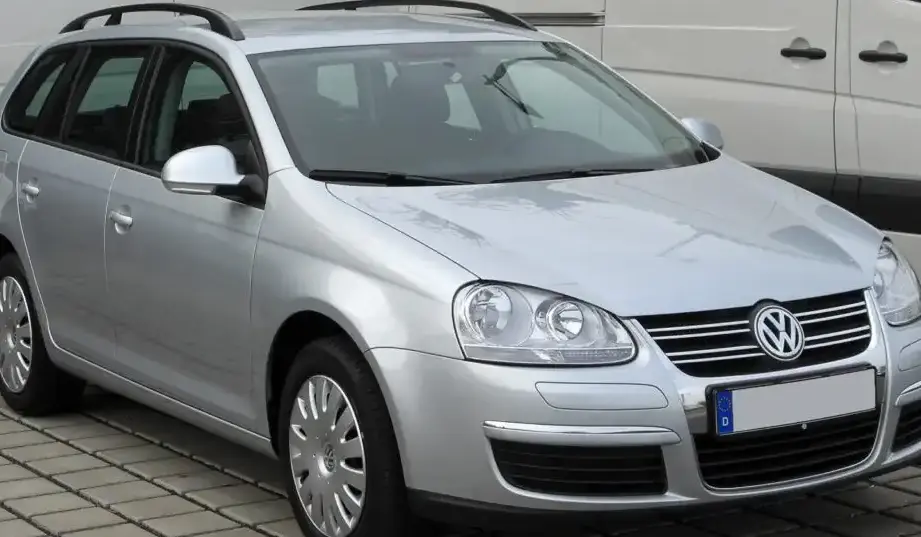
The Volkswagen Golf V Variant 2.0 TDI, producing 140 horsepower, was a popular choice in the European market between March 2007 and May 2008. Positioned as a practical and fuel-efficient option within the Golf Mk5 estate (wagon) range, it offered a balance between performance and economy for families and individuals needing versatile cargo space. This variant utilized the EA188 engine family and was a key component of Volkswagen’s strategy to offer a diverse lineup catering to various customer needs. It sat in the mid-range of the Golf V Variant offerings, above the lower-powered petrol engines and below the more expensive and performance-oriented GTI and R32 models.
Technical Specifications
| Brand | Volkswagen |
| Model | Golf |
| Generation | Golf V Variant |
| Type (Engine) | 2.0 TDI (140 Hp) |
| Start of production | March, 2007 |
| End of production | May, 2008 |
| Powertrain Architecture | Internal Combustion engine |
| Body type | Station wagon (estate) |
| Seats | 5 |
| Doors | 5 |
| Fuel consumption (urban) | 7.1 l/100 km (33.1 US mpg, 39.8 UK mpg, 14.1 km/l) |
| Fuel consumption (extra urban) | 4.8 l/100 km (49 US mpg, 58.9 UK mpg, 20.8 km/l) |
| Fuel consumption (combined) | 5.6 l/100 km (42 US mpg, 50.4 UK mpg, 17.9 km/l) |
| Fuel Type | Diesel |
| Acceleration 0 – 100 km/h | 9.8 sec |
| Acceleration 0 – 62 mph | 9.8 sec |
| Acceleration 0 – 60 mph | 9.3 sec |
| Maximum speed | 205 km/h (127.38 mph) |
| Emission standard | Euro 4 |
| Weight-to-power ratio | 10 kg/Hp, 99.9 Hp/tonne |
| Weight-to-torque ratio | 4.4 kg/Nm, 228.2 Nm/tonne |
| Power | 140 Hp @ 4000 rpm |
| Power per litre | 71.1 Hp/l |
| Torque | 320 Nm @ 1750 rpm (236.02 lb.-ft. @ 1750 rpm) |
| Engine layout | Front, Transverse |
| Engine Model/Code | EA188 / BKD |
| Engine displacement | 1968 cm3 (120.09 cu. in.) |
| Number of cylinders | 4 |
| Engine configuration | Inline |
| Cylinder Bore | 81 mm (3.19 in.) |
| Piston Stroke | 95.5 mm (3.76 in.) |
| Compression ratio | 18.5:1 |
| Number of valves per cylinder | 4 |
| Fuel injection system | Pump-nozzle (Unit Injector) |
| Engine aspiration | Turbocharger, Intercooler |
| Engine oil capacity | 3.8 l (4.02 US qt | 3.34 UK qt) |
| Coolant | 8 l (8.45 US qt | 7.04 UK qt) |
| Kerb Weight | 1402 kg (3090.88 lbs.) |
| Max. weight | 2030 kg (4475.38 lbs.) |
| Max load | 628 kg (1384.5 lbs.) |
| Trunk (boot) space – minimum | 505 l (17.83 cu. ft.) |
| Trunk (boot) space – maximum | 1495 l (52.8 cu. ft.) |
| Fuel tank capacity | 55 l (14.53 US gal | 12.1 UK gal) |
| Length | 4556 mm (179.37 in.) |
| Width | 1781 mm (70.12 in.) |
| Height | 1504 mm (59.21 in.) |
| Wheelbase | 2578 mm (101.5 in.) |
| Front track | 1535 mm (60.43 in.) |
| Rear (Back) track | 1508 mm (59.37 in.) |
| Minimum turning circle | 10.9 m (35.76 ft.) |
| Drivetrain Architecture | Front wheel drive |
| Number of gears | 6 gears, manual transmission |
| Assisting systems | ABS (Anti-lock braking system) |
| Tires size | 205/55 R16 |
| Wheel rims size | 6.5J x 16 |
Powertrain & Engine Architecture
The heart of the Golf V Variant 2.0 TDI (140 Hp) is the EA188 series 2.0-liter inline-four diesel engine, specifically the BKD engine code. This engine was a significant step forward for Volkswagen, incorporating advanced technologies like turbocharging and intercooling to deliver a good balance of power and efficiency. The BKD engine utilizes a pump-nozzle (unit injector) fuel injection system, known for its precise fuel delivery and contribution to the engine’s torque output. The engine features four valves per cylinder and a robust cast iron block. The turbocharger provides increased air intake, boosting power, while the intercooler cools the compressed air, further enhancing performance. The 6-speed manual transmission was the standard offering, providing a good spread of gears for both fuel economy and acceleration.
Driving Characteristics
The 140 hp 2.0 TDI offered a noticeable step up in performance compared to the lower-powered petrol variants of the Golf V Variant. While not a sports car, it provided ample power for everyday driving, including highway cruising and overtaking. The 320 Nm (236 lb-ft) of torque, available from a relatively low 1750 rpm, meant strong acceleration in the mid-range. The 6-speed manual transmission allowed drivers to keep the engine in its optimal power band. Compared to the higher-output 170 hp TDI version, the 140 hp model felt less stressed during acceleration and generally offered slightly better fuel economy. The manual gearbox provided a more engaging driving experience than the optional DSG (Direct-Shift Gearbox) available on some trims.
Equipment & Trim Levels
The Golf V Variant 2.0 TDI (140 Hp) typically came equipped with a reasonable level of standard features. These included air conditioning, power windows, central locking, and an audio system. Interior upholstery was usually cloth, with options for upgraded materials available. Trim levels varied by market, but generally included features like alloy wheels, fog lights, and a multi-function steering wheel as drivers moved up the range. Optional extras included a sunroof, parking sensors, and a more advanced audio system with navigation. Safety features such as ABS and multiple airbags were standard.
Chassis & Braking
The Golf V Variant’s chassis was designed to provide a comfortable and stable ride. The front suspension utilized MacPherson struts, while the rear suspension employed a multi-link setup. This configuration offered a good balance between handling and ride comfort. Braking systems varied depending on the trim level, with lower trims often featuring rear drum brakes and higher trims offering rear disc brakes. ABS (Anti-lock Braking System) was standard across the range. Stabilizer bars were fitted to both the front and rear axles to reduce body roll during cornering.
Market Reception & Comparison
The Golf V Variant 2.0 TDI (140 Hp) was well-received by automotive critics for its practicality, fuel efficiency, and comfortable ride. It was often praised as a sensible and well-rounded family car. Compared to petrol-powered Golf V Variants, the TDI offered significantly better fuel economy, making it an attractive option for drivers covering long distances. Against competitors like the Ford Focus Estate and Opel/Vauxhall Astra Estate, the Golf V Variant was often seen as offering a more refined driving experience and a higher-quality interior. However, some critics noted that the diesel engine could be slightly noisy compared to petrol alternatives.
Legacy
The EA188 2.0 TDI engine, including the BKD variant, proved to be a relatively reliable powertrain, although early versions were known to have some issues with diesel particulate filter (DPF) clogging and potential oil consumption. With proper maintenance, these engines can provide many years of service. Today, the Golf V Variant 2.0 TDI (140 Hp) remains a popular choice in the used car market, particularly for those seeking a practical, fuel-efficient, and relatively affordable estate car. Its reputation for reliability and versatility continues to make it a desirable option for budget-conscious buyers.