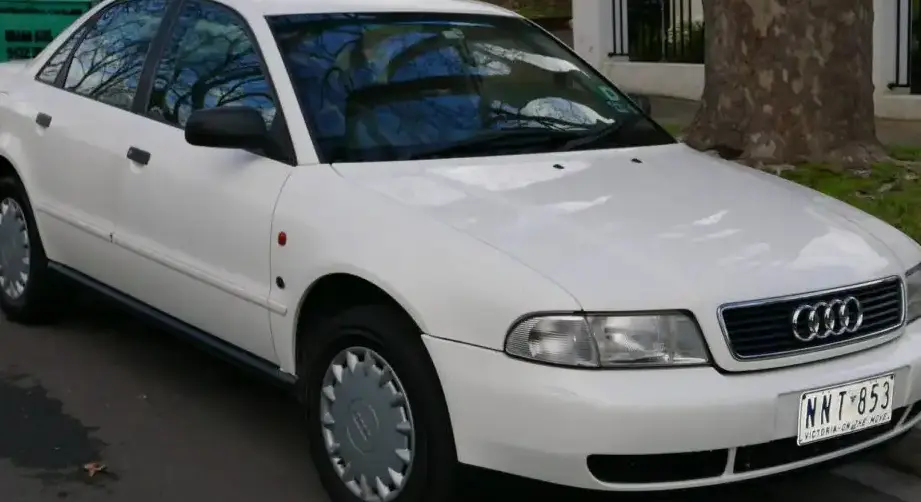
The Audi A4 (B5), produced from November 1994 to 1999, represented a significant step forward for Audi, establishing a new benchmark in the compact executive car segment. The 1.8 20V variant, powered by the ADR and ARG engine codes, occupied a crucial middle ground in the A4 B5 lineup. It offered a balance between performance and affordability, appealing to buyers who desired the A4’s sophisticated engineering and build quality without the higher price tag of the more powerful V6 models. This version was primarily aimed at the European market, where fuel efficiency and a comfortable ride were highly valued, but it also saw limited sales in North America.
Technical Specifications
| Brand | Audi |
| Model | A4 |
| Generation | A4 (B5, Typ 8D) |
| Type (Engine) | 1.8 20V (125 Hp) |
| Start of production | November, 1994 |
| End of production | 1999 |
| Powertrain Architecture | Internal Combustion engine |
| Body type | Sedan |
| Seats | 5 |
| Doors | 4 |
| Fuel consumption (urban) | 10.2 l/100 km (23.1 US mpg, 27.7 UK mpg, 9.8 km/l) |
| Fuel consumption (extra urban) | 6.5 l/100 km (36.2 US mpg, 43.5 UK mpg, 15.4 km/l) |
| Fuel consumption (combined) | 7.8 l/100 km (30.2 US mpg, 36.2 UK mpg, 12.8 km/l) |
| Fuel Type | Petrol (Gasoline) |
| Acceleration 0 – 100 km/h | 10.5 sec |
| Acceleration 0 – 62 mph | 10.5 sec |
| Acceleration 0 – 60 mph | 10 sec |
| Maximum speed | 205 km/h (127.38 mph) |
| Weight-to-power ratio | 9.8 kg/Hp, 102.5 Hp/tonne |
| Weight-to-torque ratio | 7.1 kg/Nm, 141.8 Nm/tonne |
| Power | 125 Hp @ 5800 rpm |
| Power per litre | 70.2 Hp/l |
| Torque | 173 Nm @ 3950 rpm (127.6 lb.-ft. @ 3950 rpm) |
| Engine layout | Front, Longitudinal |
| Engine Model/Code | ADR, ARG |
| Engine displacement | 1781 cm3 (108.68 cu. in.) |
| Number of cylinders | 4 |
| Engine configuration | Inline |
| Cylinder Bore | 81 mm (3.19 in.) |
| Piston Stroke | 86.4 mm (3.4 in.) |
| Compression ratio | 10.3:1 |
| Number of valves per cylinder | 5 |
| Fuel injection system | Multi-port manifold injection |
| Engine aspiration | Naturally aspirated engine |
| Valvetrain | DOHC |
| Engine oil capacity | 3.5 l (3.7 US qt | 3.08 UK qt) |
| Coolant | 6.5 l (6.87 US qt | 5.72 UK qt) |
| Kerb Weight | 1220 kg (2689.64 lbs.) |
| Max. weight | 1770 kg (3902.18 lbs.) |
| Max load | 550 kg (1212.54 lbs.) |
| Trunk (boot) space – minimum | 440 l (15.54 cu. ft.) |
| Fuel tank capacity | 62 l (16.38 US gal | 13.64 UK gal) |
| Length | 4479 mm (176.34 in.) |
| Width | 1733 mm (68.23 in.) |
| Height | 1415 mm (55.71 in.) |
| Wheelbase | 2617 mm (103.03 in.) |
| Front track | 1498 mm (58.98 in.) |
| Rear (Back) track | 1479 mm (58.23 in.) |
| Drag coefficient (Cd) | 0.31 |
| Minimum turning circle | 11.1 m (36.42 ft.) |
| Drivetrain Architecture | The Internal combustion engine (ICE) drives the front wheels of the vehicle. |
| Drive wheel | Front wheel drive |
| Number of gears and type of gearbox | 5 gears, manual transmission |
| Front suspension | Wishbone |
| Rear suspension | Suspension with traction connecting levers |
| Front brakes | Disc |
| Rear brakes | Disc |
| Assisting systems | ABS (Anti-lock braking system) |
| Steering type | Steering rack and pinion |
| Power steering | Hydraulic Steering |
| Tires size | 195/65 R 15 |
| Wheel rims size | 15 |
Powertrain & Engine Architecture
The heart of the A4 1.8 20V was the 1781cc inline-four cylinder engine, designated ADR or ARG depending on minor variations and emissions regulations. This engine featured a cast iron block and an aluminum cylinder head, incorporating dual overhead camshafts (DOHC) and five valves per cylinder (20 valves total). This valvetrain configuration was a key feature, allowing for improved breathing and higher engine speeds. Fuel delivery was handled by a Bosch Motronic multi-port fuel injection system, optimizing fuel atomization and combustion efficiency. The engine’s relatively high compression ratio of 10.3:1 contributed to its respectable power output. The 5-speed manual transmission was the most common pairing, but a 4-speed automatic transmission was also available, though it impacted acceleration and fuel economy.
Driving Characteristics
The 1.8 20V with the manual transmission offered a reasonably engaging driving experience. While not overtly powerful, the engine provided sufficient torque for everyday driving and confident overtaking. The 0-60 mph time of around 10 seconds was typical for its class. The automatic transmission, however, dulled the performance somewhat. Gear changes were not particularly quick, and the transmission tended to hunt for gears under hard acceleration. The front-wheel-drive layout provided predictable handling, but lacked the all-weather capability of Audi’s quattro all-wheel-drive system, available on higher-spec models. The suspension was tuned for comfort, providing a smooth ride over most road surfaces.
Equipment & Trim Levels
The 1.8 20V A4 typically came equipped with a respectable level of standard features. This included power windows, central locking, power steering, and an anti-lock braking system (ABS). Interior upholstery was usually cloth, with options for leather available at extra cost. Air conditioning was a common option, as were alloy wheels. Higher trim levels added features such as a sunroof, upgraded audio systems, and wood trim. The base model was fairly spartan, while the SE (Sonderausstattung) trim offered a more luxurious experience.
Chassis & Braking
The A4 B5 utilized a MacPherson strut front suspension and a semi-independent torsion beam rear suspension. This setup provided a good balance between ride comfort and handling. Brakes were disc brakes all around, providing adequate stopping power for the vehicle’s weight and performance. The ABS system helped to maintain steering control during emergency braking. The steering was a rack-and-pinion system with hydraulic power assistance, offering precise and responsive steering feel.
Market Reception & Comparison
The A4 1.8 20V was generally well-received by automotive critics. It was praised for its refined engine, comfortable ride, and high-quality interior. However, some critics noted that the engine lacked the outright punch of the V6 models. Compared to the 1.6-liter base engine, the 1.8 20V offered a significant performance upgrade. Against the 2.8 V6, it was less powerful but more fuel-efficient and more affordable. The 1.9 TDI diesel variant offered superior fuel economy but lacked the smoothness and refinement of the 1.8 20V gasoline engine.
Legacy
The Audi A4 B5 1.8 20V has proven to be a relatively reliable vehicle, with many examples still on the road today. The engine is generally durable, although regular maintenance is essential. Common issues include oil leaks, failing coolant water pumps, and occasional problems with the electronic throttle body. The automatic transmission, while comfortable, is known to be less robust than the manual gearbox. In the used car market, the 1.8 20V A4 B5 represents a good value proposition, offering a blend of German engineering, comfort, and affordability. It remains a popular choice for enthusiasts and those seeking a well-built and reliable compact executive car.