
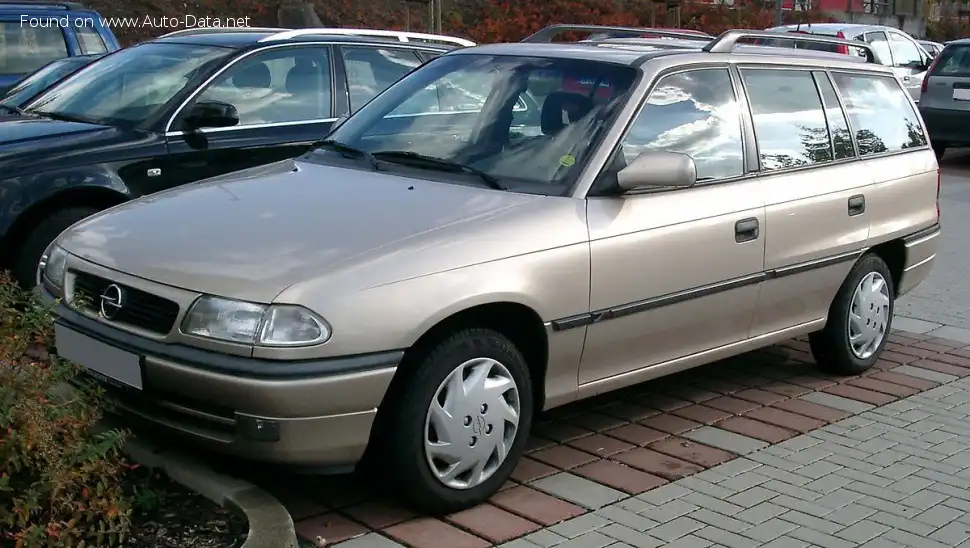
The Opel Astra F Caravan 1.4i, produced from August 1994 to June 1996, represented an entry-level offering within the facelifted Astra F range. This variant, powered by the C14NZ engine, was specifically tailored for buyers prioritizing practicality and fuel economy over outright performance. Positioned as the base model of the Caravan (estate) body style, it served as an affordable and versatile option in the European market, particularly appealing to families and those needing a spacious vehicle for everyday use. It was part of the larger Astra F generation (1991-1998), which was a significant model for Opel, representing a substantial leap forward in design, safety, and technology compared to its predecessor.
Technical Specifications
| Brand | Opel |
| Model | Astra |
| Generation | Astra F Caravan (facelift 1994) |
| Type (Engine) | 1.4i (60 Hp) |
| Start of production | August, 1994 |
| End of production | June, 1996 |
| Powertrain Architecture | Internal Combustion engine |
| Body type | Station wagon (estate) |
| Seats | 5 |
| Doors | 5 |
| Fuel consumption (urban) | 8.6 l/100 km (27.4 US mpg, 32.8 UK mpg, 11.6 km/l) |
| Fuel consumption (extra urban) | 6.2 l/100 km (37.9 US mpg, 45.6 UK mpg, 16.1 km/l) |
| Fuel consumption (combined) | 7.8 l/100 km (30.2 US mpg, 36.2 UK mpg, 12.8 km/l) |
| Fuel Type | Petrol (Gasoline) |
| Acceleration 0 – 100 km/h | 17 sec |
| Acceleration 0 – 62 mph | 17 sec |
| Acceleration 0 – 60 mph | 16.2 sec |
| Maximum speed | 155 km/h (96.31 mph) |
| Weight-to-power ratio | 17.3 kg/Hp, 57.7 Hp/tonne |
| Weight-to-torque ratio | 10.1 kg/Nm, 99 Nm/tonne |
| Power | 60 Hp @ 5200 rpm |
| Power per litre | 43.2 Hp/l |
| Torque | 103 Nm @ 2800 rpm (75.97 lb.-ft. @ 2800 rpm) |
| Engine layout | Front, Transverse |
| Engine Model/Code | C14NZ |
| Engine displacement | 1389 cm3 (84.76 cu. in.) |
| Number of cylinders | 4 |
| Engine configuration | Inline |
| Cylinder Bore | 77.6 mm (3.06 in.) |
| Piston Stroke | 73.4 mm (2.89 in.) |
| Compression ratio | 9.4:1 |
| Number of valves per cylinder | 2 |
| Fuel injection system | Single-point injection |
| Engine aspiration | Naturally aspirated engine |
| Valvetrain | SOHC |
| Engine oil capacity | 3.5 l (3.7 US qt | 3.08 UK qt) |
| Coolant | 5.7 l (6.02 US qt | 5.02 UK qt) |
| Kerb Weight | 1040 kg (2292.81 lbs.) |
| Max. weight | 1555 kg (3428.19 lbs.) |
| Max load | 515 kg (1135.38 lbs.) |
| Trunk (boot) space – minimum | 500 l (17.66 cu. ft.) |
| Trunk (boot) space – maximum | 1630 l (57.56 cu. ft.) |
| Fuel tank capacity | 50 l (13.21 US gal | 11 UK gal) |
| Length | 4278 mm (168.43 in.) |
| Width | 1696 mm (66.77 in.) |
| Width including mirrors | 1852 mm (72.91 in.) |
| Height | 1525 mm (60.04 in.) |
| Wheelbase | 2517 mm (99.09 in.) |
| Front track | 1430-1424 mm (56.3 – 56.06 in.) |
| Rear (Back) track | 1429-1423 mm (56.26 – 56.02 in.) |
| Ride height (ground clearance) | 135 mm (5.31 in.) |
| Drag coefficient (Cd) | 0.34 |
| Minimum turning circle | 10.5 m (34.45 ft.) |
| Drivetrain Architecture | The Internal combustion engine (ICE) drives the front wheels of the vehicle. |
| Drive wheel | Front wheel drive |
| Number of gears and type of gearbox | 5 gears, manual transmission |
| Front brakes | Disc |
| Rear brakes | Drum |
| Assisting systems | ABS (Anti-lock braking system) |
| Steering type | Steering rack and pinion |
| Tires size | 175/70 R13 82T; 175/65 R14 82T |
| Wheel rims size | 5.5J x 13 ET49; 5.5J x 14 ET49 |
Powertrain & Engine Architecture
The heart of the Astra F Caravan 1.4i was the C14NZ engine, a 1.4-liter inline-four cylinder petrol engine. This engine was a mainstay of Opel’s entry-level offerings during the 1990s. The C14NZ featured a single overhead camshaft (SOHC) valvetrain with two valves per cylinder. Fuel delivery was managed by a single-point fuel injection system, a relatively simple and cost-effective technology for the time. This system, while not as efficient or responsive as multi-point injection, contributed to the engine’s affordability and ease of maintenance. The engine produced 60 horsepower at 5200 rpm and 103 Nm (76 lb-ft) of torque at 2800 rpm. The engine’s relatively low output was paired with a five-speed manual transmission, which was the standard offering. An optional four-speed automatic transmission was available, though less common.
Driving Characteristics
The 1.4i automatic version of the Astra F Caravan offered a comfortable, but unhurried driving experience. Acceleration from 0-60 mph took around 16.2 seconds, and top speed was limited to 155 km/h (96 mph). The automatic transmission, while providing convenience, did detract from the engine’s limited power. Gear changes were not particularly quick or refined, and the transmission tended to hunt for gears on inclines. Compared to the 1.6-liter and 1.8-liter versions of the Astra, the 1.4i felt noticeably slower and less responsive. However, the 1.4i’s lighter weight and less stressed engine contributed to better fuel economy, making it a practical choice for daily commuting and long journeys.
Equipment & Trim Levels
The 1.4i Caravan typically came with a basic level of equipment. Standard features included power steering, central locking, and a basic stereo system. Interior upholstery was typically cloth, and the dashboard featured a simple, functional design. Optional extras included electric windows, air conditioning, and alloy wheels. The trim level was generally considered the base model, focusing on providing essential features at an affordable price point. It was aimed at buyers who prioritized practicality and value over luxury and performance.
Chassis & Braking
The Astra F Caravan featured a MacPherson strut front suspension and a torsion beam rear suspension. The braking system consisted of disc brakes on the front wheels and drum brakes on the rear. ABS (Anti-lock Braking System) was available as an option, enhancing safety. The suspension setup was tuned for comfort, providing a relatively smooth ride, although it could feel somewhat soft and wallowy when fully loaded. The drum brakes on the rear were adequate for normal driving conditions, but lacked the stopping power of disc brakes.
Market Reception & Comparison
The Astra F Caravan 1.4i was generally well-received as an affordable and practical family car. Critics praised its spacious interior, good fuel economy, and comfortable ride. However, the engine’s lack of power was a common criticism. Compared to the 1.6-liter and 1.8-liter versions, the 1.4i offered significantly less performance. The 1.6-liter provided a better balance of power and economy, while the 1.8-liter offered more spirited performance. In terms of reliability, the C14NZ engine was generally considered to be robust and dependable, although regular maintenance was essential.
Legacy
The Opel Astra F Caravan 1.4i remains a relatively common sight on European roads today, testament to its durability and affordability. The C14NZ engine, while not known for its performance, is generally regarded as a reliable unit. Parts availability is good, and maintenance costs are relatively low. In the used car market, the 1.4i Caravan represents a budget-friendly option for those seeking a practical and spacious estate car. While it may not offer the excitement of higher-performance variants, its fuel efficiency and dependability make it a sensible choice for everyday use.

