Technical Specifications
| Brand | Audi |
| Model | A4 |
| Generation | A4 (B5, Typ 8D) |
| Type (Engine) | 1.9 TDI (110 Hp) |
| Start of production | February, 1996 |
| End of production | 1999 |
| Powertrain Architecture | Internal Combustion engine |
| Body type | Sedan |
| Seats | 5 |
| Doors | 4 |
| Fuel consumption (urban) | 6.9 l/100 km (34.1 US mpg, 40.9 UK mpg, 14.5 km/l) |
| Fuel consumption (extra urban) | 4.3 l/100 km (54.7 US mpg, 65.7 UK mpg, 23.3 km/l) |
| Fuel consumption (combined) | 4.9 l/100 km (48 US mpg, 57.6 UK mpg, 20.4 km/l) |
| Fuel Type | Diesel |
| Acceleration 0 – 100 km/h | 11.3 sec |
| Acceleration 0 – 62 mph | 11.3 sec |
| Acceleration 0 – 60 mph | 10.7 sec |
| Maximum speed | 196 km/h (121.79 mph) |
| Weight-to-power ratio | 11.3 kg/Hp, 88.7 Hp/tonne |
| Weight-to-torque ratio | 5.3 kg/Nm, 189.5 Nm/tonne |
| Power | 110 Hp @ 4150 rpm |
| Power per litre | 58 Hp/l |
| Torque | 235 Nm @ 1900 rpm (173.33 lb.-ft. @ 1900 rpm) |
| Engine layout | Front, Longitudinal |
| Engine Model/Code | AFN, AVG |
| Engine displacement | 1896 cm3 (115.7 cu. in.) |
| Number of cylinders | 4 |
| Engine configuration | Inline |
| Cylinder Bore | 79.5 mm (3.13 in.) |
| Piston Stroke | 95.5 mm (3.76 in.) |
| Compression ratio | 19.5:1 |
| Number of valves per cylinder | 2 |
| Fuel injection system | Direct injection |
| Engine aspiration | Turbocharger |
| Valvetrain | OHC |
| Engine oil capacity | 3.8 l (4.02 US qt | 3.34 UK qt) |
| Coolant | 6.5 l (6.87 US qt | 5.72 UK qt) |
| Kerb Weight | 1240 kg (2733.73 lbs.) |
| Max. weight | 1790 kg (3946.27 lbs.) |
| Max load | 550 kg (1212.54 lbs.) |
| Trunk (boot) space – minimum | 440 l (15.54 cu. ft.) |
| Fuel tank capacity | 62 l (16.38 US gal | 13.64 UK gal) |
| Length | 4479 mm (176.34 in.) |
| Width | 1733 mm (68.23 in.) |
| Height | 1415 mm (55.71 in.) |
| Wheelbase | 2617 mm (103.03 in.) |
| Front track | 1498 mm (58.98 in.) |
| Rear (Back) track | 1479 mm (58.23 in.) |
| Drag coefficient (Cd) | 0.31 |
| Minimum turning circle | 11.5 m (37.73 ft.) |
| Drivetrain Architecture | The Internal combustion engine (ICE) drives the front wheels of the vehicle. |
| Drive wheel | Front wheel drive |
| Number of gears and type of gearbox | 5 gears, manual transmission |
| Front suspension | Wishbone |
| Rear suspension | Suspension with traction connecting levers |
| Front brakes | Disc |
| Rear brakes | Disc |
| Assisting systems | ABS (Anti-lock braking system) |
| Steering type | Steering rack and pinion |
| Power steering | Hydraulic Steering |
| Tires size | 195/65 R15 |
| Wheel rims size | 15 |
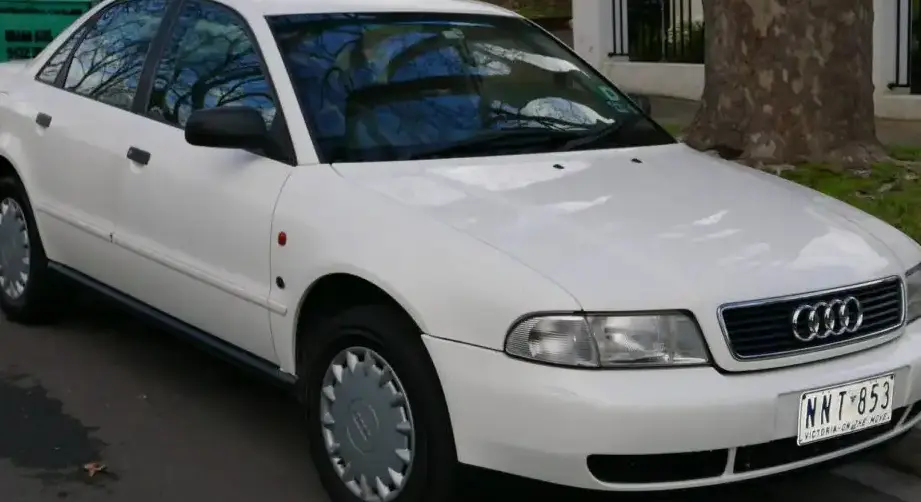
The Audi A4 (B5), produced between 1994 and 2001, marked a pivotal moment for Audi, establishing a new standard within the competitive compact executive car segment. The 1.9 TDI variant, specifically the 110 horsepower version available from February 1996 to 1999, played a significant role in the A4’s success, particularly in European markets. This model, built on the Volkswagen Group’s B5 platform (Typ 8D) – shared with the Volkswagen Passat – was aimed at buyers who prioritized fuel efficiency and reliability over outright performance. It represented a pragmatic choice within the A4 range, offering a compelling alternative to both the more powerful gasoline engines and the higher-output TDI models.
Powertrain & Engine Architecture
The 1.9 TDI 110 hp A4 was powered by a 1.9-liter inline-four cylinder diesel engine, designated with engine codes AFN and AVG. This engine utilized direct fuel injection, employing a Bosch VE pump and electronically controlled injectors. This system allowed for precise fuel metering, contributing to both improved efficiency and reduced emissions. The engine featured an overhead camshaft (OHC) valvetrain operating two valves per cylinder. A turbocharger, coupled with an intercooler, was used to increase power output, delivering enhanced torque at lower engine speeds. The 110 horsepower output was a deliberate engineering decision, prioritizing fuel economy and long-term durability over peak performance. The engine was mounted longitudinally in the front of the vehicle, driving the front wheels.
Driving Characteristics
The 1.9 TDI 110 hp A4 provided a practical and economical driving experience. Acceleration was sufficient for everyday driving, achieving a 0-60 mph time of approximately 10.7 seconds, but it wasn’t geared towards sporty performance. The turbocharger provided a noticeable power boost, though the engine lacked the responsiveness found in higher-output TDI variants or gasoline engines. The five-speed manual transmission was well-suited to the engine’s characteristics, offering smooth and precise gear changes. Compared to the 90 hp naturally aspirated diesel, the 110 hp TDI offered a substantial improvement in performance while maintaining excellent fuel economy. In contrast to the 1.8L gasoline engine, the TDI delivered superior torque and fuel efficiency, albeit at the cost of some refinement and high-end power.
Equipment & Trim Levels
The 1.9 TDI 110 hp A4 typically came equipped with a reasonably comprehensive standard package. This included power windows, central locking, and an anti-lock braking system (ABS). Interior upholstery was generally cloth, with a functional, though somewhat understated, dashboard layout. Optional extras included alloy wheels, a sunroof, climate control, and a premium audio system. Trim levels varied slightly depending on the specific market, but generally, the 1.9 TDI 110 occupied a mid-range position within the A4 lineup, offering a balanced combination of features and affordability.
Chassis & Braking
The A4 B5 featured a fully independent suspension system, incorporating wishbone suspension at the front and a multi-link setup at the rear. This configuration provided a comfortable ride and commendable handling characteristics. The 1.9 TDI models typically utilized disc brakes on all four wheels, offering adequate stopping power. The steering system was a rack-and-pinion design with hydraulic power assistance, delivering precise and responsive steering feel. Stabilizer bars were fitted to both the front and rear axles to minimize body roll during cornering maneuvers.
Market Reception & Comparison
The Audi A4 1.9 TDI 110 was well-received by both automotive critics and consumers, particularly in Europe. It was lauded for its fuel efficiency, reliability, and comfortable ride quality. When compared to other engines available in the A4 range, the 1.9 TDI offered the best fuel economy and a competitive level of performance for its price point. The higher-output TDI models (130 hp and 150 hp) provided more performance, but came at a higher cost. The 1.8L gasoline engine offered a smoother and more refined driving experience, but was less fuel-efficient. The 1.9 TDI 110 hp A4 proved to be a popular choice for both fleet buyers and individual consumers seeking a practical and economical executive car.
Legacy
The 1.9 TDI engine, in its various iterations, gained a reputation for its exceptional durability and longevity. The A4 B5 1.9 TDI 110 hp remains a relatively common sight on roads today, a testament to its robust engineering. While age and accumulated mileage inevitably take their toll, these engines are generally considered reliable, provided they have received proper maintenance. In the used car market, the 1.9 TDI models often command a premium due to their well-deserved reputation for fuel efficiency and dependability. However, prospective buyers should be aware of potential issues such as turbocharger wear and injector problems. Overall, the Audi A4 B5 1.9 TDI 110 hp represents a significant milestone in the evolution of the modern diesel-powered executive car.