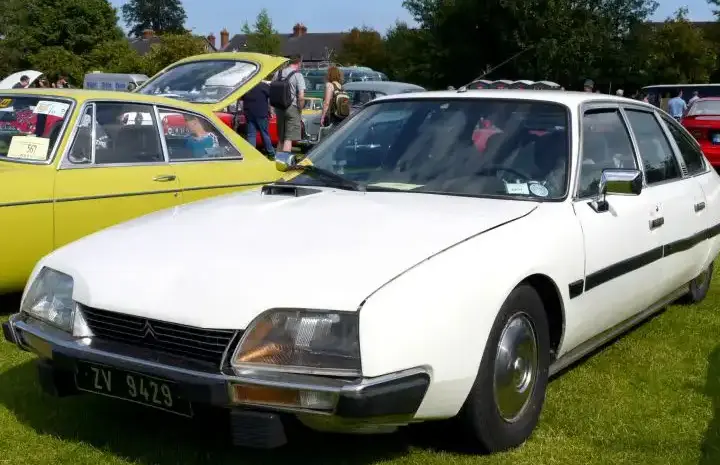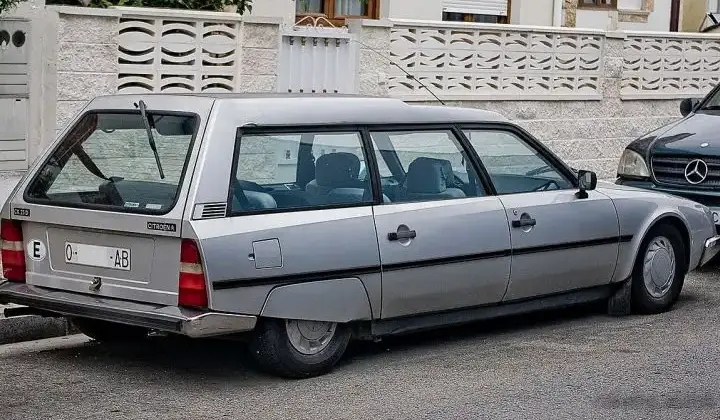
The Citroën CX I Break 2400 Automatic, produced during the initial phase of the CX series in 1982, represents a unique blend of Citroën’s innovative hydropneumatic suspension technology and a relatively accessible engine option within the Break (estate/station wagon) body style. Positioned as a comfortable and practical family vehicle, the 2400 Automatic offered a step up in performance from the lower-displacement models while remaining more affordable than the top-tier, turbocharged variants. This particular configuration was primarily aimed at buyers seeking a refined driving experience and ample cargo space without the expense or complexity of the more performance-oriented CX models. The CX I Break, launched in 1982, built upon the success of the earlier CX sedan, expanding its appeal to those needing greater versatility.
Technical Specifications
| Brand | Citroen |
| Model | CX |
| Generation | CX I Break (Phase I, 1982) |
| Type (Engine) | 2400 (120 Hp) Automatic |
| Start of production | 1982 |
| End of production | 1982 |
| Powertrain Architecture | Internal Combustion engine |
| Body type | Station wagon (estate) |
| Seats | 5 |
| Doors | 5 |
| Fuel Type | Petrol (Gasoline) |
| Maximum speed | 175 km/h (108.74 mph) |
| Weight-to-power ratio | 12 kg/Hp, 83.6 Hp/tonne |
| Weight-to-torque ratio | 7.3 kg/Nm, 136.6 Nm/tonne |
| Power | 120 Hp @ 5500 rpm |
| Power per litre | 51.1 Hp/l |
| Torque | 196 Nm @ 2750 rpm (144.56 lb.-ft. @ 2750 rpm) |
| Engine layout | Front, Transverse |
| Engine Model/Code | M23.639 |
| Engine displacement | 2347 cm3 (143.22 cu. in.) |
| Number of cylinders | 4 |
| Engine configuration | Inline |
| Cylinder Bore | 93.5 mm (3.68 in.) |
| Piston Stroke | 85.5 mm (3.37 in.) |
| Compression ratio | 8.75:1 |
| Number of valves per cylinder | 2 |
| Fuel injection system | Carburettor |
| Engine aspiration | Naturally aspirated engine |
| Engine oil capacity | 5.3 l (5.6 US qt | 4.66 UK qt) |
| Coolant | 11 l (11.62 US qt | 9.68 UK qt) |
| Kerb Weight | 1435 kg (3163.63 lbs) |
| Max. weight | 2130 kg (4695.85 lbs) |
| Max load | 695 kg (1532.21 lbs) |
| Trunk (boot) space – minimum | 110 l (3.88 cu. ft.) |
| Trunk (boot) space – maximum | 2030 l (71.69 cu. ft.) |
| Fuel tank capacity | 68 l (17.96 US gal | 14.96 UK gal) |
| Permitted trailer load with brakes (12%) | 1300 kg (2866.01 lbs) |
| Length | 4952 mm (194.96 in.) |
| Width | 1734 mm (68.27 in.) |
| Height | 1456 mm (57.32 in.) |
| Wheelbase | 3095 mm (121.85 in.) |
| Front track | 1474 mm (58.03 in.) |
| Rear (Back) track | 1390 mm (54.72 in.) |
| Front overhang | 1050 mm (41.34 in.) |
| Rear overhang | 807 mm (31.77 in.) |
| Drag coefficient (Cd) | 0.43 |
| Minimum turning circle (turning diameter) | 12.70 m (41.67 ft) |
| Drivetrain Architecture | The Internal combustion engine (ICE) drives the front wheels of the vehicle. |
| Drive wheel | Front wheel drive |
| Number of gears and type of gearbox | 3 gears, automatic transmission |
| Front brakes | Ventilated discs |
| Rear brakes | Disc |
| Steering type | Steering rack and pinion |
Introduction
The Citroën CX I Break 2400 Automatic, launched in 1982, was a significant addition to the CX range, offering the practicality of a station wagon with a comfortable, albeit not overtly sporty, driving experience. It was built on the foundation of the CX platform (1HX0/A3), known for its advanced hydropneumatic suspension system, which provided an exceptionally smooth ride. The Break body style, essentially an extended CX, catered to families and those requiring substantial cargo capacity. The 2400 engine, while not the most powerful in the CX lineup, provided a good balance of performance and fuel economy for everyday use, especially when paired with the three-speed automatic transmission.
Powertrain & Engine Architecture
The heart of the CX I Break 2400 Automatic is the M23.639 inline-four cylinder engine, displacing 2.3 liters. This engine utilized a single overhead camshaft (SOHC) valvetrain with two valves per cylinder. Unlike later fuel-injected versions, the 1982 2400 employed a Solex C35 PHH carburetor for fuel delivery. This carburetor system, while reliable, was less precise than fuel injection, impacting fuel efficiency and emissions compared to later models. The engine produced 120 horsepower at 5500 rpm and 196 Nm (144.56 lb-ft) of torque at 2750 rpm. The three-speed automatic transmission, while providing convenience, was not known for its responsiveness or efficiency. It featured a torque converter and relatively widely spaced gear ratios, prioritizing smooth cruising over rapid acceleration.
Driving Characteristics
The CX I Break 2400 Automatic offered a distinctly comfortable ride, largely due to the hydropneumatic suspension. This system automatically adjusted the ride height and damping characteristics to maintain a level and smooth ride, even over uneven surfaces. However, the combination of the 2.3-liter engine and the three-speed automatic transmission resulted in somewhat leisurely acceleration. The automatic transmission’s gear ratios were geared towards economy, meaning the engine often felt strained during quick overtaking maneuvers. Compared to the manual transmission versions of the 2400, the automatic was noticeably slower. The higher-output 2.5-liter and turbocharged variants offered significantly more performance, but at a higher price point. Steering was light and precise, thanks to the power-assisted rack and pinion system, but the car’s considerable weight (1435 kg / 3163.63 lbs) was always apparent.
Equipment & Trim Levels
The CX I Break 2400 Automatic was generally well-equipped for its time, though the level of luxury varied depending on the specific market and optional extras selected. Standard features typically included cloth upholstery, central locking, power steering, and the aforementioned hydropneumatic suspension. The dashboard layout was characteristically Citroën, featuring a unique combination of analog gauges and toggle switches. Optional extras included leather upholstery, air conditioning, a sunroof, and upgraded audio systems. The Break body style itself offered a significant amount of practicality, with a minimum trunk capacity of 110 liters (3.88 cu. ft.) expanding to a cavernous 2030 liters (71.69 cu. ft.) with the rear seats folded down.
Chassis & Braking
The CX I Break utilized a monocoque chassis construction, providing a good balance of strength and weight. The front suspension employed independent double wishbones, while the rear suspension relied on the hydropneumatic system, offering self-leveling and adjustable damping. Braking was provided by ventilated discs at the front and solid discs at the rear. The braking system was generally effective, but the lack of anti-lock brakes (ABS) was a notable omission by modern standards. Stabilizer bars were fitted to both the front and rear axles to reduce body roll during cornering.
Market Reception & Comparison
The CX I Break 2400 Automatic was generally well-received by automotive critics as a comfortable and practical family vehicle. However, the automatic transmission was often criticized for its lack of responsiveness and its impact on fuel economy. Compared to the manual transmission versions, the automatic offered less engaging driving experience. Against competitors like the Volvo 240 Estate and the Ford Taunus Turnier, the CX I Break stood out for its unique hydropneumatic suspension and distinctive styling, but it was often more expensive to maintain due to the complexity of its systems. Fuel economy was reasonable for the time, but not exceptional, averaging around 25-30 mpg in mixed driving conditions.
Legacy
The Citroën CX I Break 2400 Automatic, while not the most sought-after variant of the CX range, remains a fascinating example of Citroën’s engineering innovation. The M23 engine, while relatively simple, proved to be reasonably reliable when properly maintained. The hydropneumatic suspension, however, requires regular attention and can be expensive to repair. Today, the CX I Break 2400 Automatic is a relatively rare sight, appealing to enthusiasts who appreciate its unique character and advanced technology. Parts availability can be challenging, but a dedicated community of CX owners and specialists exists to support the preservation of these iconic vehicles. The car represents a high point in Citroën’s history, showcasing their commitment to comfort, innovation, and distinctive design.