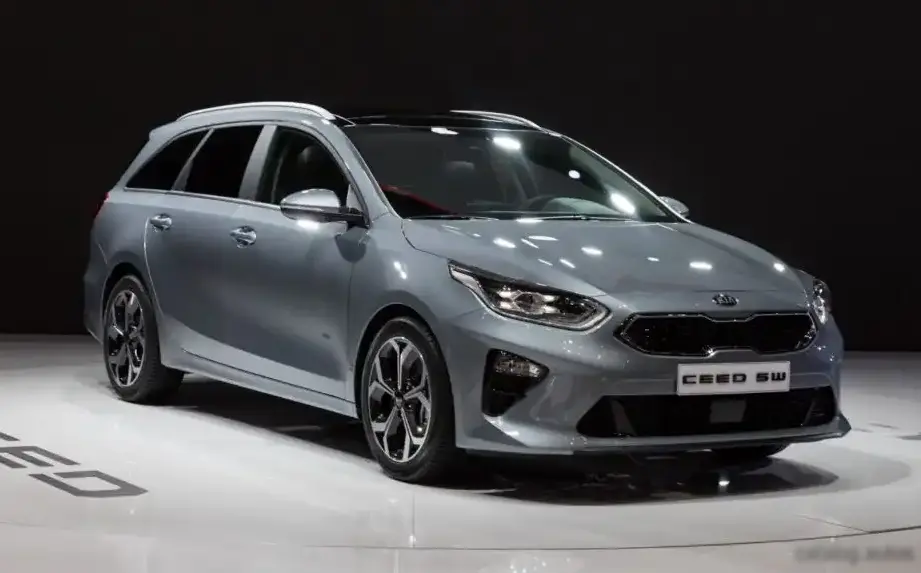
Technical Specifications
| Brand | Kia |
| Model | Ceed |
| Generation | Ceed III Sportswagon |
| Type (Engine) | 1.6 CRDi (115 Hp) Mild Hybrid DCT |
| Start of production | April, 2020 |
| End of production | January, 2021 |
| Powertrain Architecture | MHEV (Mild Hybrid Electric Vehicle) |
| Body type | Station wagon (estate) |
| Seats | 5 |
| Doors | 5 |
| Fuel consumption (urban) | 4.2-4.3 l/100 km (61.9 – 58.8 US mpg) |
| Fuel consumption (extra urban) | 3.7-3.9 l/100 km (74.3 – 70.6 UK mpg) |
| Fuel consumption (combined) | 3.8-4 l/100 km (61.9 – 58.8 US mpg) |
| CO2 emissions | 100-105 g/km |
| Fuel Type | Diesel |
| Acceleration 0 – 100 km/h | 11.1 sec |
| Acceleration 0 – 62 mph | 11.1 sec |
| Acceleration 0 – 60 mph | 10.5 sec |
| Maximum speed | 192 km/h (119.3 mph) |
| Emission standard | Euro 6d TEMP |
| Weight-to-power ratio | 12.2 kg/Hp |
| Weight-to-torque ratio | 4.7 kg/Nm |
| Gross battery capacity | 0.46 kWh |
| Battery voltage | 48 V |
| Battery technology | Lithium-ion (Li-Ion) |
| Electric motor power | 14 Hp |
| Power | 115 Hp @ 4000 rpm |
| Torque | 300 Nm @ 1500-2500 rpm (221.27 lb.-ft.) |
| Engine displacement | 1598 cm3 (97.52 cu. in.) |
| Number of cylinders | 4 |
| Engine configuration | Inline |
| Compression ratio | 15.9:1 |
| Fuel injection system | Diesel Commonrail |
| Engine oil capacity | 4.4 l (4.65 US qt | 3.87 UK qt) |
| Coolant capacity | 7.7 l (8.14 US qt | 6.78 UK qt) |
| Kerb Weight | 1407-1528 kg (3101.9 – 3368.66 lbs.) |
| Max. weight | 1960 kg (4321.06 lbs.) |
| Trunk (boot) space – minimum | 512 l (18.08 cu. ft.) |
| Trunk (boot) space – maximum | 1581 l (55.83 cu. ft.) |
| Fuel tank capacity | 50 l (13.21 US gal | 11 UK gal) |
| Number of gears | 7 |
| Gearbox type | Automatic transmission DCT |
The Kia Ceed III Sportswagon, launched in 2018, represented a significant step forward for the Korean automaker in the European market. The Sportswagon body style, introduced alongside the five-door hatchback, catered to buyers needing increased cargo capacity. The 1.6 CRDi (115 hp) Mild Hybrid DCT variant, introduced in 2020, was designed to appeal to customers prioritizing fuel economy and lower emissions without sacrificing practicality. It utilized Kia’s ‘Smartstream’ diesel engine technology and a 48V mild-hybrid system to achieve these goals. This model falls within the PD platform, shared with the Hyundai i30.
Powertrain & Engine Architecture
At the heart of the Ceed Sportswagon 1.6 CRDi MHEV lies the D4FE ‘Smartstream’ diesel engine. This 1.6-liter inline-four cylinder engine utilizes a second-generation common-rail fuel injection system, delivering fuel at pressures up to 2,200 bar for optimized combustion. The engine features a variable geometry turbocharger (VGT) and an intercooler to enhance power and torque delivery. The 48V mild-hybrid system incorporates a belt starter generator (BSG) and a small lithium-ion battery (0.46 kWh) located under the trunk floor. The BSG allows for extended engine-off coasting, regenerative braking to recapture energy, and a smoother start-stop operation. The engine produces 115 horsepower at 4,000 rpm and 300 Nm (221 lb-ft) of torque between 1,500 and 2,500 rpm. The engine is paired with a 7-speed dual-clutch transmission (DCT), offering quick and smooth gear changes.
Driving Characteristics
The 115 hp output and DCT transmission provide adequate, though not exhilarating, performance. Acceleration from 0-60 mph takes around 10.5 seconds, and the top speed is 119.3 mph. The DCT transmission is well-tuned for everyday driving, offering responsive shifts and contributing to the car’s fuel efficiency. Compared to the more powerful 1.6 T-GDi gasoline variants, the diesel feels less eager to rev, but the abundant low-end torque makes it well-suited for overtaking and cruising. The mild-hybrid system is largely transparent to the driver, providing subtle assistance during acceleration and coasting. The gear ratios are optimized for fuel economy, meaning the engine can feel slightly strained when climbing steep hills or carrying a full load. Compared to a manual transmission version, the DCT offers convenience but may feel slightly less engaging for driving enthusiasts.
Equipment & Trim Levels
The 1.6 CRDi Mild Hybrid DCT Sportswagon typically came equipped with a generous level of standard features. These included air conditioning, a touchscreen infotainment system with Apple CarPlay and Android Auto compatibility, Bluetooth connectivity, and a suite of safety features such as autonomous emergency braking, lane keeping assist, and driver attention warning. Interior upholstery was typically cloth, with options for leather upgrades. Higher trim levels added features like heated seats, a larger touchscreen display, a panoramic sunroof, and parking sensors. Exterior features included alloy wheels, chrome window trim, and LED headlights.
Chassis & Braking
The Ceed Sportswagon utilizes a McPherson strut front suspension and a multi-link rear suspension, providing a comfortable and controlled ride. Stabilizer bars are fitted to both axles to reduce body roll during cornering. Braking duties are handled by ventilated discs at the front and solid discs at the rear. Anti-lock braking system (ABS) and electronic stability control (ESC) are standard features. The steering is electrically assisted, providing a light and precise feel. The suspension tuning is geared towards comfort, prioritizing ride quality over outright sportiness.
Market Reception & Comparison
The Kia Ceed Sportswagon 1.6 CRDi Mild Hybrid DCT was generally well-received by automotive critics. It was praised for its fuel efficiency, practicality, and comfortable ride. However, some reviewers noted that the engine lacked the refinement and performance of some of its competitors. Compared to other diesel variants in the Ceed lineup, the 115 hp version offered a good balance between economy and usability. Against rivals like the Volkswagen Golf Estate, Ford Focus Estate, and Peugeot 308 SW, the Ceed Sportswagon offered a competitive price point and a longer warranty, making it an attractive option for budget-conscious buyers. Fuel economy figures consistently hovered around 60 mpg combined, making it a very economical choice for long-distance drivers.
Legacy
The Kia Ceed III Sportswagon 1.6 CRDi Mild Hybrid DCT represents an important step in Kia’s development of fuel-efficient and environmentally friendly vehicles. While the mild-hybrid system is now superseded by more advanced hybrid and electric technologies, it paved the way for Kia’s broader electrification strategy. On the used car market, these models are generally considered reliable and offer good value for money. The Smartstream diesel engine has proven to be durable, and the DCT transmission, while requiring occasional maintenance, is generally robust. The Ceed Sportswagon remains a popular choice for families and individuals seeking a practical and economical estate car.