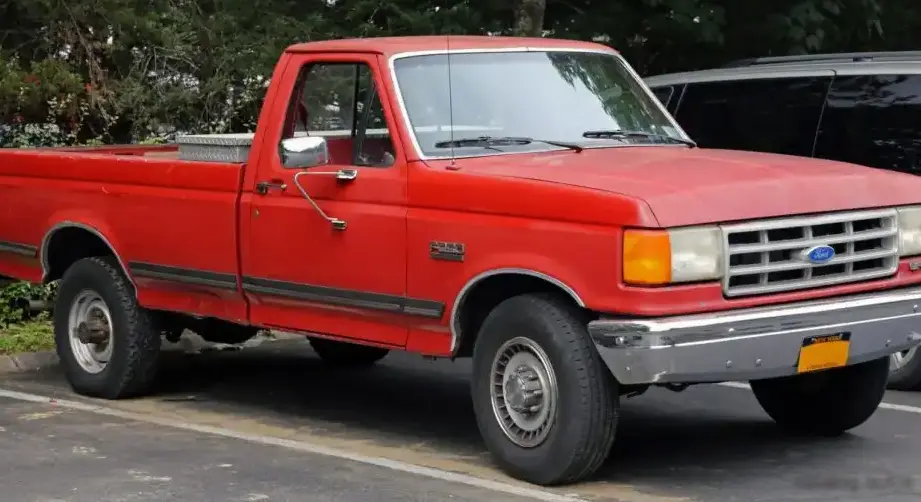
The Ford F-Series F-250 VIII Regular Cab, equipped with the 4.9-liter (300 cubic inch) inline-six engine producing 145 horsepower and a four-wheel-drive (4×4) drivetrain, was a mainstay of Ford’s heavy-duty truck lineup from 1986 to 1988. This configuration represented a work-focused, entry-level offering within the eighth generation (1987-1991) of the F-Series, designed for buyers prioritizing capability and durability over outright performance. It served as a crucial component of Ford’s dominance in the North American truck market, appealing to farmers, ranchers, and tradespeople needing a robust and reliable vehicle.
Technical Specifications
| Brand | Ford |
| Model | F-Series F-250 |
| Generation | F-Series F-250 VIII Regular Cab |
| Type (Engine) | 4.9 300 Six (145 Hp) 4×4 |
| Start of production | 1986 |
| End of production | 1988 |
| Powertrain Architecture | Internal Combustion engine |
| Body type | Pick-up |
| Seats | 3 |
| Doors | 2 |
| Fuel Type | Petrol (Gasoline) |
| Power | 145 Hp |
| Power per litre | 29.5 Hp/l |
| Torque | 359 Nm / 264.78 lb.-ft. |
| Engine layout | Front, Longitudinal |
| Engine displacement | 4916 cm3 / 299.99 cu. in. |
| Number of cylinders | 6 |
| Engine configuration | Inline |
| Fuel injection system | Multi-port manifold injection |
| Engine aspiration | Naturally aspirated engine |
| Max. weight | 2994 kg / 6600.64 lbs. |
| Fuel tank capacity | 72 l / 19.02 US gal | 15.84 UK gal |
| Length | 5339 mm / 210.2 in. |
| Width | 1778 mm / 70 in. |
| Height | 1923 mm / 75.71 in. |
| Wheelbase | 3378 mm / 132.99 in. |
| Wading depth | 869 mm / 34.21 in. |
| Drivetrain Architecture | The Internal combustion engine (ICE) drives the rear wheels permanently, and the front wheels are driven through an electrically or mechanically operated clutch if necessary. |
| Drive wheel | All wheel drive (4×4) |
| Number of gears and type of gearbox | 4 gears, manual transmission |
| Front suspension | Leaf spring |
| Rear suspension | Leaf spring |
| Front brakes | Disc |
| Rear brakes | Drum |
| Power steering | Electric Steering |
| Tires size | 215/85 R16 |
| Wheel rims size | 6J x 16 |
Powertrain & Engine Architecture
The heart of this F-250 variant was the 4.9-liter inline-six engine, commonly known as the “300 Six.” This engine, a Ford stalwart for decades, was renowned for its exceptional durability and low-end torque. The 300 Six featured a cast-iron block and cylinder head, a simple overhead valve (OHV) valvetrain, and a multi-port fuel injection system. While not a high-revving engine, it delivered a broad torque curve, making it well-suited for hauling and towing. The 145 horsepower output was adequate for the intended applications, but it wasn’t designed for rapid acceleration. The four-speed manual transmission was a standard feature, providing a direct connection to the engine’s power and offering good control in demanding conditions. The transmission’s gear ratios were optimized for work, prioritizing pulling power over fuel efficiency at highway speeds.
Driving Characteristics
Behind the wheel, the F-250 4.9L 4×4 felt like a true work truck. Acceleration was modest, and the engine required downshifting for passing maneuvers or climbing steep hills. However, the engine’s strong low-end torque made it capable of handling substantial loads. The four-wheel-drive system provided excellent traction in off-road conditions and inclement weather. The leaf spring suspension, while providing a robust ride, was not particularly comfortable on paved roads. Compared to the available V8 engines (such as the 351 Windsor or 460), this 300 Six offered significantly less horsepower and acceleration. However, it also offered better fuel economy and a reputation for being virtually indestructible. The manual transmission, while requiring more driver involvement than an automatic, provided a more direct and engaging driving experience.
Equipment & Trim Levels
The F-250 VIII Regular Cab with the 4.9-liter engine typically represented the base trim level. Standard features were minimal, focusing on functionality rather than luxury. The interior usually featured a vinyl bench seat, a basic dashboard with essential gauges, and rubber floor mats. Air conditioning, power steering, and an upgraded sound system were often optional extras. The exterior typically featured minimal chrome trim and steel wheels. The emphasis was on providing a durable and affordable truck for practical use. Buyers could add options like a sliding rear window, a trailer towing package, or a heavier-duty suspension to tailor the truck to their specific needs.
Chassis & Braking
The F-250’s chassis was built for heavy-duty work. It featured a robust ladder frame construction and a solid rear axle. The front suspension utilized leaf springs, while the rear suspension also employed leaf springs, providing a high load-carrying capacity. The braking system consisted of disc brakes on the front axle and drum brakes on the rear. Power steering was often included, making maneuvering the large truck easier. The tires, typically 215/85 R16, were designed for durability and traction in a variety of conditions. The overall chassis design prioritized strength and reliability over ride comfort.
Market Reception & Comparison
The F-250 4.9L 4×4 was generally well-received by buyers who needed a dependable and affordable heavy-duty truck. Critics acknowledged its durability and strong low-end torque, but noted its lack of refinement and modest performance. Compared to the V8-powered F-250s, the 300 Six offered better fuel economy, but at the expense of power. The 300 Six was also considered easier to maintain and less prone to major mechanical failures than the more complex V8 engines. This variant appealed to buyers who prioritized practicality and long-term reliability over outright performance and luxury.
Legacy
The 4.9-liter inline-six engine has earned a legendary reputation for its longevity and simplicity. Many examples of this engine are still in service today, often with hundreds of thousands of miles on the odometer. The F-250 4.9L 4×4 remains a popular choice among collectors and enthusiasts who appreciate its ruggedness and dependability. In the used car market, these trucks are often valued for their affordability and potential for restoration. While not the fastest or most luxurious truck of its era, the F-250 4.9L 4×4 represents a classic example of American work ethic and engineering. Its enduring popularity is a testament to its robust design and unwavering reliability.