
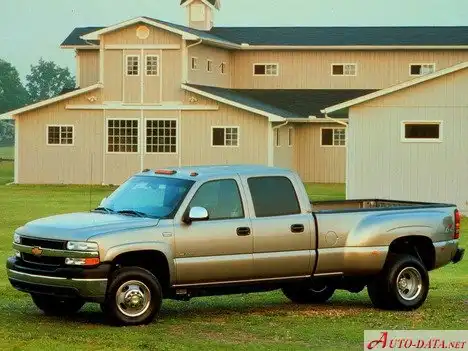
The Chevrolet Silverado 1500 Crew Cab, powered by the 4.8-liter V8 engine and paired with a four-speed automatic transmission, represents a significant entry point into the full-size pickup truck market during its 1998-2002 production run. This variant occupied a middle ground within the first generation of the redesigned Silverado (C/K series), offering a balance between capability, comfort, and affordability. It was positioned below the more powerful 5.3L and 6.0L V8 options, targeting buyers who prioritized everyday usability over outright towing capacity or performance. The Crew Cab configuration, introduced in 1999, provided expanded rear passenger space, making it a popular choice for families and work crews.
Technical Specifications
| Brand | Chevrolet |
| Model | Silverado 1500 |
| Generation | Silverado 1500 I Crew Cab |
| Type (Engine) | 4.8 (275 Hp) Automatic |
| Start of production | 1998 |
| End of production | 2002 |
| Powertrain Architecture | Internal Combustion engine |
| Body type | Pick-up |
| Seats | 4 |
| Doors | 5 |
| Fuel consumption (urban) | 14.7 l/100 km (16 US mpg, 19.2 UK mpg, 6.8 km/l) |
| Fuel consumption (extra urban) | 11.2 l/100 km (21 US mpg, 25.2 UK mpg, 8.9 km/l) |
| Fuel Type | Petrol (Gasoline) |
| Power | 275 Hp @ 5200 rpm |
| Power per litre | 57.2 Hp/l |
| Torque | 386 Nm @ 4000 rpm (284.7 lb.-ft. @ 4000 rpm) |
| Engine layout | Front, Longitudinal |
| Engine displacement | 4807 cm3 (293.34 cu. in.) |
| Number of cylinders | 8 |
| Engine configuration | V-engine |
| Cylinder Bore | 96 mm (3.78 in.) |
| Piston Stroke | 83 mm (3.27 in.) |
| Compression ratio | 9.5:1 |
| Number of valves per cylinder | 2 |
| Fuel injection system | Multi-port manifold injection |
| Engine aspiration | Naturally aspirated engine |
| Engine oil capacity | 5.7 l (6.02 US qt, 5.02 UK qt) |
| Coolant | 12.7 l (13.42 US qt, 11.17 UK qt) |
| Length | 6025 mm (237.2 in.) |
| Width | 1994 mm (78.5 in.) |
| Height | 1956 mm (77.01 in.) |
| Wheelbase | 3885 mm (152.95 in.) |
| Front track | 1899 mm (74.76 in.) |
| Rear track | 1676 mm (65.98 in.) |
| Drivetrain Architecture | Rear wheel drive |
| Number of gears | 4 |
| Gearbox type | Automatic transmission |
| Front suspension | Torsion |
| Rear suspension | Leaf spring |
Powertrain & Engine Architecture
The heart of this Silverado variant is the 4.8L (293 cubic inch) small-block Chevrolet V8, internally designated as the Vortec 4800. This engine, part of the Vortec family, featured a cast iron block and aluminum cylinder heads. It utilized a multi-port fuel injection system, delivering fuel directly to each cylinder for improved efficiency and power delivery. The engine’s 9.5:1 compression ratio and two valves per cylinder contributed to its broad torque curve. The four-speed 4L60E automatic transmission was the standard pairing. This transmission, known for its durability, featured electronic control for smoother shifting and adaptive learning capabilities. The 4L60E’s gear ratios were optimized for both towing and highway cruising, though it wasn’t as refined as some of the newer automatic transmissions available in later model years.
Driving Characteristics
The 4.8L V8, producing 275 horsepower and 285 lb-ft of torque, provided adequate power for everyday driving and moderate towing. Acceleration was respectable, but not particularly brisk. The four-speed automatic transmission, while reliable, could sometimes feel sluggish during quick acceleration or when downshifting. Compared to the 5.3L and 6.0L V8 options, the 4.8L offered a more fuel-efficient driving experience, but at the expense of overall performance. The Crew Cab configuration added weight, further impacting acceleration and handling. The rear-wheel-drive setup provided a traditional truck feel, with a focus on hauling and towing rather than sporty handling.
Equipment & Trim Levels
The Silverado 1500 Crew Cab 4.8L Automatic typically came standard with features such as air conditioning, power windows and locks, and an AM/FM stereo. Higher trim levels, such as the LT, added features like cloth or leather upholstery, upgraded sound systems, and alloy wheels. Optional extras included a towing package, sunroof, and various convenience features. The interior design was functional and durable, prioritizing practicality over luxury. The Crew Cab’s spacious rear seating was a major selling point, offering ample legroom and headroom for passengers.
Chassis & Braking
The Silverado 1500 Crew Cab utilized a body-on-frame construction, providing a robust and durable platform. The front suspension consisted of torsion bars, while the rear suspension employed leaf springs. This setup was designed to handle heavy loads and provide a comfortable ride. Braking duties were handled by disc brakes up front and drum brakes in the rear. Anti-lock brakes (ABS) were available as an option. The rear drum brakes were a cost-saving measure, and some critics noted that they didn’t offer the same stopping power as disc brakes on all four wheels.
Market Reception & Comparison
The Silverado 1500 Crew Cab 4.8L Automatic was generally well-received by critics and consumers. It was praised for its spacious interior, comfortable ride, and relatively affordable price. However, some reviewers noted that the 4.8L engine lacked the power of its larger counterparts, and the four-speed automatic transmission felt dated compared to newer transmissions. Compared to the Ford F-150 and Dodge Ram 1500, the Silverado offered a competitive combination of features, performance, and value. Fuel economy was average for a full-size pickup truck, with EPA estimates ranging from 14 mpg city to 21 mpg highway.
Legacy
The 4.8L Vortec engine and 4L60E transmission proved to be remarkably durable and reliable powertrains. Many Silverado 1500s equipped with this combination are still on the road today, often with well over 200,000 miles. While not known for blistering performance, the 4.8L engine is appreciated for its simplicity and longevity. In the used car market, these Silverados represent a relatively affordable entry point into the full-size pickup truck segment. They are often sought after by buyers who need a capable and reliable truck for everyday use, without the expense of a more powerful or feature-rich model. Regular maintenance, including oil changes and transmission fluid flushes, is key to ensuring the long-term reliability of this powertrain.
