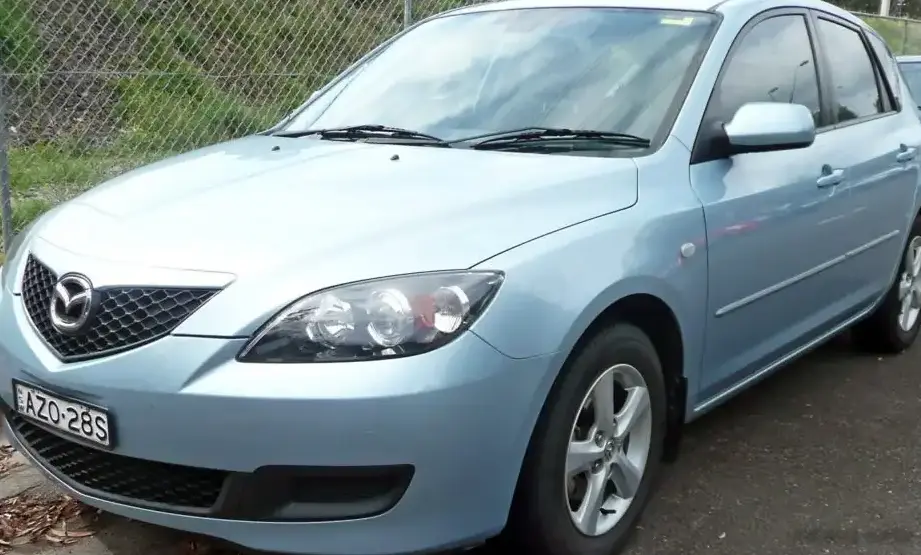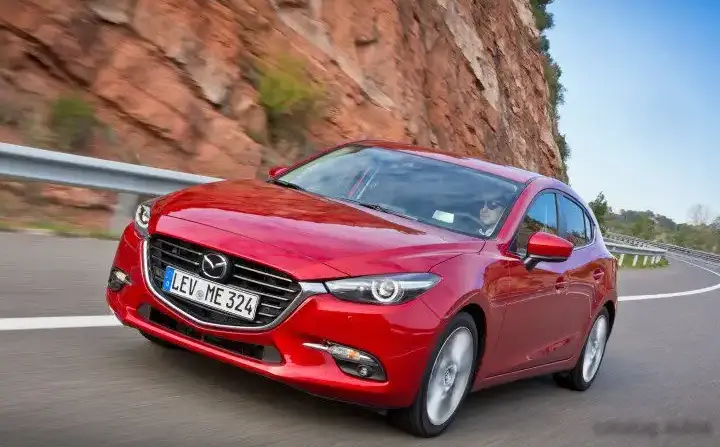
The Mazda 3 III Hatchback, specifically the facelift model released in 2017, represented a significant evolution of Mazda’s popular compact car. This generation (BM) saw Mazda refine its “Kodo – Soul of Motion” design language and introduce its SkyActiv technology suite. The 2.0 SkyActiv-G variant, producing 120 horsepower, was a key offering in many markets, positioned as a balance between affordability and driving enjoyment. Production of this specific configuration ran from 2017 to 2018, falling within the broader lifespan of the BM generation which spanned from 2013 to 2018 (with the facelift arriving mid-cycle). It competed directly with vehicles like the Volkswagen Golf, Ford Focus, and Honda Civic.
Technical Specifications
| Brand | Mazda |
| Model | 3 |
| Generation | 3 III Hatchback (BM, facelift 2017) |
| Type (Engine) | 2.0 SkyActiv-G (120 Hp) |
| Start of production | 2017 |
| End of production | 2018 |
| Powertrain Architecture | Internal Combustion engine |
| Body type | Hatchback |
| Seats | 5 |
| Doors | 5 |
| Fuel consumption (urban) | 6.5 l/100 km (36.2 US mpg, 43.5 UK mpg, 15.4 km/l) |
| Fuel consumption (extra urban) | 4.3 l/100 km (54.7 US mpg, 65.7 UK mpg, 23.3 km/l) |
| Fuel consumption (combined) | 5.1 l/100 km (46.1 US mpg, 55.4 UK mpg, 19.6 km/l) |
| CO2 emissions | 119 g/km |
| Fuel Type | Petrol (Gasoline) |
| Acceleration 0 – 100 km/h | 8.9 sec |
| Acceleration 0 – 62 mph | 8.9 sec |
| Acceleration 0 – 60 mph | 8.5 sec |
| Maximum speed | 195 km/h (121.17 mph) |
| Emission standard | Euro 6 |
| Weight-to-power ratio | 10 kg/Hp, 99.6 Hp/tonne |
| Weight-to-torque ratio | 5.7 kg/Nm, 174.3 Nm/tonne |
| Power | 120 Hp @ 6000 rpm |
| Power per litre | 60.1 Hp/l |
| Torque | 210 Nm @ 4000 rpm (154.89 lb.-ft. @ 4000 rpm) |
| Engine layout | Front, Transverse |
| Engine displacement | 1998 cm3 (121.93 cu. in.) |
| Number of cylinders | 4 |
| Engine configuration | Inline |
| Cylinder Bore | 83.5 mm (3.29 in.) |
| Piston Stroke | 91.2 mm (3.59 in.) |
| Compression ratio | 14:1 |
| Number of valves per cylinder | 4 |
| Fuel injection system | Direct injection |
| Engine aspiration | Naturally aspirated engine |
| Engine oil capacity | 4.2 l (4.44 US qt | 3.7 UK qt) |
| Coolant | 6.2 l (6.55 US qt | 5.46 UK qt) |
| Kerb Weight | 1205-1291 kg (2656.57 – 2846.17 lbs.) |
| Max. weight | 1815 kg (4001.39 lbs.) |
| Max load | 524-610 kg (1155.22 – 1344.82 lbs.) |
| Trunk (boot) space – minimum | 364 l (12.85 cu. ft.) |
| Trunk (boot) space – maximum | 1263 l (44.6 cu. ft.) |
| Fuel tank capacity | 51 l (13.47 US gal | 11.22 UK gal) |
| Max. roof load | 75 kg (165.35 lbs.) |
| Permitted trailer load with brakes (8%) | 1600 kg (3527.4 lbs.) |
| Permitted trailer load with brakes (12%) | 1300 kg (2866.01 lbs.) |
| Permitted trailer load without brakes | 600 kg (1322.77 lbs.) |
| Permitted towbar download | 75 kg (165.35 lbs.) |
| Length | 4470 mm (175.98 in.) |
| Width | 1795 mm (70.67 in.) |
| Width including mirrors | 2053 mm (80.83 in.) |
| Height | 1465 mm (57.68 in.) |
| Wheelbase | 2700 mm (106.3 in.) |
| Ride height (ground clearance) | 155 mm (6.1 in.) |
| Minimum turning circle | 10.6 m (34.78 ft.) |
| Drivetrain Architecture | The Internal combustion engine (ICE) drives the front wheels of the vehicle. |
| Drive wheel | Front wheel drive |
| Number of gears and type of gearbox | 6 gears, manual transmission |
| Front suspension | Independent, type McPherson with coil spring and anti-roll bar |
| Rear suspension | Independent multi-link suspension |
| Front brakes | Ventilated discs |
| Rear brakes | Disc |
| Assisting systems | ABS (Anti-lock braking system) |
| Steering type | Steering rack and pinion |
| Power steering | Electric Steering |
| Tires size | 205/60 R16; 215/45 R18 |
| Wheel rims size | 16; 18 |
Powertrain & Engine Architecture
The heart of this Mazda 3 variant is the 1.998-liter (2.0L) SkyActiv-G four-cylinder engine. This engine is a key component of Mazda’s SkyActiv technology, designed to maximize efficiency without sacrificing driving pleasure. It features direct injection, a high compression ratio of 14:1, and optimized combustion chamber design. The engine utilizes a conventional naturally aspirated setup, foregoing turbocharging in favor of a responsive and linear power delivery. The engine code varies by region, but is commonly found as PE-VPH. The 120 hp output is achieved at 6,000 rpm, with a torque peak of 210 Nm (154.89 lb-ft) at 4,000 rpm. This engine is paired with a six-speed automatic transmission, offering smooth shifts and contributing to the car’s overall refinement. The transmission is designed to work in harmony with the engine’s characteristics, providing adequate acceleration and fuel economy.
Driving Characteristics
The 2.0L SkyActiv-G with the automatic transmission delivers a comfortable and predictable driving experience. While not overtly sporty, the engine provides sufficient power for everyday driving situations. Acceleration from 0-60 mph takes around 8.5 to 8.9 seconds, depending on testing conditions. The automatic transmission is well-tuned, offering smooth gear changes and a willingness to downshift when needed. Compared to the manual transmission version, the automatic offers convenience but slightly diminishes the sense of driver engagement. Higher output variants, such as those with more powerful engines, offer significantly quicker acceleration. The gear ratios are optimized for fuel efficiency, but can sometimes feel a bit tall, requiring the transmission to downshift on inclines or during overtaking maneuvers.
Equipment & Trim Levels
The 2.0 SkyActiv-G automatic trim typically sat in the mid-range of the Mazda 3 lineup. Standard equipment often included air conditioning, power windows and locks, a touchscreen infotainment system with Bluetooth connectivity, and a suite of safety features like ABS, stability control, and multiple airbags. Higher trim levels added features such as leather upholstery, a sunroof, a premium sound system, and advanced driver-assistance systems like lane departure warning and automatic emergency braking. Interior upholstery was typically cloth, with options for upgraded materials on higher trims. Dashboard configurations were consistent across the range, featuring a clean and modern design.
Chassis & Braking
The Mazda 3 III Hatchback utilizes a front-wheel-drive platform with an independent suspension setup. The front suspension employs a McPherson strut design with coil springs and an anti-roll bar, while the rear features a multi-link suspension. This setup provides a good balance between ride comfort and handling precision. Braking duties are handled by ventilated discs at the front and solid discs at the rear. ABS (Anti-lock Braking System) is standard, enhancing braking performance and stability. The chassis is relatively lightweight, contributing to the car’s agility and fuel efficiency.
Market Reception & Comparison
The 2.0 SkyActiv-G automatic variant of the Mazda 3 was generally well-received by critics. It was praised for its fuel efficiency, comfortable ride, and refined interior. However, some reviewers noted that the engine could feel a bit underpowered, especially when fully loaded or driving uphill. Compared to the 1.5L engine option, the 2.0L offered a noticeable improvement in performance. Against competitors like the Volkswagen Golf and Ford Focus, the Mazda 3 offered a more engaging driving experience and a more premium interior feel, though it sometimes lagged behind in terms of outright performance. Fuel economy figures of around 46.1 US mpg combined were competitive for its class.
Legacy
The 2.0 SkyActiv-G engine has proven to be a reliable and durable powertrain. While not without its minor issues (such as occasional oil consumption in some early models), it generally requires minimal maintenance and offers good long-term reliability. On the used car market, this variant of the Mazda 3 remains a popular choice, offering a good balance of affordability, fuel efficiency, and driving enjoyment. Its reputation for reliability and Mazda’s overall build quality contribute to its continued desirability. Parts availability is generally good, and maintenance costs are reasonable, making it a practical and sensible choice for budget-conscious buyers.