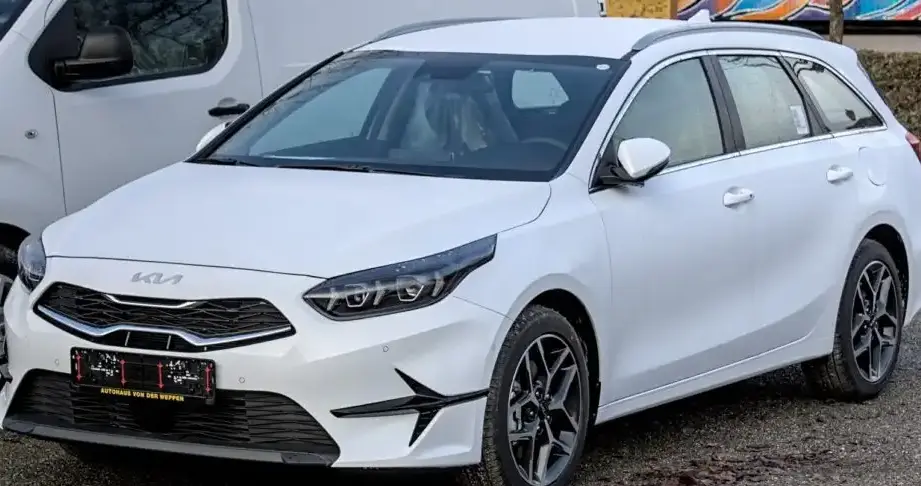
The Kia Ceed III Sportswagon (facelift 2021) 1.5 T-GDI, producing 160 horsepower, represents a significant iteration within the third generation of Kia’s popular compact estate car. Introduced in October 2021 and remaining in production until April 2024, this variant occupied a mid-range position in the Ceed Sportswagon lineup, offering a balance between performance, fuel efficiency, and practicality. It builds upon the foundation of the PD platform (internally known as 1HX0/A3), shared with the Hyundai i30, and benefits from the styling updates and technological enhancements introduced with the 2021 facelift. This version aimed to appeal to buyers seeking a versatile family vehicle with a more responsive engine than the base models, while remaining more affordable than the higher-performance GT trims.
Technical Specifications
| Brand | Kia |
| Model | Ceed |
| Generation | Ceed III Sportswagon (facelift 2021) |
| Type (Engine) | 1.5 T-GDI (160 Hp) |
| Start of production | October, 2021 |
| End of production | April, 2024 |
| Powertrain Architecture | Internal Combustion engine |
| Body type | Station wagon (estate) |
| Seats | 5 |
| Doors | 5 |
| Combined fuel consumption (WLTP) | 5.5-6.3 l/100 km (42.8 – 37.3 US mpg, 51.4 – 44.8 UK mpg, 18.2 – 15.9 km/l) |
| CO2 emissions (WLTP) | 125-142 g/km |
| Fuel consumption (economy) – urban (NEDC, WLTP equivalent) | 6.8-7.1 l/100 km (34.6 – 33.1 US mpg, 41.5 – 39.8 UK mpg, 14.7 – 14.1 km/l) |
| Fuel consumption (economy) – extra urban (NEDC, WLTP equivalent) | 4.5-5.1 l/100 km (52.3 – 46.1 US mpg, 62.8 – 55.4 UK mpg, 22.2 – 19.6 km/l) |
| Fuel consumption (economy) – combined (NEDC, WLTP equivalent) | 5.3-5.8 l/100 km (44.4 – 40.6 US mpg, 53.3 – 48.7 UK mpg, 18.9 – 17.2 km/l) |
| CO2 emissions (NEDC, WLTP equivalent) | 121-132 g/km |
| Fuel Type | Petrol (Gasoline) |
| Acceleration 0 – 100 km/h | 8.6 sec |
| Acceleration 0 – 62 mph | 8.6 sec |
| Acceleration 0 – 60 mph | 8.2 sec |
| Maximum speed | 210 km/h (130.49 mph) |
| Emission standard | Euro 6d |
| Weight-to-power ratio | 8.1 kg/Hp, 122.9 Hp/tonne |
| Weight-to-torque ratio | 5.1 kg/Nm, 194.3 Nm/tonne |
| Power | 160 Hp @ 5500 rpm |
| Power per litre | 108 Hp/l |
| Torque | 253 Nm @ 1500-3500 rpm (186.6 lb.-ft. @ 1500-3500 rpm) |
| Engine layout | Front, Transverse |
| Engine Model/Code | G4LH |
| Engine displacement | 1482 cm3 (90.44 cu. in.) |
| Number of cylinders | 4 |
| Engine configuration | Inline |
| Cylinder Bore | 71.6 mm (2.82 in.) |
| Piston Stroke | 92 mm (3.62 in.) |
| Compression ratio | 10.5:1 |
| Number of valves per cylinder | 4 |
| Fuel injection system | Direct injection |
| Engine aspiration | Turbocharger, Intercooler |
| Engine oil capacity | 4.2 l (4.44 US qt | 3.7 UK qt) |
| Coolant | 6.1 l (6.45 US qt | 5.37 UK qt) |
| Kerb Weight | 1302-1418 kg (2870.42 – 3126.15 lbs.) |
| Max. weight | 1850 kg (4078.55 lbs.) |
| Max load | 432-548 kg (952.4 – 1208.13 lbs.) |
| Trunk (boot) space – minimum | 625 l (22.07 cu. ft.) |
| Trunk (boot) space – maximum | 1694 l (59.82 cu. ft.) |
| Fuel tank capacity | 50 l (13.21 US gal | 11 UK gal) |
| Max. roof load | 80 kg (176.37 lbs.) |
| Permitted trailer load with brakes (12%) | 1410 kg (3108.52 lbs.) |
| Permitted trailer load without brakes | 600 kg (1322.77 lbs.) |
| Permitted towbar download | 75 kg (165.35 lbs.) |
| Length | 4600-4605 mm (181.1 – 181.3 in.) |
| Width | 1800 mm (70.87 in.) |
| Width including mirrors | 2055 mm (80.91 in.) |
| Height | 1460-1465 mm (57.48 – 57.68 in.) |
| Wheelbase | 2650 mm (104.33 in.) |
| Front track | 1559-1565 mm (61.38 – 61.61 in.) |
| Rear (Back) track | 1567-1573 mm (61.69 – 61.93 in.) |
| Front overhang | 880-885 mm (34.65 – 34.84 in.) |
| Rear overhang | 1070 mm (42.13 in.) |
| Minimum turning circle (turning diameter) | 10.6 m (34.78 ft.) |
| Drivetrain Architecture | The Internal combustion engine (ICE) drives the front wheels of the vehicle. |
| Drive wheel | Front wheel drive |
| Number of gears and type of gearbox | 6 gears, manual transmission |
| Front suspension | Independent type McPherson |
| Rear suspension | Independent multi-link spring suspension with stabilizer |
| Front brakes | Ventilated discs, 305×25 mm |
| Rear brakes | Disc, 284×10 mm |
| Assisting systems | ABS (Anti-lock braking system) |
| Steering type | Steering rack and pinion |
| Power steering | Electric Steering |
| Tires size | 205/55 R16H; 225/45 R17V |
| Wheel rims size | 6.5J x 16 ET50; 7.0J x 17 ET53 |
INTRODUCTION
The Kia Ceed III Sportswagon 1.5 T-GDI (160 Hp) is a five-door, five-seat station wagon that formed part of the third generation of the Ceed model line, produced from 2018 onwards. The 2021 facelift brought revised styling, updated technology, and refinements to the powertrain options. This particular variant, powered by the 1.5-liter turbocharged gasoline direct injection (T-GDI) engine, was positioned as a compelling alternative to diesel-powered estates, offering a good balance of performance and fuel economy. It aimed to attract buyers who needed the practicality of a wagon but didn’t want to compromise on driving enjoyment. The Sportswagon body style itself is crucial to Kia’s European strategy, catering to a market with a strong preference for estate cars.
Powertrain & Engine Architecture
At the heart of the Ceed Sportswagon 1.5 T-GDI lies the G4LH engine, a 1482cc inline-four cylinder unit. This engine utilizes direct fuel injection, a technology that improves combustion efficiency and power output. The engine also features a single scroll turbocharger with an intercooler, which helps to reduce intake air temperature and further enhance performance. The engine produces 160 horsepower at 5500 rpm and 253 Nm (186.6 lb.-ft.) of torque between 1500 and 3500 rpm. This broad torque curve provides good responsiveness in everyday driving situations. The engine is paired with a six-speed manual transmission as standard, delivering power to the front wheels. The engine’s architecture incorporates a timing chain for durability and reduced maintenance compared to timing belts. It also features a particulate filter to reduce emissions, meeting Euro 6d standards.
Driving Characteristics
The 1.5 T-GDI engine provides a noticeable step up in performance compared to the lower-powered 1.0-liter T-GDI engine offered in other Ceed Sportswagon trims. Acceleration from 0 to 60 mph takes approximately 8.2 seconds, and the car feels adequately powered for overtaking and highway cruising. The six-speed manual transmission is well-matched to the engine’s characteristics, offering smooth gear changes and a reasonably engaging driving experience. While not a sports car, the Ceed Sportswagon 1.5 T-GDI offers a comfortable and composed ride, with well-controlled body roll. The steering is precise and provides decent feedback, although it lacks the ultimate feel of some competitors. Compared to the diesel variants, the 1.5 T-GDI offers a more refined and responsive driving experience, albeit with slightly higher fuel consumption.
Equipment & Trim Levels
The Ceed Sportswagon 1.5 T-GDI typically came equipped with a generous level of standard equipment. This included air conditioning, a touchscreen infotainment system with Apple CarPlay and Android Auto compatibility, Bluetooth connectivity, and a suite of safety features such as autonomous emergency braking, lane keeping assist, and driver attention warning. Higher trim levels added features such as a larger touchscreen display, navigation system, heated seats, a panoramic sunroof, and leather upholstery. Interior materials were generally of good quality, with a focus on durability and practicality. The dashboard layout was clean and intuitive, with logically placed controls.
Chassis & Braking
The Ceed Sportswagon utilizes a McPherson strut front suspension and a multi-link rear suspension, providing a good balance of ride comfort and handling. The suspension is tuned to prioritize comfort, but it still offers decent body control. The braking system consists of ventilated discs at the front and solid discs at the rear. Anti-lock braking system (ABS) and electronic stability control (ESC) are standard features, providing enhanced safety and control. The steering is electrically assisted, offering a light and precise feel.
Market Reception & Comparison
The Kia Ceed Sportswagon 1.5 T-GDI was generally well-received by automotive critics. It was praised for its spacious interior, practical load-carrying capacity, and competitive pricing. The 1.5 T-GDI engine was considered a good compromise between performance and fuel economy. Compared to rivals such as the Volkswagen Golf Estate and the Ford Focus Estate, the Ceed Sportswagon offered a compelling value proposition, with a longer warranty and a generous level of standard equipment. Fuel economy figures typically ranged from 5.5 to 6.3 l/100 km (42.8 – 37.3 US mpg), depending on driving conditions and style.
Legacy
The Kia Ceed III Sportswagon 1.5 T-GDI has proven to be a reliable and durable vehicle. The G4LH engine has a good reputation for longevity, and the overall build quality of the Ceed Sportswagon is generally high. On the used car market, these models represent a good value for money, offering a practical and well-equipped estate car at an affordable price. While not a collector’s item, the Ceed Sportswagon 1.5 T-GDI remains a popular choice for buyers seeking a versatile and dependable family vehicle.