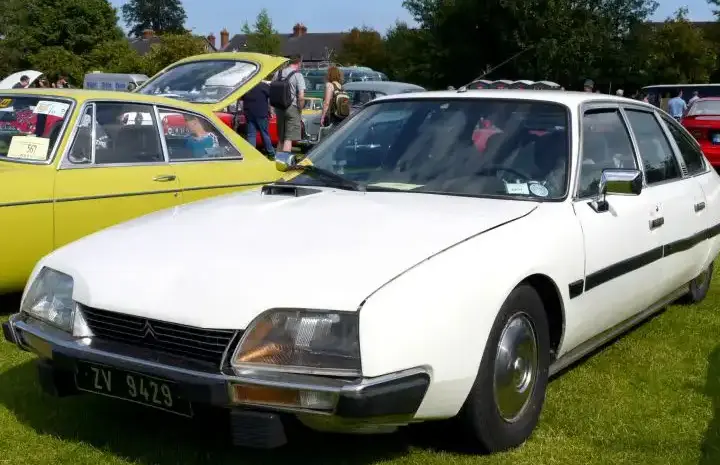
Technical Specifications
| Brand | Citroën |
| Model | CX |
| Generation | CX I (Phase I, 1982) |
| Type (Engine) | 20 (106 Hp) |
| Start of production | 1982 |
| End of production | 1985 |
| Powertrain Architecture | Internal Combustion engine |
| Body type | Hatchback |
| Seats | 5 |
| Doors | 5 |
| Fuel Type | Petrol (Gasoline) |
| Acceleration 0 – 100 km/h | 11.7 sec |
| Acceleration 0 – 62 mph | 11.7 sec |
| Acceleration 0 – 60 mph | 11.1 sec |
| Maximum speed | 176 km/h (109.36 mph) |
| Weight-to-power ratio | 11.7 kg/Hp, 85.8 Hp/tonne |
| Weight-to-torque ratio | 7.4 kg/Nm, 134.4 Nm/tonne |
| Power | 106 Hp @ 5500 rpm |
| Power per litre | 53.1 Hp/l |
| Torque | 166 Nm @ 3250 rpm (122.44 lb.-ft. @ 3250 rpm) |
| Engine layout | Front, Transverse |
| Engine Model/Code | 829.A5 |
| Engine displacement | 1995 cm3 (121.74 cu. in.) |
| Number of cylinders | 4 |
| Engine configuration | Inline |
| Cylinder Bore | 88 mm (3.46 in.) |
| Piston Stroke | 82 mm (3.23 in.) |
| Compression ratio | 9.2:1 |
| Number of valves per cylinder | 2 |
| Fuel injection system | Carburettor |
| Engine aspiration | Naturally aspirated |
| Engine oil capacity | 5.5 l (5.81 US qt | 4.84 UK qt) |
| Coolant | 9.5 l (10.04 US qt | 8.36 UK qt) |
| Kerb Weight | 1235 kg (2722.71 lbs.) |
| Max. weight | 1780 kg (3924.23 lbs.) |
| Max load | 545 kg (1201.52 lbs.) |
| Trunk (boot) space – minimum | 325 l (11.48 cu. ft.) |
| Fuel tank capacity | 68 l (17.96 US gal | 14.96 UK gal) |
| Length | 4659 mm (183.43 in.) |
| Width | 1770 mm (69.69 in.) |
| Height | 1360 mm (53.54 in.) |
| Wheelbase | 2845 mm (112.01 in.) |
| Front track | 1514 mm (59.61 in.) |
| Rear (Back) track | 1360 mm (53.54 in.) |
| Front overhang | 1050 mm (41.34 in.) |
| Rear overhang | 764 mm (30.08 in.) |
| Drag coefficient (Cd) | 0.36 |
| Minimum turning circle | 11.7 m (38.39 ft.) |
| Drivetrain Architecture | The Internal combustion engine (ICE) drives the front wheels of the vehicle. |
| Drive wheel | Front wheel drive |
| Number of gears and type of gearbox | 5 gears, manual transmission |
| Front brakes | Ventilated discs |
| Rear brakes | Disc |
| Steering type | Steering rack and pinion |
The Citroën CX 20, specifically the Phase I model produced between 1982 and 1985, represented a significant evolution in Citroën’s long history of innovative automotive engineering. Positioned as a mid-range offering within the CX lineup, the 20 model – powered by a 1.995-liter, 106 horsepower engine – aimed to provide a balance of comfort, performance, and affordability. It was a key component of the CX series, which itself was built upon the foundation of the earlier Citroën DS and ID models, continuing the tradition of hydropneumatic suspension and advanced aerodynamic design. The CX, and the 20 variant, were primarily marketed in Europe, offering a distinctly French alternative to more conventional large family cars.
Powertrain & Engine Architecture
The Citroën CX 20 utilized the 829.A5 engine, a 1,995 cc inline-four cylinder petrol engine. This engine, while not the most powerful in the CX range (the CX 25 GTI boasted significantly more horsepower), was known for its smoothness and relative reliability. It employed a single overhead camshaft (SOHC) valvetrain with two valves per cylinder. Fuel delivery was managed by a Solex C35 PHH carburetor, a common setup for European cars of the era. This carburetor system, while effective, was less precise than fuel injection, impacting fuel economy and emissions compared to later designs. The engine’s 9.2:1 compression ratio contributed to its modest power output. The five-speed manual transmission was standard, providing a reasonable spread of gears for both city driving and highway cruising. The engine was mounted transversely at the front of the vehicle, driving the front wheels.
Driving Characteristics
The CX 20, with its 106 horsepower and 122 lb-ft of torque, offered a comfortable but not particularly sporty driving experience. Acceleration from 0-60 mph took around 11.1 seconds, and top speed was approximately 109 mph. The five-speed manual transmission allowed drivers to keep the engine in its optimal power band, but the carburetor’s response could sometimes feel sluggish. Compared to the more powerful CX 25 models, the 20 felt noticeably less eager to accelerate. However, the CX’s signature hydropneumatic suspension provided an exceptionally smooth and comfortable ride, absorbing bumps and imperfections in the road with remarkable ease. This suspension system, combined with the CX’s aerodynamic shape, made for a refined and quiet driving experience, even at higher speeds. The gear ratios were fairly standard for the time, prioritizing comfortable cruising over outright acceleration. First gear was geared for quick starts, while fifth gear was optimized for efficient highway travel.
Equipment & Trim Levels
The CX 20 in Phase I trim typically included features such as power-assisted steering, front disc brakes, and comfortable cloth upholstery. The interior design was characteristically Citroën – functional and ergonomically focused, though perhaps not as luxurious as some of its German competitors. Optional extras included a sunroof, air conditioning, and upgraded audio systems. The dashboard featured a distinctive array of gauges and controls, many of which were integrated into the steering column. The CX 20 aimed for a balance between practicality and comfort, offering a well-equipped vehicle without the premium price tag of the higher-spec models. Base models were fairly spartan, while higher trims could include features like tinted glass and more elaborate interior trim.
Chassis & Braking
The CX’s chassis was a monocoque construction, providing a strong and rigid platform. The hydropneumatic suspension system, utilizing spheres filled with nitrogen and hydraulic fluid, was the defining feature of the CX’s handling. This system allowed the car to maintain a level ride height regardless of load, and it provided exceptional ride comfort. The front brakes were ventilated discs, offering good stopping power, while the rear brakes were solid discs. The steering was a rack-and-pinion system with power assistance, making the car relatively easy to maneuver. Stabilizer bars were fitted to both the front and rear axles to reduce body roll during cornering. The suspension geometry was carefully tuned to maximize stability and minimize understeer.
Market Reception & Comparison
The Citroën CX 20 was generally well-received by automotive critics, who praised its ride comfort, aerodynamic design, and innovative technology. However, some critics noted its relatively modest performance and the complexity of its hydropneumatic suspension system, which could be expensive to maintain. Compared to the CX 25 models, the 20 offered a more affordable entry point into the CX range, but it lacked the performance and prestige of its larger-engined siblings. Fuel economy was reasonable for the time, but not exceptional. The CX 20 competed with other large family cars such as the Peugeot 505, Renault 20/30, and Ford Granada. The CX 20 appealed to buyers who prioritized comfort and innovation over outright performance, while the CX 25 attracted those seeking a more sporting driving experience.
Legacy
The Citroën CX, including the 20 variant, remains a beloved classic among enthusiasts. While the hydropneumatic suspension system can require specialized maintenance, the CX’s unique driving experience and distinctive styling have ensured its enduring appeal. The 829.A5 engine, while not known for being particularly high-performance, is generally considered to be reliable if properly maintained. Today, well-preserved CX 20 models are sought after by collectors and Citroën aficionados, representing a unique and innovative chapter in automotive history. Finding parts can be challenging, but a dedicated community of owners and specialists continues to support the preservation of these iconic vehicles. The CX 20’s influence can be seen in later Citroën models, and it continues to inspire automotive designers today.